“Don’t let politicians make the audience’s judgment for them” ... Film industry figures push back over ‘Assassin(s)’ controversy
- Input
- 2026-10-08 17:14:40
- Updated
- 2026-10-08 17:14:40
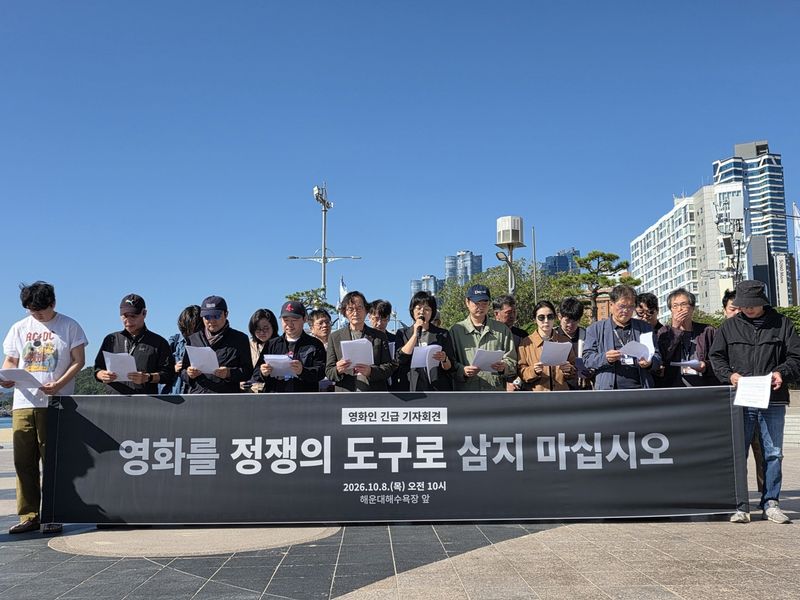
[Financial News] A group of more than 20 film industry figures, including directors Jeong Ji-young and Lee Myung-se, have joined forces in response to the controversy surrounding the film ‘Assassin(s).’ They urged politicians not to use the film as a tool in political disputes.
Directors Jeong Ji-young, Lee Myung-se, Kim Hong-jun and Baek Jae-ho; Kim Dong-hyun, executive director of the Seoul Independent Film Festival; and film critics Yoon Seong-eun and Jeon Chan-il were among those attending an emergency press conference held at the Haeundae Event Plaza in Busan on the morning of the 8th. They issued a joint statement outlining their position on the relationship between film and politics.
The film industry figures said it was possible to criticize a particular work or interpret a historical event differently. However, they voiced concern that the controversy surrounding ‘Assassin(s)’ had spread beyond its director and actors to include its production company, investment institutions, public institutions, theaters, schools and screenings at international film festivals.
In their joint statement, they said, “Don’t use film as a tool in political disputes, and don’t let politicians make the audience’s judgment for them.”
They also argued that it was problematic for politicians to be the first to pass judgment on a work. Asking, “Who gets to watch a film and judge it for themselves?”, the film industry figures stressed that audiences should be able to decide for themselves what a film means and what its creators intended, rather than having politicians define those things.
Earlier, on the 6th, the People Power Party sent a letter to Jeremy Chua, executive director of the Singapore International Film Festival, demanding that the festival withdraw its selection of ‘Assassin(s)’ as the opening film.
They also stated their position on the powers exercised by the National Assembly of the Republic of Korea, such as conducting parliamentary audits and demanding the submission of materials. The film industry figures said these powers should be exercised on the basis of specific facts and evidence, stressing that “public authority must not be used as a tool of political pressure.”
Director Jeong Ji-young said cultural and artistic figures should be able to raise new questions about historical events through their work. Prefacing his remarks by saying they reflected his personal view, he said it was not desirable to make creative work that revisits past events a target of political disputes.
The film industry figures who attended the press conference explained that they had gathered not because they had a direct stake in ‘Assassin(s),’ but to raise concerns about the relationship between film and politics. Film critic Jeon Chan-il said the practical circumstances facing film festivals, and the burdens that come with them, should also be taken into account.
Director Lee Myung-se argued that an environment was needed in which people could continue creating regardless of political pressure. He said creators’ freedom and autonomy must be guaranteed in cultural and artistic activities, including filmmaking.
The film industry figures said the press conference was not intended to ask people to support or oppose ‘Assassin(s).’ They stressed that judgments of individual works should be left to audiences and that the film industry’s autonomy and freedom of creation should be respected.
[email protected] Han Seung-gon Reporter