Single-Stock Leveraged ETFs: Lee Denies Alleged Cheong Wa Dae Directive; Says It Falls Under FSC’s Remit and He Heard Various Views
- Input
- 2026-10-08 17:25:28
- Updated
- 2026-10-08 17:25:28
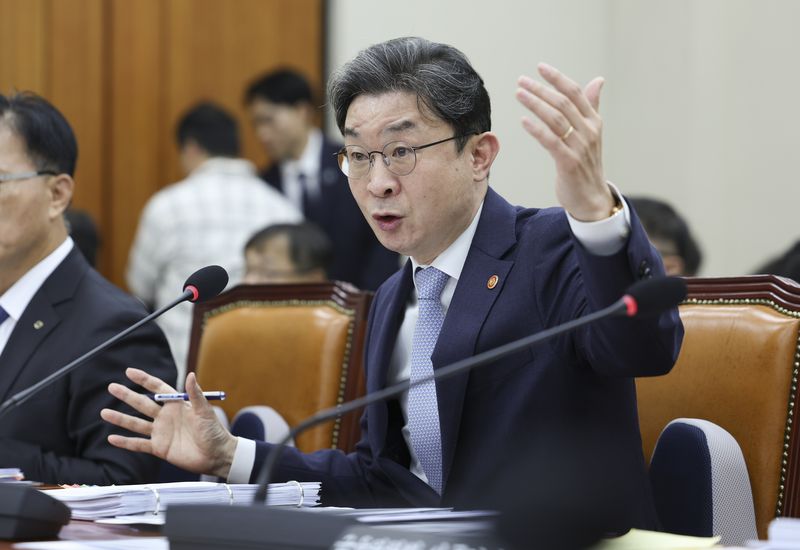
“The amendment to the enforcement decree (for the introduction of single-stock leveraged exchange-traded funds) falls under the FSC’s remit.” (Lee Eok-won, chairman of the Financial Services Commission)
At a National Assembly Political Affairs Committee audit on the 8th, Financial Services Commission (FSC) Chairman Lee Eok-won categorically denied allegations that Cheong Wa Dae directed or intervened in the introduction of single-stock leveraged exchange-traded funds (ETFs) based on Samsung Electronics and SK hynix. The introduction was linked to last July’s sharp KOSPI decline, and the ETFs inflicted heavy losses on retail investors. After Lee denied the alleged “Cheong Wa Dae directive,” observers wondered whether policy and legal responsibility for introducing the ETFs—estimated to have caused losses of at least 50 trillion won for retail investors—would ultimately fall to Lee. However, Lee indicated that the decision was not made independently by the FSC, saying that it had “consulted with relevant ministries” and “heard various views.” Disputes over responsibility among the relevant ministries and agencies, including the Ministry of Finance and Economy, the Financial Supervisory Service, the Korea Exchange and the Korea Financial Investment Association, are expected to continue.
Lee Eok-won Denies Alleged ‘Cheong Wa Dae Directive’
During the audit that day, Lee denied allegations of Cheong Wa Dae involvement as many as eight or nine times in response to repeated challenges from opposition lawmakers asking whether Cheong Wa Dae had ordered the introduction of single-stock leveraged ETFs. When Cho Jung-hoon, a People Power Party member of the National Assembly’s Political Affairs Committee, asked whether he planned to apologize to the public for introducing the ETFs, Lee stood up, bowed his head and said, “We introduced them after seeing the need, but the outcome has been a range of difficult circumstances. As head of the financial authorities, I sincerely regret this and offer my apologies. I’m sorry.”
In response to opposition lawmakers’ criticism that “Cheong Wa Dae is trying to scapegoat others,” Lee emphasized that the basis for introducing single-stock leveraged ETFs was an amendment to an enforcement decree, which fell under the FSC’s remit. He added, “On January 31, we issued an advance legislative notice for the proposal related to the introduction (an amendment to the Enforcement Decree of the Capital Markets Act), and before that, we consulted with the relevant ministries.” Earlier, on the 6th, Kwon Dae-young, now first vice minister of the Ministry of Finance and Economy and the FSC vice chairman when the ETFs were introduced, said at a National Assembly Finance and Economy Planning Committee audit that “the FSC made the final decision to introduce single-stock leveraged ETFs.” With both Kim Yong-beom, the former Cheong Wa Dae policy chief, and Koo Yun-cheol, deputy prime minister for economic affairs and minister of the Ministry of Finance and Economy, having been replaced, only a few key officials remain involved in the government: Lee, Lee Chan-jin, governor of the Financial Supervisory Service, and First Vice Minister Kwon Dae-young. The opposition bloc called for former chief Kim and others to appear, but the motion to select them as witnesses failed after the ruling party opposed it.
Single-stock leveraged ETFs based on Samsung Electronics and SK hynix were listed on the Korea Exchange in May following an amendment to the Enforcement Decree of the Capital Markets Act, with the aim of pushing up the won-dollar exchange rate and supporting the stock market. Warnings that retail investors could suffer losses came repeatedly, particularly from stock market experts. In July, the ETFs experienced sharp volatility and contributed to a steep market decline—not only in the products themselves but across the KOSPI, including Samsung Electronics and SK hynix. Losses to individual investors alone are estimated at 54 trillion won.
Park Jun-tae, a People Power Party lawmaker, pressed Lee, asking, “Wasn’t the introduction effectively decided at a closed-door meeting chaired by Kim Yong-beom, then Cheong Wa Dae policy chief, on January 13?” Lee again denied it, replying, “That is not the case. The issue had been raised for some time that products people could invest in overseas were being blocked in Korea, and the decision was made after consultations with the relevant ministries.” Park Sung-hoon, a People Power Party lawmaker, called for former chief Kim, Mirae Asset Group Chairman Park Hyun-joo and Korea Financial Investment Association Chairman Hwang Seong-yeop to be summoned as witnesses. Kim Hyun-jung, a Democratic Party of Korea lawmaker, criticized the Korea Exchange’s inadequate market surveillance.
“Financial-Sector Hacking: Reviewing Effective Approaches to Network-Separation Regulations”
Questions also continued about recent hacking incidents in the financial sector involving artificial intelligence (AI). In response, Lee said, “To defend against AI-driven attacks, we ultimately have no choice but to use AI,” adding, “We are examining phased and effective ways to change the network-separation rules.” The FSC put on hold the selection of participants for the “second round of emergency regulatory easing for network separation,” which had originally been scheduled to be announced the previous day. The FSC had set a policy direction of easing the rules, but is understood to have judged that it needed to proceed more slowly to narrow the gap between the financial sector’s own security capabilities and the easing of regulations. On real estate loan regulations, Lee said, “We are focusing on housing supply and will expand it substantially and quickly to stabilize the market.”
[email protected] Cho Eun-hyo, Park Moon-soo Reporter