Hyundai to “integrate and reorganize Latin American sales organization” as BYD advances in Brazil
- Input
- 2026-10-12 14:13:03
- Updated
- 2026-10-12 14:13:03
■ Monthly gap widens to more than 10,000 units at its peak
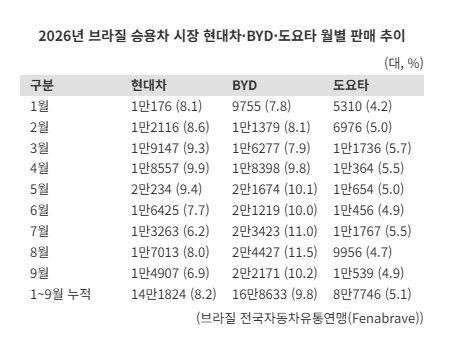
By month, Hyundai sold more than BYD every month from January (10,176 units) through April (18,557 units). Its market share in April was 9.9%, its highest this year. But in May, BYD sold 21,674 units, beating Hyundai’s 20,234 by 1,440 and staying ahead for five consecutive months through September. The gap was widest in July, at 10,160 units. In August, BYD also overtook GM to rank third for the month, selling 24,427 units (11.5%).
Hyundai’s monthly market share consequently hit a yearly low of 6.2% in July and stood at just 6.9% (14,907 units) in September. With cumulative passenger-car sales falling behind BYD, Hyundai also lost its position as the top Asian brand in Brazil.
Hyundai maintained its lead over Japan’s Toyota. Toyota ranked sixth, with passenger-car sales of 87,746 units (5.1%) from January to September. Hyundai outsold Toyota every month during the nine-month period, with a cumulative lead of 54,078 units. The monthly gap fluctuated considerably, narrowing from 9,580 units in May to 1,496 in July.
By model, the compact sport utility vehicle (SUV) Creta ranked seventh among passenger-car models with 54,250 units sold from January to September, while the compact HB20 hatchback ranked eighth with 53,589. The Creta retained its lead among SUVs in the retail market, which excludes direct sales to rental-car companies and corporate customers, with 37,470 units. However, it has lost the top spot across all retail vehicle models—a position it held for three consecutive years starting in 2023—to BYD’s Dolphin Mini, which sold 46,898 units from January to September this year.
■ Chinese brands and electrification intensify their push
BYD is not the only Chinese brand making gains. In cumulative sales from January to September, Great Wall Motor (GWM) ranked 10th with 58,211 units, while Chery-affiliated CAOA Chery ranked 11th with 58,041. Geely increased its sales from 1,337 units (16th) in January to 7,524 (11th) in August, while OMODA & JAECOO grew from 1,689 (14th) in January to 6,629 (13th) in September.The rapid growth of the electrified-vehicle market is also cited as a factor behind Chinese brands’ gains. From January to September, sales of hybrid and electric passenger cars in Brazil rose 124.25% year on year to 425,735 units. BYD ranked first in both categories, with 65,389 hybrids and 103,243 electric vehicles sold. Hyundai did not rank among the top 15 brands in hybrid and electric passenger-car sales either cumulatively from January to September or in September alone.
Hyundai Motor Brazil (HMB) launched a new organizational structure on the 21st of last month, integrating the operation of its sales activities in Brazil and Latin America. In announcing the changes on the 18th of last month, HMB cited strengthening operational capabilities, accelerating the development of new business models, supporting sustainable profit generation, and strengthening ties between Brazil and other Latin American markets as the goals. The plan is to improve cross-market integration, consistency in sales processes and decision-making speed across dealer networks in around 40 markets in the region.
Gerardo Carmona, vice president in charge of product, marketing, communications and sales for Latin America, was appointed the new chief operating officer (COO). He will oversee sales throughout Brazil and Latin America while continuing to handle his existing product and marketing responsibilities. Carmona has held his current position since March 2022. His previous roles include CEO of Peugeot Mexico, an executive position at Groupe PSA (before the launch of Stellantis), and global and regional leadership roles at Infiniti and Nissan. The title of Marcus Fonseca, previously COO of the Brazilian plant, has changed to chief manufacturing officer (CMO).
Hyundai Latin America regional CEO and President Ayrton Cousseau said, “The new structure reaffirms Hyundai’s commitment to maintaining close, transparent and productive relationships with its dealer network in Brazil and distributors in Latin America.” He added, “We are building a more efficient, competitive and future-ready structure that strengthens regional integration and operational discipline and supports sustainable business growth across the region.”
[email protected] Kim Dong-chan Reporter