Active ETF Scorecards Turn Around, With One Gaining More Than Four Times the KOSDAQ’s Gain
- Input
- 2026-10-11 14:24:02
- Updated
- 2026-10-11 14:24:02
[Financial News] KOSDAQ active exchange-traded funds (ETFs), which had been struggling, are posting strong returns through aggressive rebalancing and turning in a very different report card. With performance gaps widening depending on stock selection, competition to separate the winners from the losers is expected to intensify.
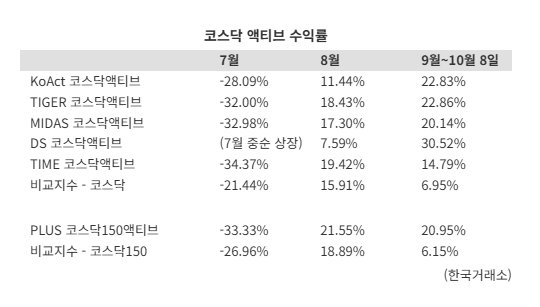
According to the Korea Exchange on the 11th, the KOSDAQ index rose 6.95% from the beginning of last month through the 8th. Over that period, DS KOSDAQ Active surged 30.52%, more than four times the KOSDAQ’s return. TIGER KOSDAQ Active rose 22.86%, KoAct KOSDAQ Active 22.83%, MIDAS KOSDAQ Active 20.14% and TIME KOSDAQ Active 14.79%.
Over the same period, PLUS KOSDAQ 150 Active, which uses the KOSDAQ 150 (6.15%) as its benchmark, also posted a strong gain of 20.95%.
This is a stark contrast with last July. While the KOSDAQ fell 21.44% at the time, KoAct KOSDAQ Active dropped 28.09%, TIGER KOSDAQ Active 32.00%, MIDAS KOSDAQ Active 32.98% and TIME KOSDAQ Active 34.37%. PLUS KOSDAQ 150 Active also fell 33.33%, a steeper decline than the KOSDAQ 150’s 26.96%.
In August, the KOSDAQ index rose by double digits, but two of the six active ETFs underperformed their benchmarks. The other four generated excess returns in the 1% to 3% range, but that was not enough to recover the previous month’s losses.
The recent strong performance of active ETFs is seen as the result of trimming volatile pharma and biotech stocks while actively adding semiconductor-related stocks. Unlike passive products that simply track an index, active ETFs are designed to pursue excess returns by having asset managers select stocks and adjust their weightings flexibly. With some 1,800 companies listed on the KOSDAQ, performance can vary depending on which stocks are included.
Only two active ETFs currently include pharma or biotech stocks among their top 10 holdings. In early July, all five ETFs other than DS KOSDAQ Active, which was listed later, included pharma and biotech stocks among their key holdings; their portfolios have changed substantially in just three months. In particular, TIGER KOSDAQ Active had three pharma or biotech stocks among its top 10 in early July, but has now removed them all.
TIME KOSDAQ Active is the only fund to include biotechnology company Alteogen Inc. among its major portfolio holdings. Despite Alteogen’s status as the KOSDAQ’s largest company by market capitalization, this appears to reflect efforts to protect returns in light of the wide price swings typical of the pharma and biotech sector.
Asset managers have taken different approaches even as they actively added semiconductor-related stocks. MIDAS KOSDAQ Active filled all of its top 10 holdings with semiconductor-related stocks, while KoAct KOSDAQ Active, TIGER KOSDAQ Active and DS KOSDAQ Active each held eight or nine, highlighting the concentration.
By contrast, TIME KOSDAQ Active cut the number of semiconductor-related stocks among its top 10 holdings from nine three months ago to six, while PLUS KOSDAQ Active kept four, a level similar to before. The two funds appear to have focused on selecting individual stocks rather than increasing their exposure to semiconductor-related stocks.
An executive at an asset management company noted, “With the KOSPI, holding a few of the largest companies by market capitalization, including Samsung Electronics and SK hynix, is usually enough to track the index fairly well. But individual stocks vary much more on the KOSDAQ, so performance can differ greatly depending on which stocks you hold. Pharma and biotech stocks can hit the jackpot, but they carry just as much risk, which limits how aggressively we can invest in them.”
The executive added, “We expect active rebalancing to continue in the fourth quarter. As the benefits of AI are expected to extend beyond semiconductors and components to areas such as robotics and power, the gap in returns will widen further depending on which stocks managers identify.”
[email protected] Seo Min-ji Reporter