Open an exit route and help operators hold on: a critical window for cable TV restructuring
- Input
- 2026-10-11 16:04:05
- Updated
- 2026-10-11 16:04:05
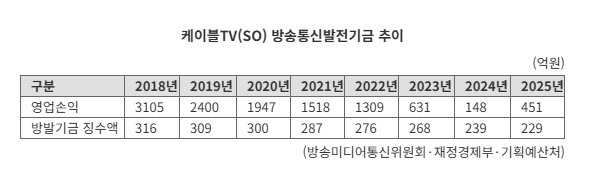
[Financial News] As financial difficulties in the cable TV industry persist, calls are growing for a “two-track” restructuring: easing cost burdens for operators that remain and opening an orderly exit route from the market for struggling operators. The system should be revised to ease the burden of the Broadcasting and Communications Development Fund and content payments, while allowing operators that cannot recover to transfer their subscribers to another operator and withdraw from the market.■ Lower the fund levy rate and ease the burden on operatorsAccording to the broadcasting industry on the 11th, amid worsening financial difficulties, general cable broadcasting operators (SO) are also struggling with the burden of the Broadcasting and Communications Development Fund. Even as subscribers and broadcasting revenue have continued to decline, the levy rate has remained at 1.5% of broadcasting service revenue from 2017 through this year. In response, the SO industry recently filed lawsuits seeking to overturn assessments of its contributions to the fund. Total SO operating profit plunged from 310.5 billion won in 2018 to 45.1 billion won in 2025, while payments to the fund fell by just 8.7 billion won over the same period, from 31.6 billion won to 22.9 billion won.
The industry believes the fund burden should be eased in recognition of the public-interest role SOs play, including operating local channels. Last year, SOs invested about 117.3 billion won in local channels. Alternatives being discussed include deducting part of that investment when calculating the levy, or excluding all or part of revenue from 8-level vestigial sideband (8VSB), a low-cost broadcasting service, from the levy base.
The levy rate can be lowered by revising a public notice, without amending the law. The Framework Act on the Development of Broadcasting and Communications stipulates that a levy rate set and announced by public notice, up to 6%, is to be applied to an SO’s broadcasting service revenue from the previous year.
The Broadcasting Media and Communications Commission also agrees that the system needs improvement and is reviewing a restructuring of the fund framework. In announcing its vision for its first term recently, the commission said it would rationalize the funding structure of the Broadcasting and Communications Development Fund. A commission official explained, “It is difficult to adjust the levy rate only for struggling operators, so we are pursuing research projects and other work to improve the system as a whole,” adding, “Having made our commitment to improving the contribution system official, we will work to develop measures for doing so.”
An industry official stressed, “Fairness among broadcasters is important, but the SOs’ management crisis is evident in the figures,” adding, “Practical measures to ease their burden, reflecting SOs’ business conditions and public responsibilities such as operating local channels, should be put in place as a priority.”
The structure for content payments is also seen as an area in need of reform. SOs pay about 90% of their subscription-fee revenue to program providers (PPs) for content, but because the criteria for calculating payments are unclear, the amount is determined through negotiations between operators each year. Proposed alternatives include establishing objective payment criteria that reflect content value and the platform’s contribution, or linking content-use fees to SO revenue to ease the burden.■ “An exit route for struggling SOs through ‘subscriber transfers’”Alongside easing cost burdens, there are calls to establish a “subscriber transfer” system that would allow operators unable to recover to transfer their subscribers to another operator and withdraw from the market in an orderly manner. If broadcasting transmission is halted because an operator goes bankrupt or its broadcasting license is revoked, users could be harmed; a system is therefore needed to enable the swift transfer of subscribers.
The current Broadcasting Act sets out procedures for approval of changes involving a broadcaster’s merger or division, among other things, but does not specify a procedure for transferring only its subscribers to another operator. The industry says that cable TV networks are poorly compatible with other operators’ equipment, limiting the incentive to acquire an entire business. This has prompted proposals to introduce a subscriber transfer system that would allow the acquiring operator to contact users directly and handle the process of signing them up for a service.
An industry official stressed, “When subscribers move to another operator, their existing rates should be maintained temporarily, and users who do not wish to transfer should be allowed to cancel without a penalty,” adding, “To prevent broadcasting transmission from being halted by the sudden bankruptcy of a struggling SO, we need guidelines for orderly market exits and must secure the industry’s sustainability through market restructuring and regulatory reform.”
[email protected] Choi Hye-rim Reporter