Land surveys and CPTPP put farmers on alert ... Ruling party, government and presidential office move to ease concerns
- Input
- 2026-10-08 16:44:49
- Updated
- 2026-10-08 16:44:49
Political circles say that as farmers’ complaints over agricultural issues mount within the Democratic Party, lawmakers representing rural constituencies are facing a growing burden of managing local sentiment. Older farmers in particular are said to be deeply concerned that a comprehensive farmland survey could lower the value of their land, a retirement asset, and dampen transactions. A Democratic Party lawmaker representing a Honam constituency said farmers were strongly concerned that “with farmland prices having fallen sharply, the government’s survey could even cost them their land.” Farmers who hold inherited farmland unrelated to speculation or have routinely leased their land out could also face disadvantages, the lawmaker said.
Opposition is growing as discussions on joining the CPTPP add to these concerns. The CPTPP is a multilateral free trade agreement that seeks a high degree of agricultural market opening, and South Korea could be asked to make further tariff cuts during accession negotiations. According to the government’s preliminary impact analysis, membership is projected to increase manufacturing output by an annual average of 6.3 trillion to 6.7 trillion won, while reducing output in agriculture, forestry and fisheries by about 850 billion won. As a result, even ruling-party lawmakers representing rural constituencies are calling for safeguards to be put in place in advance. Democratic Party lawmaker Yoon Joon-byung, the ruling party’s point person on the National Assembly’s Agriculture, Food, Rural Affairs, Oceans and Fisheries Committee, said the average market-opening rate among CPTPP member countries, measured by the number of product categories, reaches 95.9% in agriculture and 99.4% in fisheries. He called for legal and financial safeguards to guarantee the incomes of farmers and fishers.
Complaints are also mounting over what is seen as a lack of consistency in the government’s agricultural policies, including reform of Nonghyup. Farmers have been left bearing the burden of policy changes: they switched to growing strategic crops and even bought farm machinery in response to government recommendations, only for procurement volumes to be reduced later. The investment policy’s focus on advanced industries is also cited as a factor deepening farmers’ sense of relative neglect.
As concerns about worsening sentiment among farmers grow, the ruling party, government and presidential office have also moved to contain the fallout. On the 6th, President Lee Jae-myung ordered that the issue of joining the CPTPP be reconsidered from scratch. He also called for consideration of ways to boost farm incomes by using idle farmland for solar power generation. He announced plans to expand eligibility for the rural basic income program from 17 counties this year to 35 next year, and to increase the Agriculture and Fisheries Coexistence and Cooperation Fund to at least 1 trillion won.
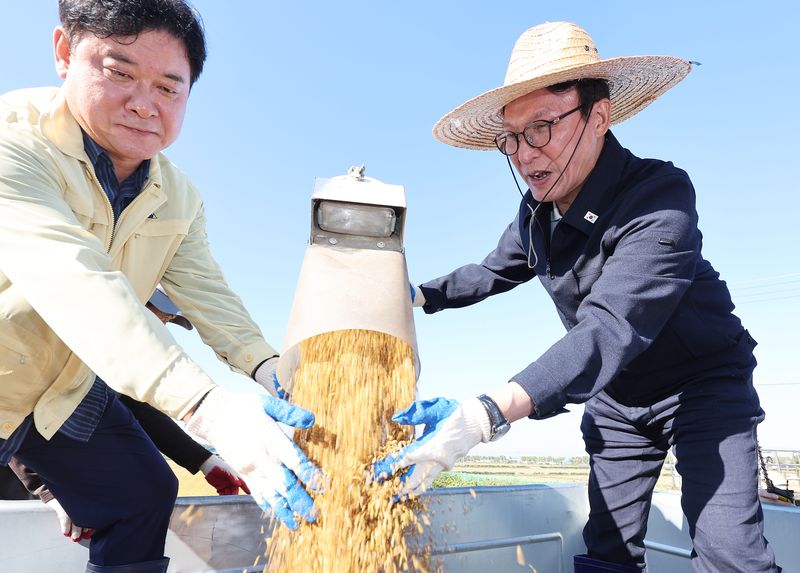
Kim Min-seok also visited a rice-harvesting site in Anseong, Gyeonggi Province, that day to speak with farmers. “We are reviewing at the ruling party-government level whether any aspects of the methods or objectives were unclear during the farmland survey,” he said, adding that they would compile the results of an interim review soon and improve the survey methods. He also stressed that they would take rural realities into account in the cases of inherited farmland unrelated to speculation and land left fallow for unavoidable reasons.
[email protected] Song Ji-won Reporter