Hair Transplants: The “Graft Survival Rate” Isn’t Everything [Kim Jin-oh’s Hair Loss Escape]
- Input
- 2026-10-08 16:02:49
- Updated
- 2026-10-08 16:02:49
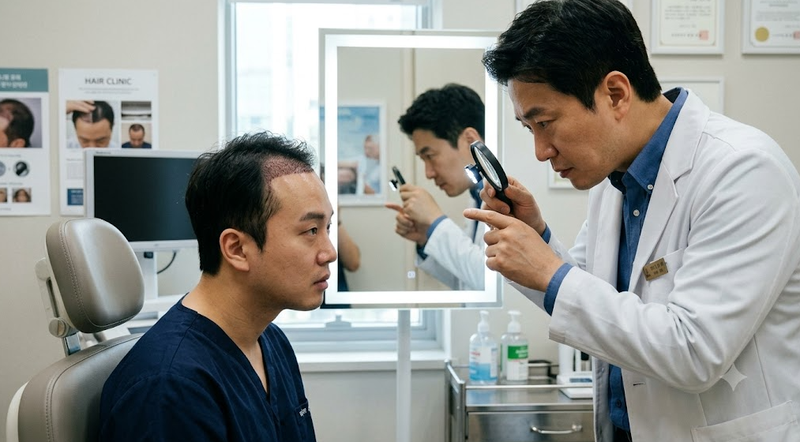
[Financial News] Patients considering a hair transplant are interested in the “graft survival rate.” They want to know how many of the transplanted hairs will survive. But the success of a hair transplant cannot be judged by the graft survival rate alone.
People consider hair transplants for reasons such as, “I wish my temples looked less bare even when I brushed my bangs up,” or “I wish I didn’t have to check my crown first whenever I took a photo.” But once they start comparing clinics, they can lose sight of those wishes and find themselves focused instead on how many grafts will be transplanted and what percentage will survive.
That’s only natural. Every clinic says it does a good job, and the before-and-after photos look good, too. Against that backdrop, figures like 95% or 98% can seem like a basis for comparison. But the graft survival rate is only one part of the outcome patients hope for. It is the proportion of transplanted follicles that survive and produce hair—not a score showing how close the result is to the desired look. Hair growing well does not necessarily mean the procedure went well.
For example, suppose follicles are distributed evenly across a large bare area at the crown. Even if the survival rate is high and hair grows from most of the transplanted follicles, the scalp may still show through. That can happen if the hair is fine or the area to be covered is large. At the front, too, even if the transplanted hair grows well, the result can be disappointing if it grows in an awkward direction or the hairline is too straight.
Patients and doctors should discuss this difference thoroughly before a hair transplant. The same number of follicles can produce different results depending on their placement, even if the same proportion survives. The surgical plan is also affected by how much coverage is possible with a high survival rate, whether to focus more on the front or the crown, and whether the patient will wear their hair up or down.
That does not mean the graft survival rate is unimportant. The number of follicles available for hair transplantation is limited. That is because the procedure moves follicles rather than creating them. Losing follicles that have been harvested means fewer options for the next time. Preserving every hard-won follicle is a basic requirement of the procedure.
From the patient’s perspective, too, there is no choice but to monitor hair growth for a period after a transplant to gauge the result. That is why it can be unsettling even after being told that transplanted hair will fall out a few weeks after surgery and then grow back. Hair shedding while the follicles remain alive is different from graft failure, but in the mirror, it looks like there is less hair. A recovery course that is medically expected is not necessarily reassuring for the patient.
If the graft survival rate is a concern, it is important to distinguish whether this is a stage when one should wait for the growth cycle to run its course or a stage when a problem with recovery needs to be checked. During the months when hair grows back gradually, records taken under consistent conditions are more useful than day-to-day impressions. Someone checking in the mirror every day and a doctor comparing photos taken months apart may see the same head of hair differently.
However, once enough time has passed for all the hair to grow back, the discussion should not end with the graft survival rate alone. It is important to check how much hair actually grew and consider what matches—and what differs from—the look the patient originally wanted. The next assessment will differ depending on whether growth was insufficient or the patient initially expected a density that was too high to achieve.
When a patient places a post-surgery photo next to a pre-surgery one, they may focus only on what they are unhappy with, even though it is clear that they have more hair. That may be the area they most wanted to change in the first place. In that moment, saying, “Still, the graft survival rate is high,” does not solve everything.

[email protected] Kim Hyun-sun Reporter