Yoon’s Acquittal Offers a Yardstick for Oh Se-hoon’s Trial; Proving ‘Mutual Agreement’ Is Key
- Input
- 2026-10-09 08:00:00
- Updated
- 2026-10-09 08:00:00
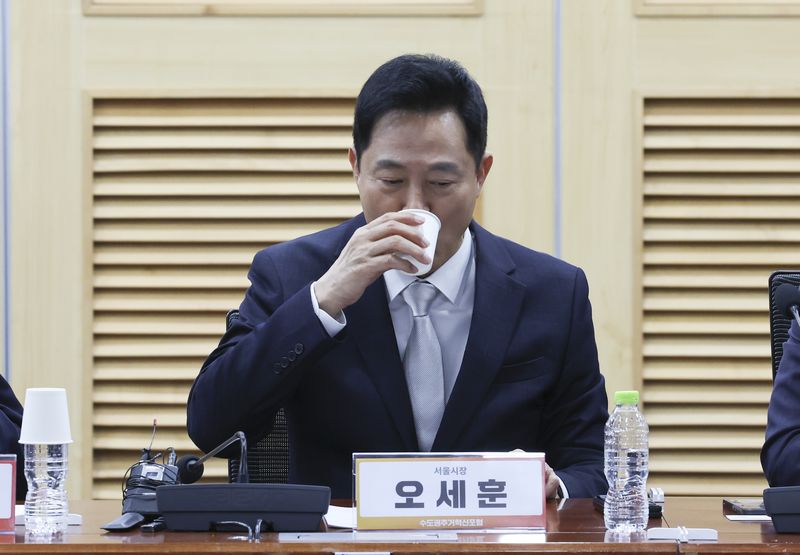
[Financial News] The acquittal of former President Yoon Suk Yeol in the appeals trial over the case involving the free receipt of opinion polls from Myung Tae-kyun has drawn attention to the trial of Seoul Mayor Oh Se-hoon, whose verdict is also pending before the same panel. Yoon’s first-trial conviction was overturned and he was acquitted outright. Oh’s side has also strengthened its case for acquittal after new evidence, including call recordings, emerged in the second trial, despite a first-instance prison sentence that would have cost him his mayoral office.
According to legal sources on the 9th, the Seoul High Court’s Criminal Division 7, presided over by Judge Gu Hoe-geun, overturned the lower court’s ruling sentencing former President Yoon to two years in prison for violating the Political Funds Act and acquitted him on the 7th.
The court cited as key grounds for acquittal that the assistance provided by Myung was difficult to regard as a “property benefit” under the Political Funds Act, and that there was no substantive evidence at all proving “mutual agreement, such as a request or consultation,” to receive the opinion polls free of charge. The court found that there were indications that former President Yoon and his wife had been involved in the nomination of former lawmaker Kim Young-sun, but concluded that neither a prior quid pro quo arrangement involving the polls nor a conspiracy had been proven.
The panel’s approach to the ruling has become a yardstick for Oh’s case. Oh was indicted on allegations that during the primary for the April 7, 2021, Seoul mayoral by-election, he commissioned 10 unpublished opinion polls from Myung and had supporter and businessman Kim Han-jung pay the 33 million won cost on his behalf. The first-instance court found five of the polls, worth about 21 million won, to be criminal and sentenced Oh to a 10 million won fine—an amount that would cost him his mayoral office—and an additional 21 million won in forfeiture.
There is also concern that the second-instance panel’s emphasis on evidence in Yoon’s case could clash with the first-instance ruling. The first-instance court rejected as unreliable Myung’s claim that Oh had called him four times in tears on January 22, 2021, to commission the polls, but still found it possible that Oh had called and commissioned them at another time. Oh’s side has strongly objected throughout the appeal, calling it “a factual error in which the court hypothesized a fictitious call that neither the prosecution, the defendant, nor even Myung claimed had taken place, and used it to construct a guilty verdict.”
In particular, a call recording submitted by Kim Han-jung’s side during the appeals trial was admitted as impeachment evidence. In the call, recorded just after the primary in March 2021, Myung said, “Oh Se-hoon doesn’t know about the opinion polls. Don’t worry. I’ll take care of it.” Kim also said, “They didn’t ask for it; I did it because I wanted to help this guy.”
Oh’s side described the conversation as “clear evidence to the contrary, showing there was no request to commission the polls or for someone else to pay for them,” and argued that it was “decisive evidence that this was an isolated incident in which a supporter’s voluntary payment coincided with Myung flaunting his influence, without Oh’s involvement.” It also identified third parties, including former committee chair Kim Jong-in, rather than Oh, as the parties seeking the polls. This resembles the legal reasoning behind the acquittal in Yoon’s case, where the panel viewed Myung as having “conducted polls on his own to expand his political influence and offered political advice,” and cited a lack of evidence of a prior request or consultation.
However, since actual payment records exist in Oh’s case, the legal reasoning in Yoon’s trial cannot be applied wholesale. The outcome is likely to hinge on whether Oh knew that the polls had been commissioned and their costs paid.
The special counsel, by contrast, is challenging the credibility of the call recordings. It is pointed out that the recordings were withheld through the end of the first trial, and that only those favorable to Oh’s side were submitted at the appeals stage, out of 35 in total. Myung, who appears in the calls, countered Oh’s side’s argument, saying the conversation concerned the primary, not the opinion polls.
After being acquitted alongside former President Yoon, Myung criticized Oh, saying, “If you look at Oh’s remarks over nearly two years, you’ll be able to tell who is lying.”
The special counsel sought a sentence of one year and six months, as in the first trial. Oh’s verdict is scheduled to be handed down on the 23rd.
[email protected] Lee Chang-hoon Reporter