KTX and Super Rapid Train (SRT) Integration Draws 9.36 Million High-Speed Rail Passengers in First Month, Up 12%
- Input
- 2026-10-08 15:01:50
- Updated
- 2026-10-08 15:01:50
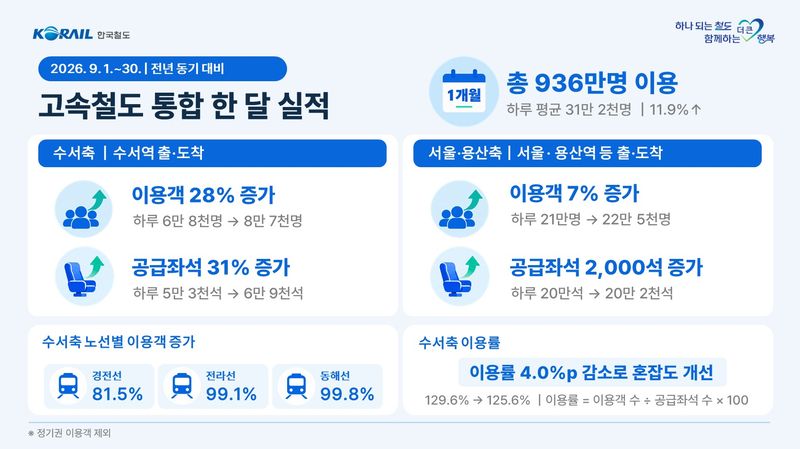
[Financial News] In the first month after KTX and SRT began operating under a single company, high-speed train ridership totaled 9.36 million, up 12% from a year earlier.
According to Korea Railroad Corporation (KORAIL) on the 8th, the average number of high-speed train passengers per day in September, the first month of integrated operations, was around 312,000. Compared with around 279,000 a day last year, that means roughly 33,000 more passengers were carried each day. Season-ticket holders were excluded from the tally.
The differences are clear across the route corridors. The daily average on the Seoul-Yongsan corridor rose 7%, from around 210,000 to 225,000, while the growth rate on the Suseo corridor was nearly four times as high, rising from around 68,000 to 87,000. Within the Suseo corridor, passenger numbers on the Jeolla Line (99.1%) and Donghae Line (99.8%) effectively doubled, while those on the Gyeongjeon Line also increased by 81.5%.
The increase in passengers was supported by expanded seat capacity. The average number of seats supplied per day in September was 271,000, 7% more than last year's 253,000. Seats on the Suseo corridor increased by 16,000 (31%), from around 53,000 to 69,000, while those on the Seoul-Yongsan corridor rose by 2,000, from around 200,000 to 202,000. As seat capacity grew faster than passenger numbers, the utilization rate on the Suseo corridor fell by 4.0 percentage points, from 129.6% to 125.6%.
These figures are the first report card since the high-speed rail operating systems, which had been split in two for about a decade after SRT began service in 2016, were brought together. KORAIL and SR Corporation completed the integration of the two organizations on August 31 after procedures including a business combination review by the Korea Fair Trade Commission and approval for the transfer of business. KTX and SRT have been operating together since September 1. The government has cited the potential to cut duplicated costs and improve the efficiency of train and seat operations through unified management as grounds for the integration.
The burden on passengers has also eased. As part of the integration, KTX fares were lowered by an average of 10% to the SRT level, and mileage worth 5% of the amount paid is now also credited for trains departing from and arriving at Suseo Station. The transfer discount, which cuts conventional train fares by 30% when passengers buy a KTX ticket and a conventional train ticket together, has also been extended to trains serving Suseo Station. In September, an average of around 9,300 passengers a day used transfers, 65% more than last year’s roughly 5,700.
Seat supply is expected to expand further. Starting in 2027, the government and KORAIL plan to roll out 31 new high-speed trainsets in stages, each with 500 seats. The trains will have about 90 more seats per trainset than the existing KTX-Sancheon. The plan is to increase the number of services as well, in tandem with expanded track capacity, including the quadruple-tracking of the Pyeongtaek-Osong section. However, challenges remain, including integrating the two organizations’ personnel and compensation systems and maintaining competitive fares and service after the end of competition.
KORAIL President Kim Tae-seung said, “We will make the integration of high-speed rail a new beginning for Korea’s railways and ensure that the public fully benefits from its results,” adding, “We will bring together the capabilities and know-how of railway workers and focus them on making rail-based public transportation across the country more active through train travel, and on creating an opportunity to reverse regional depopulation.”
[email protected] Jeong Gyeong-su Reporter