Treating ACL Tears With Injections of Cells From Patients’ Own Blood... Miracell Steps Up Its Push Into European and Global Markets
- Input
- 2026-10-08 14:54:27
- Updated
- 2026-10-08 14:54:27
[Financial News] Reconstruction surgery is generally performed when the anterior cruciate ligament (ACL) is torn. But a study has found that a nonsurgical treatment involving injections of cells extracted from the patient’s own blood improved pain, knee function and ligament structure.
Researchers at a sports medicine center in Vienna, Austria, published clinical study results using Miracell’s stem-cell extraction and concentration system SMART M-CELL in the July issue of the SCIE-indexed international journal Indian Journal of Orthopaedics.
The researchers administered a single nonsurgical treatment to 47 patients with traumatic ACL tears, using both an autologous blood-derived cell preparation and autologous platelet-rich plasma (PRP), and followed their progress for 12 months. The procedure involves collecting the patient’s peripheral blood, extracting a concentrated mononuclear cell fraction with SMART M-CELL, then injecting it directly into the injured ACL under ultrasound guidance. It is performed under local anesthesia, without graft surgery.
Analysis of the cell preparation found an average CD34+ hematopoietic stem cell concentration of 11.22±4.7 cells/μL, a mononuclear cell proportion of 70.48±10.64%, and a cell viability rate of 99.5±0.2%. It also contained abundant levels of key growth factors, including PDGF-AB, VEGF and EGF.
46 of 47 patients returned to sports
The most notable changes were reduced pain and improved knee function. The VAS score, which measures pain, steadily declined from an average of 3.36 four weeks after treatment to 0.36 at 12 months. The IKDC score, which assesses knee pain and function as well as activity levels in sports, reached 93.61 points, while the Lysholm score, which assesses overall knee function and symptoms, rose to 94.00 points.
At 12 months, 46 of the 47 patients had returned to the level of sports activity they had before their injuries. The one patient who did not respond sufficiently to treatment later underwent ACL reconstruction surgery.
MRI also showed improvement in ligament structure
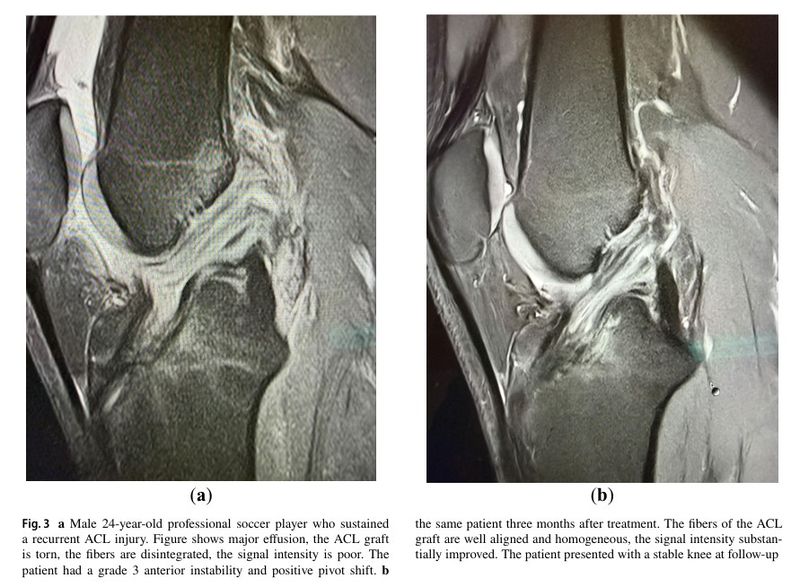
Imaging tests also confirmed improvement. MRI assessments three months after treatment showed improved ACL structure, including fiber arrangement and signal intensity, in all but one patient. Researchers also reported a case in which a completely torn ACL showed a more uniform, orderly fiber structure after treatment. In the case of a 24-year-old professional soccer player with a recurrent ACL injury, the graft fibers were evenly aligned and signal intensity improved three months after treatment, restoring knee stability.
The researchers explained that in some ACL tears, the injured ligament retains its biological capacity to heal, and that appropriate stimulation can prompt tissue regeneration. They analyzed the paracrine effects of autologous blood-derived cells and platelet growth factors as having a positive impact on inflammation control, collagen synthesis and tissue remodeling.
Building on these results, Miracell plans to expand the use of SMART M-CELL in sports medicine and step up its push into global markets, including Europe. Last April, Miracell received FDA 510(k) clearance for its blood (BSC) and bone marrow (BmSC) stem-cell concentration systems and their dedicated kits.
A Miracell representative said, “This study is highly significant because medical professionals in Austria independently conducted a clinical study using SMART M-CELL and published their findings in a renowned journal,” adding, “We will expand our collaboration with medical professionals overseas and strengthen our position in the sports medicine and regenerative medicine markets.”
[email protected] Jeong Myeong-jin, Medical Correspondent Reporter