Week One of Parliamentary Audits Sees Shouting and Scolding, but Policy Questions Also Stand Out
- Input
- 2026-10-09 07:00:00
- Updated
- 2026-10-09 07:00:00
[Financial News] The first week of the National Assembly’s parliamentary audits was marred by political clashes over Chief Justice Cho Hee-dae. Even amid the uproar, policy questions poured in on topics including mega-project scrutiny, telecom hacks and the Future Response Fund, leading some to say the audits showed potential to be policy-focused. The audits will continue until the end of October, and calls are growing for them not to devolve into political battlegrounds.
According to political sources on the 9th, the biggest issue in the parliamentary audits, which began on the 6th, was Chief Justice Cho Hee-dae’s refusal to make a renewed recommendation for a Supreme Court justice. At the Supreme Court audit conducted by the Legislation and Judiciary Committee, lawmakers engaged in heated clashes over, among other things, the decision to designate Chief Justice Cho as a witness and his refusal to take the oath. On the first day of the audits, all other issues were overshadowed by the fierce battle between the ruling and opposition parties over the chief justice.
At the Land, Infrastructure and Transport Committee’s audit on the 7th, allegations of “illegal surveillance of real estate experts” by the Moon Jae-in administration, raised by People Power Party lawmaker Kim Eun-hye, came to the fore. Kim alleged that, at the Ministry of Land, Infrastructure and Transport’s direction, the Housing Statistics Department of the Korea Real Estate Board had illegally surveilled real estate experts, journalists and others. The Democratic Party pushed back, calling the material “something we’ve never heard of or seen,” and the committee’s audit was marred by a dispute over the facts rather than policy scrutiny.
At the Culture, Sports and Tourism Committee’s audit that same day, proceedings were briefly disrupted when Park Jin-young, co-chair of the Popular Culture Exchange Committee, appeared as a witness. Park took the stand amid controversy over the exposure of a confidential contract for “Phenomenon.” People Power Party lawmaker Bae Hyun-jin said the project had drawn criticism as “the culture industry’s version of the Daejang-dong project,” and pointed out that “this is a state-funded project being pursued jointly with the government, yet all overseas trademark rights are set to belong to JYP Entertainment.” Democratic Party lawmaker Choi Min-hee defended him, asking, “Did you personally benefit from serving as chair? Wasn’t it just your time that was taken up?” She added, “You spent a lot of your own money, too, and with the trademarks secured in advance, who knows how much you might earn a few years from now. The public will know that you took on a great deal out of goodwill.”
A dispute also unfolded at the Culture, Sports and Tourism Committee over the film “Assassin(s).” Lawmakers wrangled over whether director Heo Jin-ho and other members of the production team should be designated as witnesses or reference witnesses. The People Power Party criticized the film as historical distortion and a challenge to the liberal democratic system, while the Democratic Party objected that summoning the filmmakers to the audit hearing itself amounted to prior censorship of creative and expressive freedom.
The “policy-focused audits” the public hoped for were not entirely absent. At the Science, ICT, Broadcasting and Communications Committee, Democratic Party lawmaker Lee Jeong-heon led the effort to bring a Chinese-made humanoid robot into the hearing room, sparking controversy over the “promotion of Chinese robots.” Concerns were also raised about South Korea’s competitiveness in physical AI (artificial intelligence). People Power Party lawmaker Park Jeong-ha scrutinized the fairness of the selection process for an independent AI foundation model, while lawmaker Cho Kyung-tae repeatedly pressed the Ministry of Science and ICT on its responsibility for the LG Uplus hacking incident, eliciting the response that Deputy Prime Minister Bae Kyung-hoon should request a waiver of cancellation fees.
At the Health and Welfare Committee’s audit, lawmakers raised a stream of policy questions on regional and essential medical care, emergency medical services and abortion medication. Democratic Party lawmaker Park Ji-won stressed, “Many regional trauma centers cannot meet staffing standards because they don’t have doctors. Some have been unable to hire anyone because not a single person applied.” Park added, “This won’t be solved simply by pointing out that they fail to meet the legal (staffing) requirements; the government needs to come up with measures.” Committee chair Lee Man-hee of the People Power Party criticized hospitals, saying, “They enjoy all the benefits, such as their reputation as top hospitals and high reimbursement rates, while avoiding even the most basic responsibilities.”
On the abortion medication Mifjin, Democratic Party lawmaker Nam In-soon called for expanded access to medical institutions, while People Power Party lawmaker Cho Bae-sook entered the policy debate by emphasizing the risks of side effects as well as the right to life of the fetus.
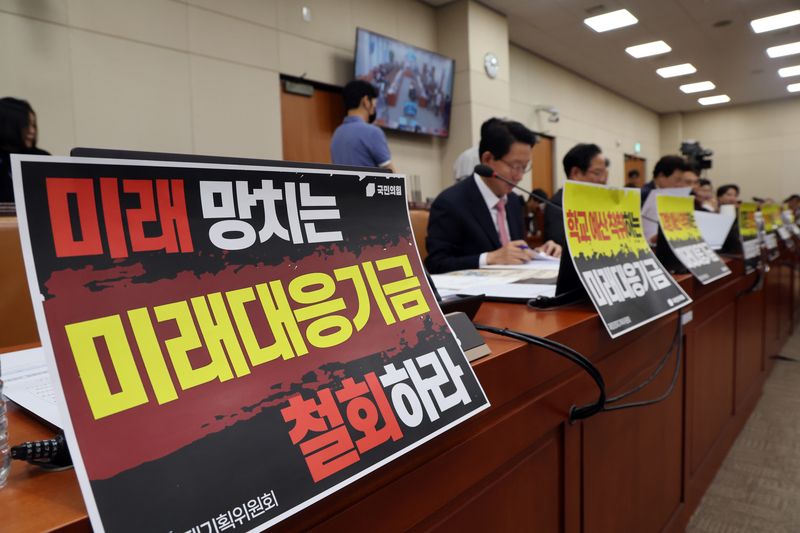
The Finance, Economy and Planning Committee also saw clashes over the creation of a 162 trillion won Future Response Fund amid the semiconductor boom. Democratic Party lawmaker Kim Nam-jun said, “A semiconductor boom is underway. It could be seen as a historic opportunity,” adding, “It’s very important to decide now how to respond to the future, and this is also an important moment for youth policy.” By contrast, People Power Party lawmaker Im Lee-ja criticized the fund, saying, “It’s a backdoor transfer account that circumvents the National Assembly’s oversight. It’s a dud account that aims to borrow at high interest and earn returns at low interest.” She added, “Isn’t this President Lee Jae-myung’s personal piggy bank? Isn’t it a slush fund the government can control at will?”
[email protected] Lee Hae-ram Reporter