After station and school access comes “parking access” ... As parking woes worsen, “parking appeal” draws attention
- Input
- 2026-10-08 14:48:42
- Updated
- 2026-10-08 14:48:42
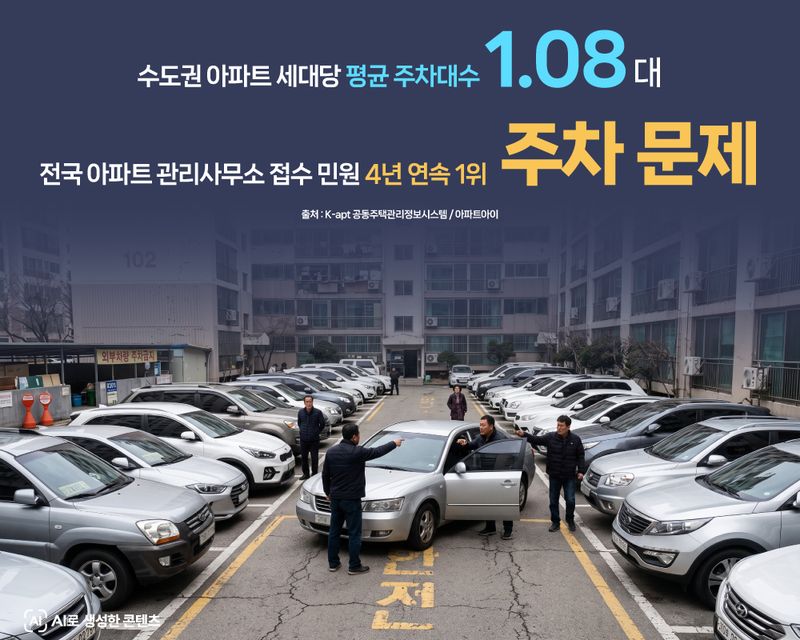
On the 8th, according to Ministry of Land, Infrastructure and Transport statistics, the cumulative number of registered vehicles nationwide stood at 26,676,359 as of the end of June this year. That is one vehicle for every 1.92 people, and about 44% of them—approximately 11,687,000 vehicles—are concentrated in the Seoul metropolitan area. By contrast, K-apt’s Apartment Management Information System shows that apartments subject to mandatory management in the Seoul metropolitan area have an average of just 1.08 parking spaces per household.
Given that it has become common for each household to own two cars due to dual-income households and leisure activities, the physical parking capacity of older apartment complexes is bound to be woefully inadequate. Indeed, according to complaint data analyzed by the lifestyle-support platform Apartment i, parking-related disputes have ranked as the most common complaint for several years, and are cited as a major cause of declining residential satisfaction.
The rapid growth in eco-friendly vehicles, the requirement to provide electric-vehicle charging spaces, and the growing preference for larger SUVs have further intensified the parking woes experienced by owners of internal-combustion vehicles. As disputes over the “parking war” at rush hour and “door dings” deepen tensions between neighbors, newly marketed apartment complexes with comfortable, spacious parking have become a top priority for homebuyers.
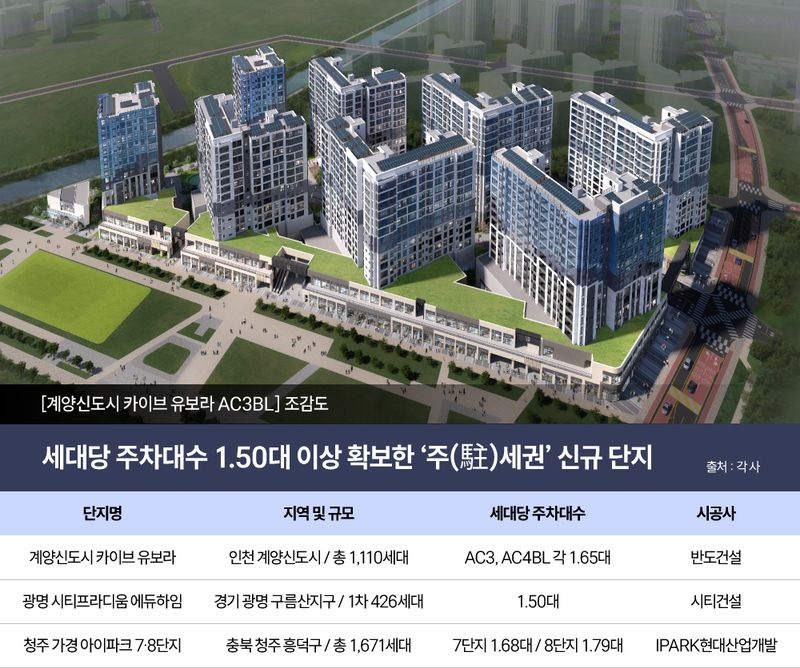
Bando Construction is currently selling Gyeyang New Town Kaive Yubora in Blocks AC3 and AC4 of Incheon’s Gyeyang New Town. The complex, which will comprise 1,110 homes with exclusive areas of 84–93 square meters, provides a generous 1.65 parking spaces per household in both blocks. To maximize convenience, 40% of the total parking spaces are designed to be wider, making it easier to park large SUVs and vans.
City Construction is offering Gwangmyeong City Pradium Eduheim in the Gureumsan District of Gwangmyeong City, Gyeonggi Province. The project will comprise 930 homes in total, with 426 in its first phase. It has 1.5 parking spaces per household, and a specialized three-sided balcony design in the 84-square-meter Type D units expands usable space.
IPARK Hyundai Development Company’s Cheongju Gagyeong IPARK Complexes 7 and 8, being introduced in Gagyeong-dong, Heungdeok-gu, Cheongju, North Chungcheong Province, also boast exceptional parking facilities. Complex 7 will provide 1.68 parking spaces per household and Complex 8 will provide 1.79, which is expected to significantly ease residents’ parking stress.
An industry official said, “Parking convenience is a key factor directly linked to residents’ satisfaction with their homes after moving in,” and predicted, “The popularity of newly built complexes with ample parking per household and wider parking spaces will continue for the time being.”
[email protected] Jeon Min-gyeong Reporter