Wi Seong-gon’s Jeju administration finalizes ₩9.7576 trillion pledge plan; securing national and private funding will be put to the test
- Input
- 2026-10-08 15:00:10
- Updated
- 2026-10-08 15:00:10
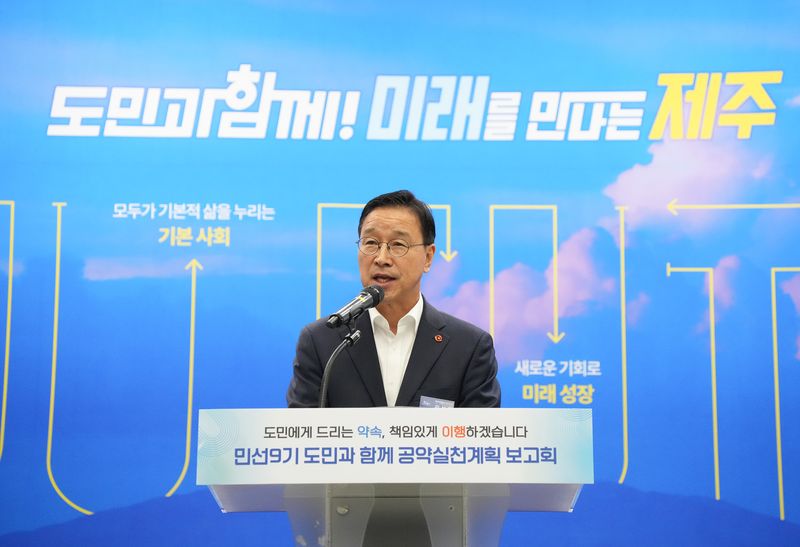
【Financial News, Jeju—By Jeong Yong-bok】 The Wi Seong-gon-led Jeju administration has finalized its pledge implementation plan for the 9th popularly elected term, which calls for ₩9.7576 trillion in investment through 2030. Although the investment plan is ₩2.5946 trillion larger than that of the 8th term, more than half of the total funding is expected to come from national funds and private investment and loans, while 52.4% of investment is concentrated in 2029 and 2030. Securing funding and carrying out projects in stages have emerged as key challenges.
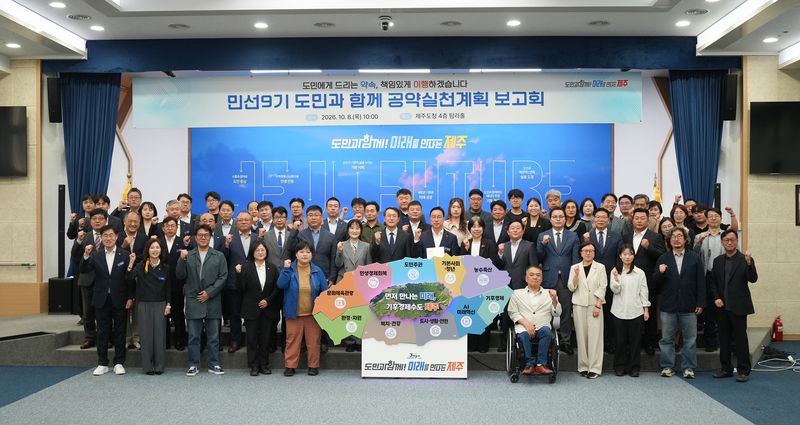
According to Jeju Special Self-Governing Province on the 8th, a full meeting of the Committee on Pledge Implementation with Residents was held that day at Tamna Hall at the provincial government building, attended by Jeju Governor Wi Seong-gon and members of the pledge implementation committee. The meeting gave final approval to the 9th-term pledge implementation plan, comprising 100 projects across 10 areas and 337 implementation tasks.
Governor Wi Seong-gon said, “What matters most about pledges is not the number or the size of the budget, but how they change residents’ lives and what changes residents actually experience.” He added that he was determined to “carry out the pledges based on the investment plan and implementation indicators for each task.”
The plan translates the seven strategies and 100 policy tasks proposed by the transition committee for the 9th popularly elected term into specific projects and investment amounts. Of the 100 pledges, 83 are slated for implementation during the term, while 17 are classified as projects that will continue beyond it.
The funding structure is the most notable aspect. Of the ₩9.7576 trillion to be invested through 2030, the provincial government will cover ₩4.2168 trillion, or 43.2% of the total. The remainder consists of ₩3.7523 trillion in national funds (38.5%) and ₩1.7885 trillion (18.3%) in private investment, loans and other sources.
National funds and private investment, loans and other sources total ₩5.5408 trillion, or 56.8% of the total. This means securing government budget allocations and securing actual investment participation from the private sector are important conditions for fulfilling the pledges.
The importance of securing outside funding is even clearer for large-scale investment projects. The plan for a ₩1 trillion Jeju Future Growth Fund includes ₩600 billion in private investment. The development of offshore wind power in Jeju and the growth of related industries are also structured to draw ₩590 billion in private funding out of a planned investment of about ₩591.2 billion.
Investment is also concentrated in the latter part of the term. The annual investment plan rises from ₩1.1125 trillion this year to ₩1.5463 trillion in 2027 and ₩1.9851 trillion in 2028. It then allocates about ₩2.5572 trillion in 2029 and about ₩2.5564 trillion in 2030.
The investment planned for the final two years totals about ₩5.1136 trillion, or 52.4% of the overall amount. Since the plan is to expand investment in the latter part of the term after project-specific preparations and administrative procedures, making progress on projects and securing funding in the initial stages have become important.
An additional ₩5.7441 trillion in investment is planned from 2031, after the term ends. Combined with investment during the term, the long-term investment plan for all pledge projects amounts to ₩15.5017 trillion. Since projects and fiscal burdens may continue beyond the 9th term, medium- and long-term fiscal management and policy continuity will be needed.
The largest allocation by area, ₩1.979 trillion, is for the climate economy. Key projects include expanding electrification, building green infrastructure, developing offshore wind power and fostering the distributed energy industry.
A total of ₩1.9079 trillion will go toward revitalizing the people’s economy. The plans include the Jeju Future Growth Fund; coordinated operations involving the local currency Tamna Jeon and the public delivery app Meokkkaebi; and efforts to revitalize commercial districts for small businesses.
The plan allocates ₩1.6739 trillion to agriculture, fisheries and livestock, and ₩1.3619 trillion to the environment and resources. Key investment areas include distribution of agricultural and fishery products, stabilizing farm and fishing household incomes, water-resource management in response to the climate crisis, and building a resource-circulation system.
₩904.7 billion is allocated to future innovation in artificial intelligence (AI). The plans include a green AI data center powered by renewable energy, the space and future mobility industries, and the establishment of a Jeju Global AI Hub. The tourism sector will also use AI to drive the digital transformation of the tourism industry.
Pledges closely tied to residents’ daily lives are also reflected in specific investment plans. The province has planned ₩9.6 billion in provincial funds to introduce a Jeju-style basic income for young people and about ₩428 billion to expand tailored housing support for young people. However, the actual eligibility criteria, benefit amount and payment method for the youth basic income are still under separate review.
₩2.15 billion has been allocated to realizing residents’ right to self-determination in order to resolve conflicts over Jeju’s Second Airport. The pledges also include transitioning to a Jeju-style residents’ self-governing council, reforming the participatory budgeting system and projects related to restoring honor in connection with Jeju 4·3.
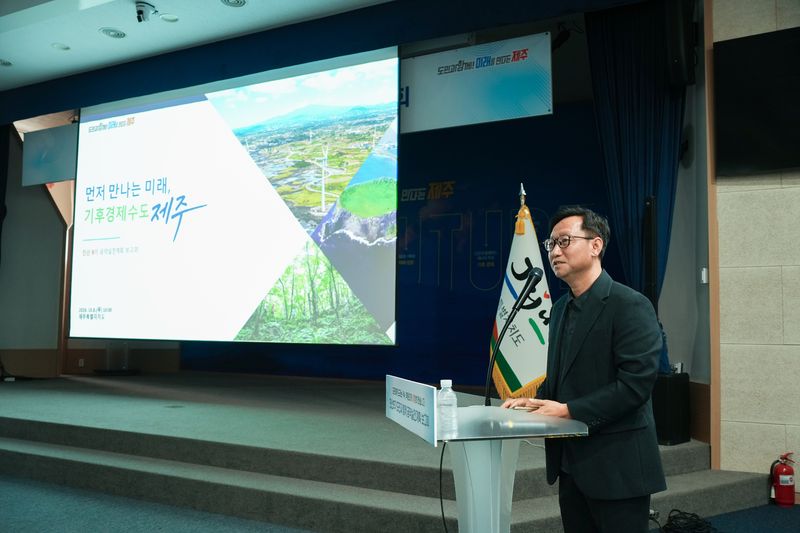
Jeju Province also selected 12 key pledges to prioritize from among the 100 projects. They include building a financial safety net for people’s livelihoods and expanding the everyday safety net; a Jeju-style basic society; laying the groundwork for a transition to a Jeju Institute of Science and Technology; sharing the benefits of wind and solar power; a major transformation of the primary industry; and an AI-driven transformation of tourism.
The planned investment during the term for the 12 key pledges is about ₩802 billion. Of that amount, about ₩652.3 billion is allocated to increasing farm and fishing household incomes and transforming Jeju’s primary industry, accounting for around 81% of investment in the key pledges.
Residents and experts also took part in developing the pledges. Since last August, Jeju Province has operated a pledge implementation committee comprising 99 members across 10 divisions. The committee reviewed the direction and investment plans for each project through 34 meetings in total, including 30 division committee meetings and four steering committee meetings.
Separately, 41 residents aged 19 or older were selected to serve on a citizens’ jury. At three meetings, the jury approved 10 proposed pledge revisions and made 40 recommendations for improvements to 10 major pledge projects.
Jeju Province plans to regularly review the implementation of the pledges and disclose progress after evaluations by the citizens’ jury and experts. It will also use implementation indicators for each task to check whether the pledges are progressing as planned.
This pledge implementation plan will serve as a benchmark for the Wi Seong-gon administration, which has reached its 100th day in office, as it moves from policy planning to execution. Key to future evaluations will be whether the planned investment of ₩9.7576 trillion translates into actual budgets and projects, whether national and private funding is secured as planned, and whether tangible results emerge in residents’ lives.
Governor Wi said, “We will make the pledge implementation process transparent and promptly address any shortcomings,” adding, “Our results will be judged not by the administration’s rate of progress, but by the changes residents actually experience.”
[email protected] Jeong Yong-bok Reporter