Land Minister Hong Ji-seon Inspects Private Housing Site After Public-Sector Visit, Previews Launch of Support Body to Get Housing Projects Underway
- Input
- 2026-10-08 14:33:33
- Updated
- 2026-10-08 14:33:33
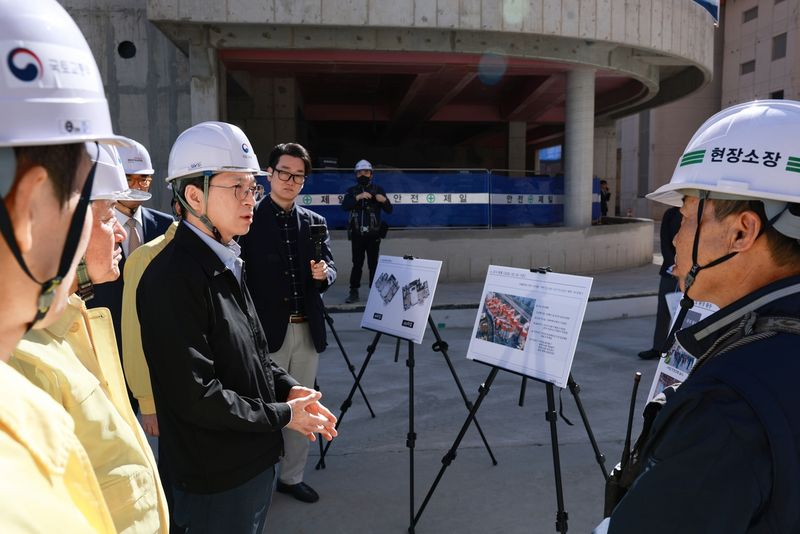
[Financial News] Hong Ji-seon, minister of land, infrastructure and transport, visited a private housing construction site after public-sector sites, lending support to the push to speed up housing supply. Hong also previewed the launch of an integrated pan-government support body to help projects that have received permits but have yet to break ground, providing assistance at each stage.
Hong visited Godeok Gangil Daesung Verhill, a private apartment construction site in the Godeok-Gangil District of Seoul’s Gangdong-gu, on the 8th. Following his visit to the Bucheon Daejang District, part of the third-generation new towns, on the 22nd of last month, this was his second inspection of a housing supply site since taking office.
The Ministry of Land, Infrastructure and Transport said Hong’s visit reflected his determination to speed up public-sector supply while also personally keeping track of conditions at private-sector sites.
Hong assessed at an on-site meeting that signs of a recovery in supply were emerging. He said the effects of the government’s easing of urban planning and building regulations and increased financial and tax support were beginning to show, while local governments and the industry were also keeping pace with the drive to expand supply. As a result, he said, permits—a leading indicator of supply—were picking up, particularly in regulated areas such as Seoul. “We will bring together the capabilities of the entire government and provide all-out support to ensure the recovery in permits leads to actual construction starts and completions, so that the public can feel the effects of housing supply,” Hong said.
He noted, however, that even in regulated areas of the Seoul metropolitan region where supply is urgently needed, a considerable number of projects have secured permits but have been unable to start construction because of financial and regulatory issues. “We plan to launch a pan-government body soon to provide integrated support for housing supply projects and closely assist housing construction projects at every stage, including before permits are granted, after permits are granted but before construction begins, and after construction starts,” Hong said.
He again stressed the private sector’s role. Referring to the government’s targets for the five years from 2026 to 2030, which it has promised the public, Hong said, “The role of the private sector, which has accounted for at least 80% of housing supply in the Seoul metropolitan area to date, is more important than anything else if we are to meet our target of starting construction on ‘1.5 million homes + α’ in the region.”
He added that follow-up measures to the Housing Rapid Supply Plan, announced on August 13 to quickly reverse the contraction in private-sector supply that has continued since 2022, were also proceeding without disruption. The government is working to expand PF guarantees from HUG and the Korea Housing Finance Corporation (HF) to 86 trillion won over 2026–2028, while pursuing measures including the easing of urban planning and building regulations and incentives for early construction starts. Hong urged HUG to “do everything possible to ensure PF guarantees are provided promptly and without disruption, so that construction finance does not become an obstacle to housing supply.”
Hong said, “To provide enough homes in the places people want, so that they feel the market has an adequate supply, we must bring together all our supply capacity, in both the public and private sectors. I will carefully listen to what people on the ground have to say and boldly remove obstacles to housing supply so that the private-sector supply ecosystem can be restored as soon as possible.”
[email protected] Jeong Gyeong-su Reporter