“Even after LASIK, high myopia requires lifelong management” ... Myopia management principles for every stage of life outlined for Eye Day [Weekend Health]
- Input
- 2026-10-08 18:16:06
- Updated
- 2026-10-08 18:16:06
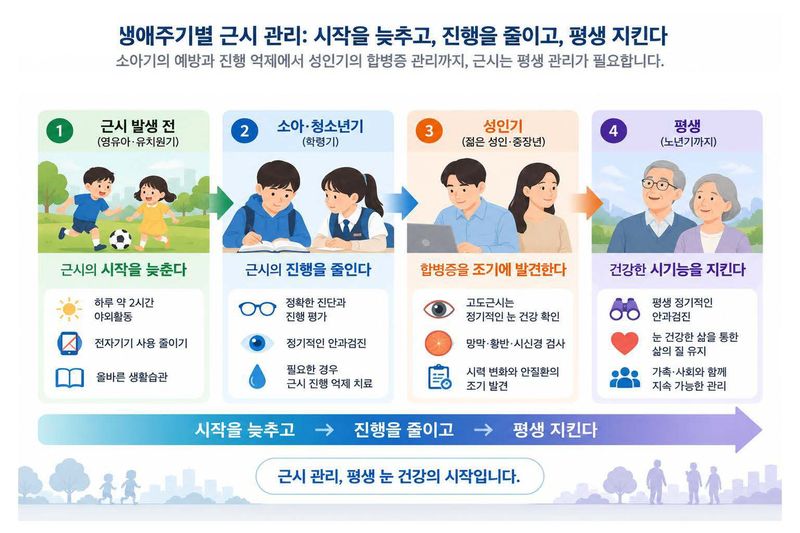
[Financial News] Even if LASIK or LASEK means you no longer need glasses, eye-health management is not over if you had high myopia before surgery. The Korean Ophthalmological Society has outlined myopia management principles for every stage of life, from delaying its onset in childhood to managing complications of high myopia in adulthood.
Ko Jae-ung, the Korean Ophthalmological Society’s public relations director and a professor of ophthalmology at Chosun University Hospital, stressed on the 8th, for Eye Day, “Myopia is not something that ends when you get glasses; it should be viewed as an issue that needs to be monitored continuously from the growth years through adulthood.”
For children and adolescents, checking their current glasses prescription alone is not enough to assess myopia. Children have strong accommodation, which can make myopia appear more severe than it is, so cycloplegic refraction testing—measuring refraction after administering a cycloplegic agent—may be considered when necessary. After diagnosis, treatments to slow progression may be considered based on a comprehensive assessment of refractive error, changes in axial length, family history and other factors. Options include specially designed spectacle lenses, multifocal soft contact lenses, orthokeratology lenses and low-dose atropine eye drops. Treatment should be selected by weighing not only its effectiveness but also its safety and whether it can be continued consistently.
The lifestyle measure with the most consistently demonstrated effect on delaying the onset of myopia is spending enough time outdoors. A study in Guangzhou, China, introduced by Ko, involved 1,903 first-graders at 12 elementary schools. An analysis of students who did not have myopia at the start of the study found that the group given an additional 40 minutes of outdoor activity on each school day had a three-year cumulative incidence of myopia of 30.4%—9.1 percentage points, or about 23% proportionally, lower than the control group’s 39.5%. The results were published in JAMA in 2015.
Ko explained, however, that this does not mean 40 minutes a day is enough or that it slows the progression of existing myopia by the same amount. Before myopia develops, children should spend about two hours outdoors each day if possible. Once myopia has developed, its rate of progression should be assessed separately through regular examinations.
He also stressed that even if refractive surgery such as LASIK, LASEK or SMILE, or phakic intraocular lens implantation, enables someone to see well without glasses, it does not reverse an already elongated axial length—the front-to-back length of the eye—or the structural characteristics of a myopic eye.
The International Myopia Institute (IMI) defines high myopia as a spherical equivalent of -6.00 diopters (D) or less in one eye when accommodation is relaxed. High myopia is more than simply having a strong glasses prescription: it can involve structural changes to the retina, choroid and optic nerve, potentially increasing the risk of conditions such as myopic maculopathy, retinal tears or detachment, glaucoma and cataracts.
Yu Jeong-gwon, the Korean Ophthalmological Society’s planning director and an ophthalmologist at Korea University Anam Hospital, explained, “Even if your prescription is close to zero after surgery, it is a good idea to tell your medical team how severe your myopia was before surgery and whether you had high myopia, and to keep your preoperative examination records if possible.” He added, “Even if you can see well now and have no symptoms, it is important to work with an ophthalmologist to set a screening plan that matches your individual risk, taking into account the degree of myopia, axial length, age, family history and other factors.”
The Korean Ophthalmological Society summed up the course of myopia management as “delay onset, slow progression, and protect eye health for life.” Before myopia develops, outdoor activity can help delay its onset; during childhood and adolescence, accurate diagnosis can guide treatment to slow progression when needed; and in adulthood, complications affecting the retina, macula and optic nerve should be monitored regularly. Myopia management in childhood and eye health in adulthood should not be treated as disconnected issues. Even after surgery makes it possible to stop wearing glasses, the degree of myopia before surgery and a history of high myopia remain important.
[email protected] Jeong Myeong-jin, Medical Correspondent Reporter