Ahn Cheol-soo: Government’s Real Estate Policies Completely Out of Sync... Fails to Use Three Key Tools to Rein In Home Prices
- Input
- 2026-10-08 14:13:36
- Updated
- 2026-10-08 14:13:36
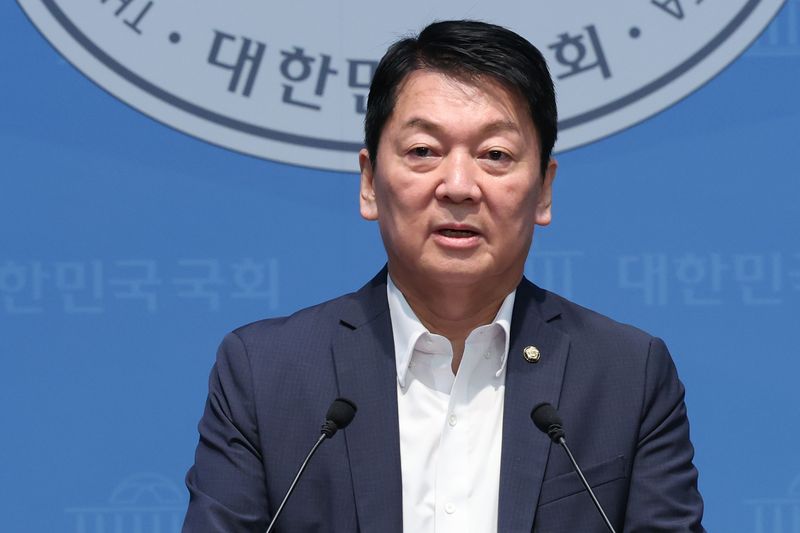
[Financial News] Ahn Cheol-soo, a People Power Party lawmaker, criticized the government’s real estate policies on the 8th, saying they were “completely out of sync and failing to produce proper results.” He said the government was not making proper use of its three key policy tools: housing supply, lending and taxes. He called for a comprehensive review of real estate policy, noting that long commutes among young people were undermining national competitiveness, beyond the issue of home prices.
At a forum titled “Where Are the Korean Economy and Real Estate Policy Headed?” held that day at the National Assembly Members’ Office Building, Ahn said, “The government’s most important policy tools with a major impact on real estate prices are supply, finance—especially lending—and taxes.” He added, “The current government is not making proper use of these three tools, and they are working at cross-purposes.”
He continued, “The Bank of Korea is pursuing a tightening policy by raising interest rates, while the government continues to pursue a policy of increasing the overall budget.” He said the result was “a situation where the policies are completely out of sync and failing to produce proper results.”
Referring to his past experience representing Seoul’s Nowon District, Ahn noted that rising home prices had worsened housing conditions for young people.
“Nowon District had the lowest apartment prices in Seoul, and many newlyweds and people who had just landed their first jobs lived there,” he said. “I saw firsthand how, as home prices surged under the Moon Jae-in administration, young couples and people just starting their careers had no choice but to move to Gyeonggi Province.”
He said the housing problem was also serious in Bundang District, Seongnam, Gyeonggi Province, which is his current constituency. In particular, he pointed to the reality that young people working at Pangyo Techno Valley could not live near their workplaces because of high housing costs and other factors.
Ahn stressed, “Most people in their 20s to 40s who work at Pangyo Techno Valley cannot live there and instead live elsewhere.” He added, “If they have to endure hour-long commutes from the start of the morning, their productivity suffers.”
He added, “This is truly undesirable from the standpoint of national competitiveness,” and argued that “we need to broaden the concept of a home beyond simply being a place where one lives.”
He added, “It is important to create an environment and living conditions that enable young workers to maximize their productivity as soon as they arrive at work.” He said, “I have rarely seen this issue raised at real estate policy seminars.”
On the redevelopment of first-generation new towns, Ahn referred to the New Town Special Act, which he introduced as lead sponsor, and said redevelopment in Bundang was progressing faster than in other new towns. He stressed, however, that policies were needed both to expand housing supply and to improve the living conditions of actual residents.
The forum was organized that day by Kim Jae-seop, a People Power Party lawmaker, together with the Korea Economic Commentators Association and other groups. Kim described economic issues as key concerns directly tied to people’s livelihoods and called on experts to offer policy proposals. He said, “Please reach out to me anytime if you have a policy proposal or something you think needs to be said,” expressing his intention to gather opinions at the National Assembly level.
Experts delivered presentations at the forum on topics including the outlook for the Korean economy, the semiconductor industry, real estate demand and supply, and tax reform. Ahn added, “If experts come up with sound policy alternatives, I will do my utmost, as a member of the National Assembly, to reflect them in policy and help advance the country’s development.”
[email protected] Kim Kyung-min Reporter