Sewoon and Taereung developments under scrutiny as preservation standards debated at Korea Heritage Service audit [2026 Parliamentary Audit]
- Input
- 2026-10-08 14:24:29
- Updated
- 2026-10-08 14:24:29
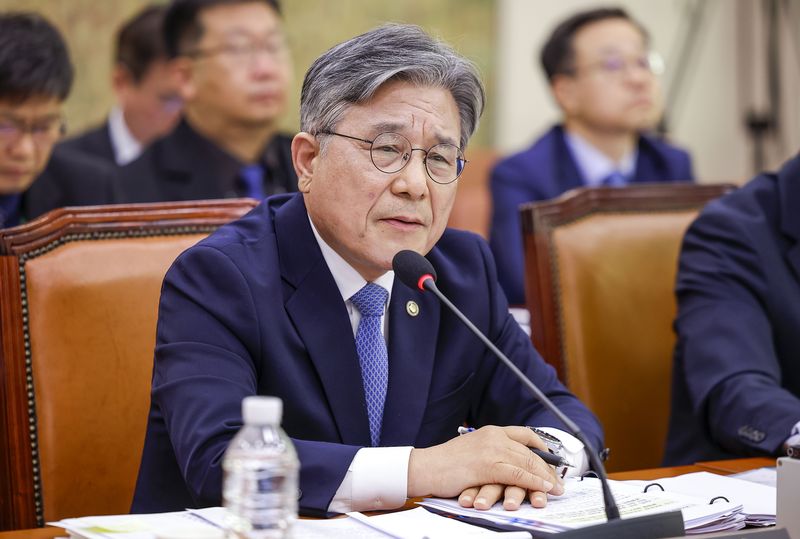
At a work briefing during the National Assembly’s Culture, Sports and Tourism Committee audit on the 8th, Huh Min, chief of the Korea Heritage Service, said, “We introduced an impact assessment system by revising the Enforcement Decree of the Special Act on the Preservation, Management and Utilization of World Heritage, so that World Heritage preservation and development can coexist in harmony.” He added, “We recently completed the establishment of detailed operating guidelines to ensure the system is implemented effectively.”
The impact of the assessment on housing supply was raised during questioning that day. People Power Party lawmaker Yun Yong-geun noted that the assessment results had not yet been released in connection with the proposed development of Taereung Country Club, adjacent to the World Heritage site of Taereung. The development of Taereung Country Club was included in the government’s “Jan. 29 Metropolitan Area Housing Supply Plan.”
Yun asked whether the Korea Heritage Service had checked with the Ministry of Land, Infrastructure and Transport whether an apartment complex could be built. He then asked, “If the assessment results are unfavorable, could the housing supply at Taereung Country Club be reduced, or could development be blocked altogether?”
Huh said the Korea Heritage Service had held prior consultations with the Ministry of Land on the assumption that the project would undergo an impact assessment. He explained that housing supply targets and design fall under the ministry’s remit, while the Korea Heritage Service’s role is to ensure that development is carried out in a way that respects World Heritage values.
People Power Party lawmaker Jeong Yeon-uk took issue with delays in demolishing and relocating the Seokgwan-dong campus of the Korea National University of Arts, which is located on the site of Uireung, one of the Joseon Royal Tombs and a World Heritage site. He criticized the Korea Heritage Service for applying inconsistent standards, noting that the university’s relocation had remained unresolved for 17 years, while in the case of Sewoon District 4 the agency had even raised the possibility of filing a police complaint and having Seoul City revoke its approval.
Huh denied the criticism that the agency applies different standards to different cases, saying it continues to press the Korea National University of Arts to draw up a relocation roadmap and secure an alternative site.
The Democratic Party of Korea emphasized the need to protect the value of Jongmyo Shrine before proceeding with development in Sewoon District. The Korea Heritage Service has opposed the development plan, ordering an HIA on the grounds that high-rise buildings could damage the view from Jongmyo.
Democratic Party lawmaker Jo Gye-won pointed out that in 2014 the Cultural Heritage Committee capped the height of buildings in Sewoon District 4 at 71.9 meters, taking the view of Jongmyo into account, but that Seoul City raised the limit to 145 meters. He also raised suspicions that developers had influenced the process of increasing the height limit.
Jo stressed that an HIA should be conducted given Jongmyo’s significance, saying, “World Heritage sites must not become a means for developers to make money.”
Huh said the Korea Heritage Service had sent Seoul City several official letters requesting that it revoke the approval after Jongno-gu authorized a change to the project implementation plan without an impact assessment having been conducted. He explained that the agency had also requested revocation through the Ministry of Culture, Sports and Tourism, asking the Ministry of Land to cancel the approval.
On the development of Sewoon District 4 itself, Huh said, “Construction is possible,” adding, “Development and preservation must be balanced through an impact assessment.”
[email protected] Jang In-seo Reporter