Mokpo Mayor Kang Seong-hwi: “I will complete Mokpo’s great transformation through changes citizens can feel and effective implementation”
- Input
- 2026-10-08 14:20:01
- Updated
- 2026-10-08 14:20:01
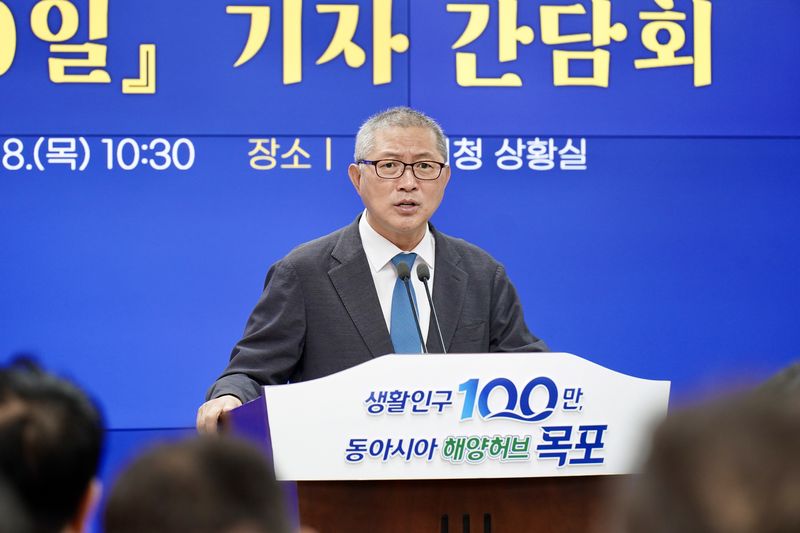
【Financial News, Mokpo = Reporter Hwang Tae-jong】 Mokpo Mayor Kang Seong-hwi said on the 8th, “I will complete the ‘Great Transformation of Mokpo’ through substantive changes that improve citizens’ quality of life and concrete action.”
Kang said this as he held a press conference that day, marking 100 days since the launch of the ninth popularly elected administration, to review the city government’s achievements over the past 100 days and outline specific plans for implementing its key policies.
Kang first explained, “The total cost of the 100 pledges for the ninth popularly elected administration is about 3 trillion won, of which we plan to cover around 370 billion won with city funds alone. We will allocate city funds transparently and reasonably each year over the four-year period, and secure the rest through national and provincial government funding and private investment to carry out the pledges without a hitch.”
Kang highlighted “vitality-boosting finance” and “fast-action finance” as the core of the ninth administration’s fiscal management, aiming to deliver “finance citizens can feel.” The annual budget amounts to about 1.2 trillion won, but funds available for discretionary use are limited. The aim is to cut unnecessary spending and focus fiscal resources on areas directly tied to citizens’ lives.
“The real purpose of fiscal reform is to improve citizens’ lives,” Kang said. “I will quickly direct the money we save to where it is needed most and deliver fiscal policies whose impact citizens can feel in their everyday lives.”
Kang also said, “We will address population decline with a two-pronged strategy: expanding the resident population while also working toward a living population of 1 million.” The city plans to proactively develop Imseong District to strengthen its role as a residential hub supporting the southwestern region’s semiconductor and energy industrial belt. It will create a community that brings together eco-friendly housing, education, medical services and culture, providing a foundation for young people and talent moving to the southwest to settle in Mokpo.
Kang also emphasized, “We will devote our efforts to developing offshore wind power, seafood products and the laver industry, which are future growth engines for Mokpo.” With the offshore wind support wharf at Mokpo New Port now included in the national plan, the city plans to begin feasibility reviews and basic and detailed design work next year, while working to secure national funding and implement the project.
The city has also secured an investment of 82.5 billion won, in partnership with the National Federation of Fisheries Cooperatives and others, for seafood processing, storage and distribution facilities. With construction of the facilities underway, it plans to link them with the Seafood Export Complex to boost the competitiveness of the seafood industry.
In the second half of the year, the city plans to link the opening of the Dried Laver Exchange with the Seafood Export Complex. It will also continue efforts to attract the National Institute for Laver Industry Promotion and designate a laver industry promotion zone, with the aim of building an industry ecosystem spanning production, processing, distribution and exports.
On the proposed national medical school and university hospital in South Jeolla Province, Kang said, “I apologize for causing citizens concern and a sense of loss.” He added, “To secure healthcare rights for residents of the southwestern region, we will restore procedural fairness and continue to urge the government and the integrated special city to establish a national medical school and build a regionally self-sufficient healthcare system.”
He added, “We also plan to develop practical healthcare measures that citizens can feel in their daily lives, including expanding emergency and essential medical care infrastructure.”
Finally, Kang stressed, “I will make the next four years a time when citizens can clearly feel that ‘Mokpo has really changed’ and ‘it has become a better place to live.’”
[email protected] Hwang Tae-jong Reporter