All three Yonsei University CubeSats launched aboard Nuri (KSLV-II) successfully establish contact
- Input
- 2026-10-08 13:38:45
- Updated
- 2026-10-08 13:38:45
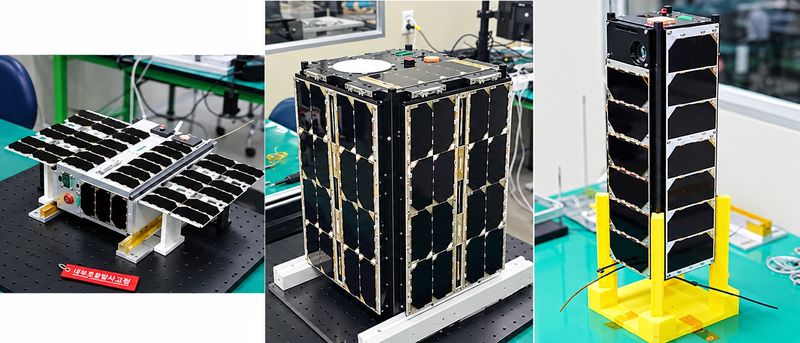
[Financial News] Three miniature satellites independently developed by Yonsei University researchers were carried aboard Nuri (KSLV-II) and launched into space. After successfully making their first contact with a ground station, they began their full-scale mission.
Yonsei University said on the 8th that the three CubeSats developed by a research team led by Professor Park Hong-gyu of its Department of Physics and launched yesterday had successfully reached their target orbit and completed two-way communications with a ground station. This is the first time that three CubeSats built by a single university research team in South Korea have been launched into space simultaneously and successfully established contact.
A CubeSat is a box-shaped miniature satellite measuring around 10 cm on each side. Compared with large satellites that cost several hundred billion won, CubeSats are inexpensive to build and take less time to develop, drawing attention as a way to rapidly validate next-generation space technologies.
The three CubeSats, which have reached orbit and sent back signals, will test whether advanced components function in an environment of extreme temperature changes and intense radiation. Key test items include next-generation optical and quantum devices, space-grade semiconductors, and high-performance sensors.
The research team plans to validate data collected in the space environment and verify the reliability of domestically produced components, with the aim of bringing forward the commercialization of the technology. Once validation is complete, the technology is expected to be applicable across a range of industries, including communications, environmental monitoring, and space exploration.
The successful communications are expected to help establish a technology-validation system using microsatellites within South Korea’s space-development ecosystem, which has been centered on large satellites, and increase the localization rate of key space components.
Professor Park Hong-gyu said, “We confirmed that the CubeSat built using purely domestic technology is operating normally in orbit,” adding, “Through this mission, we will do our utmost to contribute to the localization of space components and train skilled professionals with hands-on expertise.”
[email protected] Kim Man-gi Reporter