“Stretched sheet metal to its limits”... Hyundai Motor Company unveils technology behind the All-New Hyundai Tucson
- Input
- 2026-10-09 09:00:00
- Updated
- 2026-10-09 09:00:00
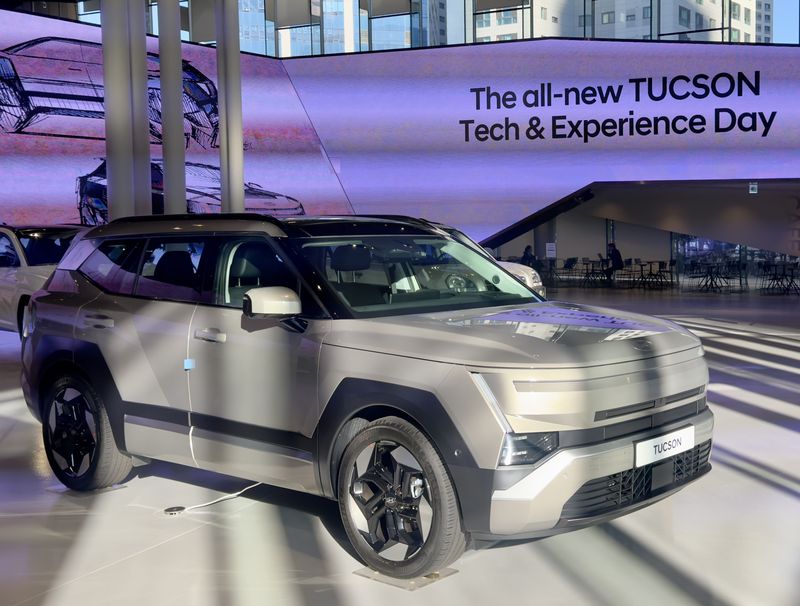
When footage of a flat sheet of metal being pressed in a die and turned into a body panel played on the stage screen at Hyundai Motorstudio in Goyang, Gyeonggi Province, on the 7th, Kwon Yong-wook, a manager on Hyundai’s Forming Development Team 1, made this remark. He explained that the new Tucson’s body was the result of pushing the sheet metal’s properties to just short of its tensile limit.
That day, Hyundai Motor Company held the ‘All-New Tucson Tech & Experience Day’ and unveiled key technologies in its fully redesigned fifth-generation model. Representatives from six fields—including design, forming engineering, powertrains and safety research—took turns on stage to explain the development process. Since its first launch in 2004, the Tucson surpassed 10 million units in cumulative global sales last year, becoming the first SUV in the Hyundai Motor Group to do so.
That day, Choi Sang-in, a principal researcher on the MLV Project Team 1, first presented findings from an analysis of Tucson sales data over the past 22 years. The analysis showed that customers want a combination of fuel efficiency, driving enjoyment, the sturdiness of an SUV and everyday convenience. “In response, we developed the All-New Hyundai Tucson as a ‘highly refined compact SUV’ that makes no compromises in any area,” he said.
■ Pushing sheet metal to its tensile limit to bring ‘Art of Steel’ into mass production
The field with the most presenters that day was body-forming technology, with three forming engineers taking turns on stage. This reflected just how challenging it was to bring the bold exterior, based on the ‘Art of Steel’ design language, to a mass-produced vehicle. “To express steel’s inherent strength and taut tension in the form of an actual vehicle, we created volumes and edges right up to the sheet metal’s tensile limit,” explained Choi Tae-wook, a principal researcher on Hyundai’s Exterior Design Team 1.The most challenging area was the side outer panel, the body’s exterior side panel. As the rear fender’s volume was increased, the forming angle became about 13 degrees steeper, changing from 39.5 degrees to 26.5 degrees, while the forming depth increased by about 31 mm, from 40 mm to 71 mm. “It was an extremely challenging situation, with two opposing problems—cracking and wrinkling—occurring in the same area,” recalled Hong Gyu-seon, a senior manager on Hyundai’s Forming Development Team 1.
Hyundai Motor Company controlled wrinkles with its ‘multi-directional tension control’ technology. Sheet metal in areas that would later be cut away, such as the rear quarter glass and rear-door openings, is pressed inward beforehand, causing the surrounding metal to be pulled in multiple directions. Cracking was curbed with a ‘multi-stage forming’ process that creates the shape in stages.
The hood underwent a similar process. It was changed to an extended clamshell type that covers the sides of the front fenders, increasing its length by 15% and the volume on both sides by 50%. As the parting line moved from the top to the sides and the hood extended to the area around the A-pillars, the forming challenge became comparable to that of the side outer panel. Hyundai Motor Company applied ‘Pogi Shape Control’ technology, which forms excess sheet metal that will be trimmed away into a convex shape. The technique reduces surface waviness by delaying when areas prone to distortion come into contact with the die. The sides of the cowl are nearly vertical, making the hemming process, which folds the edges, difficult. For this process, the company incorporated a ‘unit cam’ structure that directs pressure toward the skin surface.
During this process, the side outer panel underwent around three times or more as many forming simulations as on other vehicle models, and the hood around five times or more. “Many overseas competitors use a five-stage process, forming parts with a total of five press operations. Hyundai Motor Company, however, produces exterior body panels of equivalent quality more efficiently in just four stages by optimizing its process configuration and die technology,” Kwon said.
■ 245 PS hybrid... Larger body, greater rigidity and enhanced safety
The 1.6 turbo gasoline model has a larger-capacity turbocharger, raising maximum output by 13 PS to 193 PS. It is paired with an eight-speed automatic transmission instead of a seven-speed DCT. The 1.6 turbo hybrid uses Hyundai Motor Group’s next-generation hybrid system, raising system output by 10 PS to 245 PS. Instead of a P0 motor connected to the engine by a belt, the system uses a P1 motor directly connected to the engine and a P2 drive motor. Combined fuel economy improves by 1.2 km/L to 17.4 km/L (with 17-inch wheels and 2WD).The hybrid also includes features to improve fuel economy. These include expanded regenerative braking control, which continues regenerative braking until just before ABS activation, and coasting guidance, which tells the driver when to lift their foot off the accelerator. Stay Mode, which allows climate-control and electrical functions to operate while the vehicle is stopped without starting the engine, has also been added. The coefficient of drag (Cd) has been reduced from 0.33 to 0.30 in both gasoline and hybrid models. This was achieved by adding sealing material to the active air flap and refining the shapes of the rear spoiler and 17-inch wheels.
The body has grown by 60 mm in length, 40 mm in width and 20 mm in height, while the wheelbase has increased by 30 mm. Second-row legroom and headroom have increased by 14 mm and 29 mm, respectively. Trunk capacity has grown from 622 liters to 645 liters in the gasoline model and from 610 liters to 639 liters in the hybrid. Wide-open hinges have increased the rear-door opening angle from 73 degrees to 83 degrees. For a quieter ride, the thickness of the front-row side acoustic glass has increased by 1 mm to 5 mm, and acoustic glass has been extended to the second row. The transmission mount also features a dual-stopper structure, a first for Hyundai Motor Company.
For safety, the use of hot-stamped steel and ultra-high-strength steel rated at 1 GPa or more has been increased, raising the share of ultra-high-strength steel in the body from 55.2% to 58%. Average body tensile strength is up 9.7% to 726 MPa. Torsional rigidity and bending stiffness have increased by 20.7% and 34.5%, respectively.
The Tucson also features Hyundai Motor Company’s first ‘door-unlock power redundancy’ system, which allows the doors to be unlocked using a separate power source even if a collision cuts off the main power supply. Standard features also include nine airbags, with a new front-row center side airbag, pedal misapplication safety assistance and emergency braking in P for the electronic shift lever.
Hyundai Motor Company will hold a technology exhibition for the general public at Hyundai Motorstudio Goyang from the 9th to the 25th. Visitors can compare actual body parts from the fourth- and fifth-generation Tucson, including the hood and side outer panels.
A Hyundai Motor Company representative said, “The All-New Hyundai Tucson builds on the practicality and efficiency customers expect from the Tucson while further raising the overall refinement of the vehicle in areas including design, driving performance, space, safety and digital experience. We expect the Tucson, embarking on a new journey after surpassing 10 million units in cumulative global sales, to establish itself as a leading family SUV that accompanies customers around the world in their varied daily lives.”
[email protected] Kim Dong-chan Reporter