“North Korea’s border fortification to be completed in 2028,” JCS says... JCS chief acknowledges “some limits on U.S. intelligence sharing”
- Input
- 2026-10-08 14:58:22
- Updated
- 2026-10-08 14:58:22
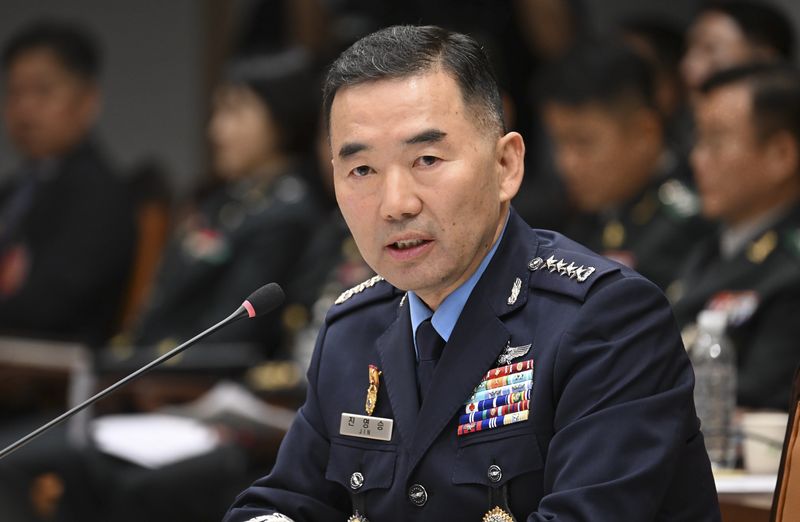
At the National Assembly National Defense Committee’s audit of the JCS on the 8th, Jin gave a briefing focused on these points and answered lawmakers’ questions.
According to the JCS, most of North Korea’s so-called “border-line fortification,” now underway around the Military Demarcation Line (MDL) following North Korea’s declaration of “hostile two-state relations,” has been completed. The JCS reported that some sections had been converted into tactical roads and that work on obstacles, including installing barbed-wire fences and laying mines, was accelerating. The military said it had expanded ground surveillance and was concentrating its airborne intelligence, surveillance and reconnaissance (ISR) assets in response.
Regarding measures to respond to the front-line DMZ landmine explosion, Jin said resuming loudspeaker broadcasts to North Korea, cited as a possible response, “would have limited effect.” This is in line with Defense Minister Kang Shin-chul’s position the previous day. Jin also made clear his intention to prevent accidental clashes. He acknowledged that there had been some shortcomings in surveillance and reconnaissance of North Korea at the time of the landmine explosion on the 21st of last month.
He also fleshed out plans to introduce nuclear-powered submarines. Jin said, “I believe acquisition will be possible by 2035.” The government is currently pursuing construction of a nuclear-powered submarine as a national strategic project, and is working on consultations with the United States over the transfer of nuclear materials, a policy of domestic construction, the enactment of a special law, and consultations with the IAEA, among other measures.
Questions poured in at the audit that day about the partial restrictions on U.S. intelligence sharing on North Korea. In response to questions from People Power Party lawmaker Yoo Yong-weon and others, Jin said, “It is true that this (intelligence sharing) has not been fully restored, but we have no problem sharing information on signs of nuclear or missile launches or their trajectories.”
The United States has been partly restricting intelligence sharing on North Korea in protest against remarks by Unification Minister Chung Dong-young in March about “North Korea’s uranium enrichment facility in Kusong.” The information is reportedly related to North Korean technology and was collected by the U.S. side via satellite.
It was also reported that the National Intelligence Service was excluded at the United States’ request from a meeting of the South Korea-U.S.-Japan consultative body on responding to North Korean cyber threats, held in the United States in June.
[email protected] Lee Jong-yun Reporter