Semiconductor boom puts annual operating profit of 370 trillion won within reach ... DX faces the task of restoring profitability
- Input
- 2026-10-08 16:37:03
- Updated
- 2026-10-08 16:37:03
[Financial News] Buoyed by a semiconductor superboom, Samsung Electronics Co., Ltd.’s annual operating profit this year is expected to come close to 370 trillion won. Analysts say its high-bandwidth memory (HBM) business has hit its stride and rising memory prices are expected to drive earnings growth. Competition among global tech giants to invest in artificial intelligence (AI) is also boosting expectations for improved earnings. However, rising memory-chip prices are increasing cost pressures on finished-goods businesses such as smartphones, TVs and home appliances, and the earnings gap between business divisions is expected to widen further.
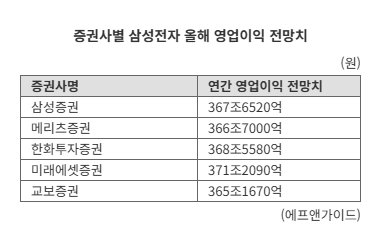
■HBM4 a key driver of earnings improvementAccording to financial information provider FnGuide on the 8th, the consensus forecast—the average of brokerages’ estimates—for Samsung Electronics Co., Ltd.’s fourth-quarter operating profit stands at 115.7468 trillion won. Adding that to its cumulative operating profit of 254.13 trillion won through the third quarter this year puts its expected annual operating profit at about 369.8 trillion won.
After helping drive earnings in the third quarter, the HBM business, which has now hit its stride, is seen as a key engine of future growth. Samsung Electronics Co., Ltd. is increasing HBM4’s share of its sales by supplying the chips for NVIDIA Corporation’s next-generation artificial intelligence (AI) accelerator, Vera Rubin. HBM4 is a high-value-added product that can command higher prices and generate greater profitability than previous-generation products. Choi Bo-young, an analyst at Kyobo Securities, said, “Samsung Electronics Co., Ltd.’s HBM4 sales are expected to at least triple in the third quarter from the previous quarter, with HBM4’s share of HBM sales in the second half projected to rise to at least 60%. ”
Rising prices for conventional DRAM amid tight supply and demand are also expected to continue through the end of the year, as expanded HBM4 production limits the company’s capacity to increase conventional DRAM supply. According to market research firm TrendForce, contract prices for conventional DRAM rose 13–18% in the third quarter this year from the previous quarter. Although the increase was smaller than in the prior quarter (53–58%), prices still posted double-digit growth.
While some are concerned that memory price increases could slow further, other analysts say earnings will be supported by securing stable buyers through long-term agreements (LTAs) and favorable pricing terms. Samsung Electronics Co., Ltd. said at its second-quarter earnings announcement that it would shift up to 70% of its memory production capacity to an LTA model, making it likely that supply volumes under long-term contracts also increased in the third quarter. Lee Jong-wook, an analyst at Samsung Securities Co., Ltd., noted, “Even if the pace of memory price increases slows going forward, Samsung Electronics Co., Ltd. is well-positioned to secure profitability, thanks to its diversified customer base, improved HBM profitability and favorable pricing terms in its long-term agreements (LTAs).”■The downside of the boom... mounting cost pressuresBy contrast, the Device eXperience (DX) Division, which handles finished-goods businesses, is expected to have posted a wider loss than in the previous quarter. The sharp rise in memory prices has left it bearing the full brunt of higher costs.
The Mobile (MX) and Network businesses, which handle the smartphone business, are estimated to have posted losses of around 1.8 trillion won amid rising component prices. TrendForce estimates that contract prices for low-power double data rate (LPDDR)5X memory used in smartphones rose a further 8–13% in the third quarter.
The TV (VD) and home appliance (DA) businesses are also expected to have posted losses of around 400 billion won as the surge in memory prices increased manufacturing costs. Contract prices for 4-gigabyte (GB) DDR4 (double data rate 4) memory, used mainly in 4K TVs, have risen at least fourfold in a year. The TV business is also finding it difficult to defend profitability amid weak global demand and aggressive low-price competition from Chinese companies. The home appliance business is likewise expected to see limited earnings improvement due to slowing consumption and logistics costs.
An industry official said, “The semiconductor business benefits from rising memory prices, but the finished-goods business is structured in a way that makes it difficult to pass all of the increase in component costs on to selling prices. For the time being, the earnings gap between Device Solutions (DS) and the DX Division is expected to persist, while the finished-goods business will continue efforts to narrow its losses through cost efficiencies.”
[email protected] Park Ji-yeon, Park So-hyeon Reporter