Pyeongtaek’s standard-size apartments near ₩1 billion; Jije-dong home prices up 8% this year on shuttle-bus access
- Input
- 2026-10-08 13:19:28
- Updated
- 2026-10-08 13:19:28
[Financial News] As exclusive 84-square-meter units in a leading complex near PyeongtaekJije Station trade close to ₩1 billion, attention is turning to whether this area, too, will enter the era of ₩1 billion standard-size apartments. With home prices in the area up more than 8% so far this year, some are also suggesting that the area around Jije Station could emerge as an alternative residential area after major parts of southern Gyeonggi Province were designated as land transaction permit zones, since it faces relatively less regulatory burden.
According to the Actual Transaction Price Disclosure System of the Ministry of Land, Infrastructure and Transport, an exclusive 84-square-meter unit at Jije Station The Sharp Central City in Jije-dong, Pyeongtaek-si, sold for ₩950 million last September, setting a record high. This was the highest price paid this year for an 84-square-meter apartment in Pyeongtaek.
Prices are also rising steeply. An exclusive 84-square-meter unit in the complex sold for ₩850 million last year, representing a rise of more than 10% in a year. Transaction volume has also increased sharply. The complex recorded just 98 transactions in all of last year, but had already topped 150 by August this year.
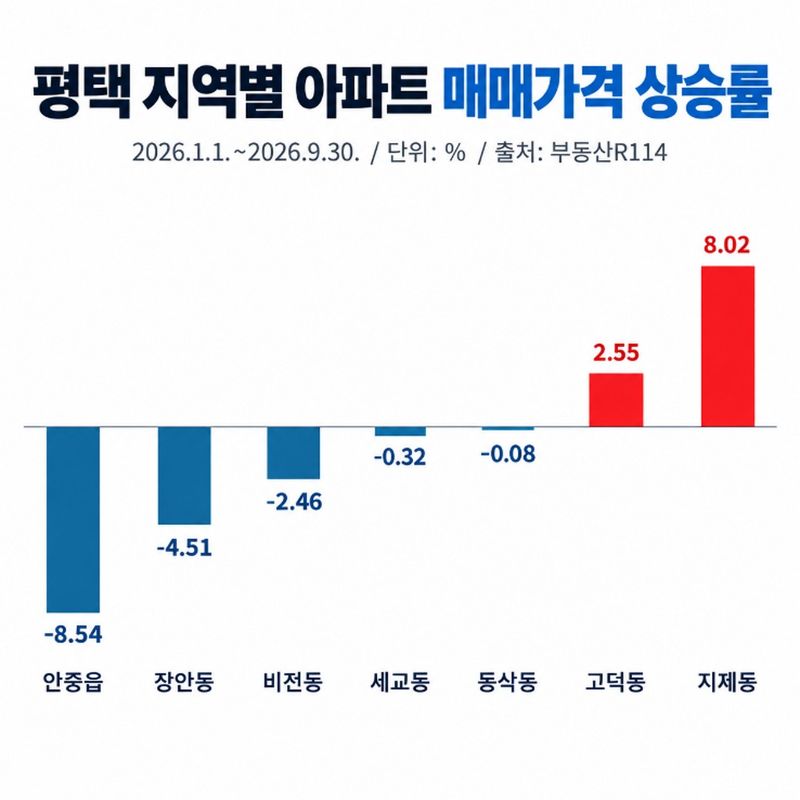
Unlike Pyeongtaek as a whole, the area around Jije Station has recently seen steep price gains. According to Real Estate R114, apartment sale prices in Jije-dong, Pyeongtaek-si, Gyeonggi Province, rose 8.02% from January to September this year. Over the same period, apartment prices across Pyeongtaek-si fell 0.34%. Price trends have thus diverged within Pyeongtaek, particularly in the Jije Station area.
The area’s location as a residential base for the semiconductor industry is a key factor. PyeongtaekJije Station is about 5 km from Samsung Electronics’ Pyeongtaek Campus, and commuter buses run via the Jije Station area and Dongsak-dong, among other places. Its proximity to Samsung Electronics commuter-bus stops—what is known as a “shuttle-bus catchment”—is seen as one factor influencing housing demand.
The area’s regional transport links are another strength. PyeongtaekJije Station provides access to Seoul Metropolitan Subway Line 1 and high-speed rail. By high-speed train, passengers can reach Dongtan Station in about 10 minutes and Suseo Station in the 20-minute range. In addition, plans to extend the Metropolitan Area Rapid Transit Line A (GTX-A) and Line C to Pyeongtaek, as well as the project to connect KTX directly from Suwon, are underway, and the transport network is expected to expand further.
The area’s price competitiveness is also drawing attention. Home prices in key residential areas of southern Gyeonggi Province, including Dongtan, have risen sharply this year, leading to the implementation of the land transaction permit system. As a result, the Jije Station area, where prices are relatively more affordable and regulations less restrictive, is attracting interest.
According to Real Estate R114, apartment prices in Dongtan-gu, Hwaseong-si, rose 15.9% from January to September this year, while those in Cheonggye-dong rose 23.47%. As of September, the average sale price of apartments completed within the past five years was ₩1.42837 billion in Dongtan-gu and ₩859.76 million in Jije-dong, about 66% higher in Dongtan-gu.
An industry source said, “The area around Jije Station is attracting attention as an alternative because residents can use both Samsung Electronics’ Pyeongtaek Campus commuter buses and the regional rail network, while home prices are still relatively low.” The source added, “It is emerging as an alternative residential area for people who commute to major industrial centers in southern Gyeonggi Province and want to reduce the cost of buying a home.”
The source continued, “When prices in a local housing market are rising, leading complexes often set new record highs first, with the upward trend later spreading to nearby developments.” The source added, “The key question is whether, if a ₩1 billion sale of a standard-size apartment becomes a reality around Jije Station, it will remain a record for a single complex or mark a turning point that raises the benchmark for home prices across Pyeongtaek, supported by regional transport links and station-area development.”
The scarcity of newly built apartments around Jije Station is also seen as a factor pushing prices up. According to Real Estate R114, a total of 23,650 apartment units were scheduled for occupancy across Pyeongtaek-si from 2024 through this year. With supply concentrated in areas such as Godeok International New Town and Hwayang District during that period, there were no new move-in units in Jije-dong or Segyo-dong.
With new supply in established residential areas limited, station-area development is being pursued over the medium to long term. The government plans to create a public housing district with 33,000 homes across about 4.53 million square meters in Jije-dong, Sindae-dong, Segyo-dong, Mogok-dong and Godeok-myeon. The plan is to develop the area within 600 meters of PyeongtaekJije Station at high density and create a self-sufficient “compact city” bringing together residential, business, educational, cultural and medical facilities.
With a new apartment offering planned for the first time in five years, interest is expected to continue. Hanwha Corporation E&C Division will build Hanwha Forena Jije Station near lot 725 in Segyo-dong, Pyeongtaek-si. The development will comprise 12 buildings, with two basement levels and up to 27 floors above ground, and a total of 1,098 homes. It will include 950 units with 84 square meters of exclusive floor space and 148 units with 116 square meters.
The complex features a predominantly south-facing building layout and generous spacing between buildings. Inside the homes, the developer plans to introduce a circulation-style layout that allows movement between spaces via a pantry, improving storage and ease of movement.
[email protected] Choi A-young Reporter