“₩181 trillion evaporated in just one month”... The National Pension shock and why retail investors are on edge
- Input
- 2026-10-08 14:10:17
- Updated
- 2026-10-08 14:10:17
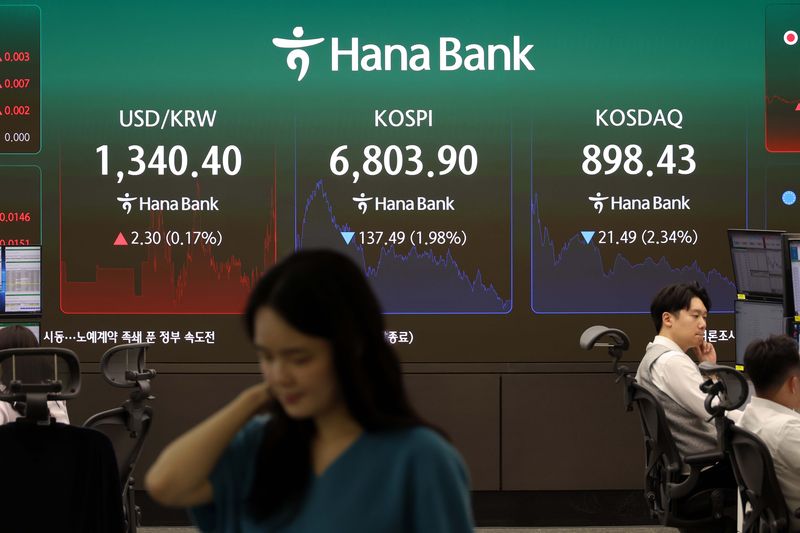
[Financial News] The National Pension Service Fund’s assets fell by about 181 trillion won in a month, raising alarm over the outlook for supply and demand in South Korea’s stock market. While the drop reflects reduced valuation gains from falling share prices alone, warnings are growing that large-scale selling could flood the market during future asset reallocation (rebalancing), as the fund’s allocation to domestic stocks remains well above its target.
According to disclosure data from the National Pension Service’s Fund Management Headquarters on the 7th, the fund’s assets stood at 1,684.173 trillion won at market value at the end of July. That was down 9.7% (about 181.4 trillion won) from the end of June, when they hit a record 1,865.576 trillion won.
Most of the decline came from a drop in the valuation of domestic stocks. The value of domestic stock assets plunged by 124.646 trillion won (22.9%) in a month, from 543.204 trillion won to 418.558 trillion won. The fall was far steeper than those in overseas stocks (down about 37 trillion won) and other assets (down about 19.4 trillion won). As a result, the fund’s return since the start of the year nearly halved, from 27.22% at the end of June to 14.84% at the end of July. However, this reflects a decline in unrealized valuation gains, not realized losses; compared with the start of the year, the fund’s assets are still up about 226 trillion won.
The problem is that the National Pension Service’s allocation to domestic stocks remains far above the target guidelines set by the National Pension Fund Operation Committee.
In May, the National Pension Fund Operation Committee raised the target allocation to domestic stocks from 14.9% to 20.8%. But amid the KOSPI’s strength in the first half of the year, the National Pension Service’s domestic stock allocation surged to 29.1% at the end of June, reaching 29.4% at one point during the trading day. Even after the sharp market decline in July, it stood at 24.9%—still 4.1 percentage points above the 20.8% target.
In principle, the National Pension Service should net-sell its overweight domestic stocks or buy other assets to maintain balance across its portfolio. But if the country’s largest institutional investor starts reducing its allocation, enormous selling pressure will inevitably hit the market, particularly in large-cap stocks such as Samsung Electronics and SK Hynix.
Park Jong-hoon, director of the Knowledge Economy Research Institute, said on his YouTube channel, “Park Jong-hoon’s Jisik Hanbang,” that “the National Pension Fund is not money to prop up the stock market; it is a fund meant to protect people’s retirement savings safely, so it must rebalance when assets become overly concentrated.” He added, “The adjustment was delayed after the opportunity was missed when the market had ample buying capacity, including from share buybacks. If stock prices rebound, this could lead to a massive wave of selling by pension funds.” In fact, share buybacks worth a total of 55 trillion won by Samsung Electronics and SK Hynix are 97% and 83% complete, respectively, and are effectively in their final stages.
The distorted portfolio structure is also having repercussions across the bond and broader financial markets. At the end of July, the National Pension Service’s allocation to domestic bonds was 16.8%, far short of the 23.1% target. In monetary terms, the shortfall is about 106 trillion won. Analysts warn that the overweight position in domestic stocks is reducing the fund’s capacity to buy government bonds, pushing up government bond yields (and lowering bond prices); this could in turn add to household burdens, including through higher mortgage rates at commercial banks.
Market participants see the completion of SK Hynix’s share buybacks around the middle of this month and the release of the National Pension Service’s “August Management Status” at the end of the month as key turning points for supply and demand. The financial investment industry is also closely watching whether the National Pension Fund Operation Committee will adjust the allocation to domestic stocks at its scheduled meeting in December.
[email protected] Moon Young-jin Reporter