SKT and Upstage Move to Boost AI Cybersecurity Capabilities as Part of K-LLM
- Input
- 2026-10-08 09:44:47
- Updated
- 2026-10-08 09:44:47
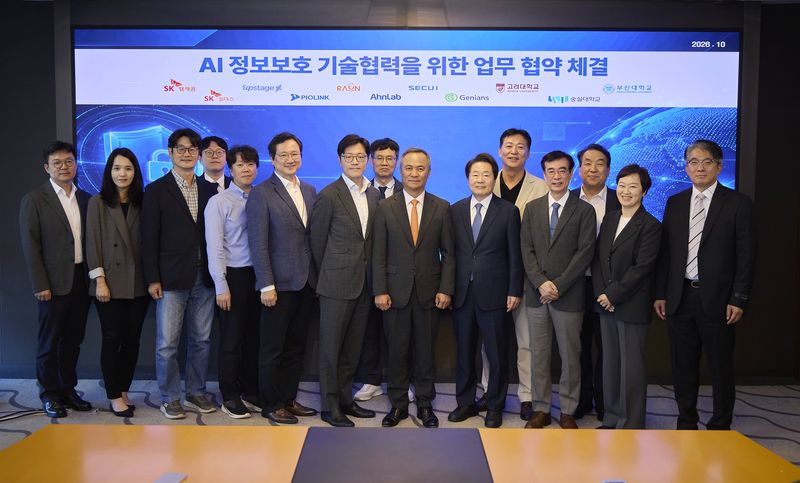
[Financial News] SK Telecom and Upstage, participants in the Independent AI Foundation Model Project (K-LLM), a national flagship artificial intelligence (AI) development initiative, are joining forces with South Korean security companies and universities to develop AI that analyzes malware and software vulnerabilities. They will train independent AI models on data collected in real-world security operations and improve their security capabilities and safety by having the two models attack each other to identify vulnerabilities.
Training on real-world security data to strengthen vulnerability analysis and incident response
SK Telecom said on the 8th that it had launched the Independent AI Cybersecurity Council with a total of 11 organizations, including Upstage, and signed a memorandum of understanding on cooperation in AI information-security technology. The agreement ceremony, held the previous day, was attended by SK Telecom and Upstage, six security companies—SK Shieldus, SECUI, AhnLab, Inc., RaonSecure, GENIANS and PIOLINK—and three universities: Korea University, Soongsil University and Pusan National University.At the heart of the collaboration are SK Telecom’s A.X K series, which advanced to Phase 3 of the K-LLM project, and Upstage’s Solar. The models will be trained on real-world data provided by security companies and, after validation by universities, applied to participating companies’ products and services.
SK Telecom and Upstage will use data generated through malware and vulnerability analysis and security monitoring to strengthen AI’s ability to understand and respond to threats. The approach is to reinforce foundational knowledge in security through pretraining, then use post-training to improve practical capabilities such as vulnerability analysis and patching, incident response at security operations centers, and the use of security tools.
SK Telecom will train its next model, A.X K3, on security data while also supplementing the data needed to operate its AI for Everyone service safely, which is intended for the entire population. Upstage plans to focus training on vulnerability detection and analysis data for the next Solar model, which can analyze large volumes of code and long-term logs at once.
Participating security companies will contribute threat intelligence and response experience accumulated in their respective fields. SK Shieldus analyzes around 17 billion threat events a day through its integrated security monitoring platform Secudium, while AhnLab, Inc. has at least 2.5 petabytes (PB) of security data and technologies for detecting malware and endpoint threats.
SECUI’s firewall technology, RaonSecure’s autonomous penetration-testing technology, GENIANS’ security-solution operational data, and PIOLINK’s technologies for autonomous attack validation and detection-rule generation will also be used to develop and validate the models. The plan is to keep incorporating newly collected threat data from security monitoring operations into training so the models can respond to evolving attack methods.
The trained models will be applied to participating companies’ products and services, including zero-day vulnerability analysis—before a security patch is available—and real-time security monitoring. The companies plan to verify performance and safety in actual operating environments and feed analysis and response experience gained through real-world testing back into training.
The council plans to identify joint research projects through regular technical exchanges and consider participating in projects in AI and information security. It also plans to expand participation to other security companies, universities, research institutes and AI companies.
Two AI models attack each other as universities verify their safety
The safety-verification process will use “mutual red teaming,” in which the two models attack and evaluate each other. Vulnerabilities exposed by the attacks will be used as training data for both models to improve their defensive capabilities.SK Telecom will expand through this collaboration its in-house automated red-teaming system, which generated and trained on about 15,000 attack-response cases during development of A.X K2. Upstage will use 210,000 high-difficulty and safety-related data items, along with a system for training models not to comply with dangerous requests.
The universities will conduct validation as third parties. Korea University will assess AI’s ability to analyze executable files and defend against attacks, while Soongsil University will examine security-performance evaluation criteria and the ability to counter attacks that bypass safeguards. Pusan National University will validate the performance and safety of next-generation and lightweight models.
Kyungsang Yu, head of SK Telecom’s AI CIC, said, “We will demonstrate the practical value of national flagship AI models in cybersecurity as models validated through the Independent AI Foundation Model Project prove their effectiveness in real-world security settings alongside leading Korean information-security companies and universities.”
[email protected] Yoon Hong-jip Reporter