Hyundai Rotem takes first step toward Egypt hydrogen tram project, lays groundwork for overseas expansion
- Input
- 2026-10-08 09:44:35
- Updated
- 2026-10-08 09:44:35
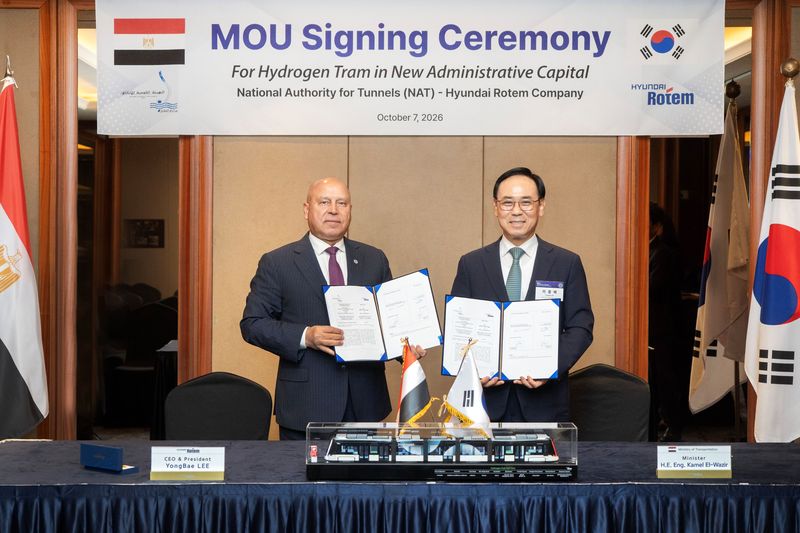
Hyundai Rotem said on the 8th that it had signed a memorandum of understanding (MOU) with Egypt’s National Authority for Tunnels (NAT) to cooperate on building a hydrogen-powered tram system for the New Administrative Capital at the Korea-Egypt Business Roundtable held at The Grand Lotte Seoul on the 7th.
The signing ceremony was attended by Kamel El-Wazir, Egypt’s minister of transport; Kim Jeong-kwan, South Korea’s minister of trade, industry and energy; Kim Wan-jung, ambassador to Egypt; and Hyundai Rotem President and CEO Yong-bae Lee, among others.
Under the agreement, the two sides agreed to continue discussions on supplying hydrogen-powered trams to Egypt’s New Administrative Capital. The project is currently at the preliminary feasibility study stage. If it proceeds, Hyundai Rotem plans to provide a comprehensive range of solutions needed for commercial operations, including vehicle supply, operations, systems and maintenance.
Egypt’s New Administrative Capital is a large-scale smart city under construction about 35 km east of Cairo. It will be large enough to accommodate at least 6 million residents when completed. Plans are under consideration to introduce 44 hydrogen-powered tram trainsets on a roughly 28 km route as a means of public transportation.
Hyundai Rotem aims to turn this agreement into its first export of hydrogen-powered trams and capture related demand in the global rail market. It expects to expand overseas opportunities for domestic partners in the hydrogen and rail sectors through the construction of infrastructure needed for operations, such as hydrogen production and refueling facilities, as well as vehicle manufacturing.
Hyundai Rotem will also link up with HTWO, Hyundai Motor Group’s hydrogen brand and business platform. It plans to identify overseas business opportunities by combining its hydrogen-powered tram technology with HTWO’s integrated solutions spanning the entire hydrogen value chain.
Hydrogen-powered trams generate electricity using onboard hydrogen fuel cells and can operate without separate overhead power lines. They emit water without directly releasing carbon during operation and filter fine dust from the air they draw in. The company says that not having to install overhead lines also helps improve the urban landscape.
A Hyundai Rotem official said, “Egypt’s New Administrative Capital is a leading future-city project where new forms of rail mobility, such as hydrogen-powered trams, can be introduced,” adding, “We will develop a hydrogen-powered tram business model optimized for local operations and work closely with the National Authority for Tunnels until the project is finalized.”
[email protected] Jeong Won-il Reporter