Euro falls to 17-month low... How much further could it drop?
- Input
- 2026-10-08 14:48:07
- Updated
- 2026-10-08 14:48:07
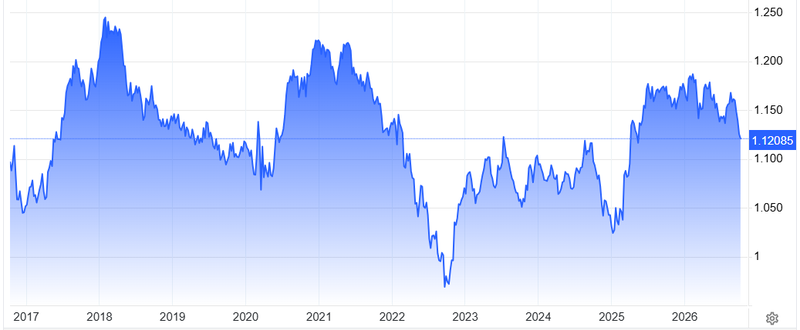
[Financial News] The euro has plunged to a 17-month low amid headwinds from Europe's energy crisis and fiscal concerns stemming from political instability in France. Market experts warn that if bond market turmoil persists, the currency could fall further to around $1.10 per euro.
On the 7th (local time), Euronews reported that at the start of the year, the euro was a sought-after investment, unlike the U.S. dollar, as investors expected the European Central Bank (ECB) to continue raising interest rates. The exchange rate topped $1.20 per euro in early January, but about nine months later, optimism has faded. The euro has declined for four consecutive weeks, recently falling as low as $1.116 to the euro, its lowest level since May 2025.■ Inflation surges amid energy shock The first cause of the euro's decline is the surge in energy prices amid instability in the Middle East. Since the Iran war broke out in late February, shipments of liquefied natural gas (LNG) through the Strait of Hormuz have been virtually blocked, leaving Europe facing a severe energy shortage. Dutch TTF futures, the benchmark for European gas prices, have surged 120% from a year ago to around 73 euros per megawatt-hour (MWh), while international oil prices have risen more than 60% this year alone, with North Sea Brent crude nearing $100 a barrel. With winter just weeks away, Europe's gas storage stood at 71.5% as of the 2nd, down from 82.6% at the same time last year.
Rising energy prices have fueled an inflation surge. According to Eurostat, the European Union's statistical agency, the eurozone (the 21 countries that use the euro) recorded annual consumer price index (CPI) inflation of 3.8% in September, the highest since September 2023. Energy prices in particular soared 18.8% year on year.
Under normal circumstances, rising prices would fuel expectations of interest rate hikes and lift the currency's value. But markets have lowered their forecast for future ECB rate hikes from 3.5 to around 2.5. ECB President Christine Lagarde recently signaled a cautious approach, saying, "Interest rate hikes are already slowing the economy, and there are no signs that higher energy prices are feeding through into wage increases."
The second headwind is France's worsening fiscal position. The spread between German and French 10-year government bond yields has widened to at least 1.4 percentage points, its largest since the 2011–12 eurozone debt crisis. The 2027 budget proposal put forward by French Prime Minister Sébastien Lecornu, which includes 43 billion euros (about 65 trillion won) in spending cuts, has yet to win majority support in parliament. Emmanuel Moulin, governor of the Bank of France, warned that the cost of servicing government debt could put pressure on public finances.■ Rising political uncertainty in EuropeFrancesco Pesole, a strategist at ING, said the bond market turmoil was hurting the euro in two ways. First, rising risks in France, a core eurozone country, are adding a risk premium to euro-denominated assets as a whole. And the more bond market turmoil intensifies, the harder it becomes for the ECB to raise rates further. Political uncertainty in Europe has also increased after Spanish Prime Minister Pedro Sánchez announced an early general election for November 29.
Major financial institutions are divided on the outlook. ING and Danske Bank forecast that if turmoil in the French government bond market and the energy crisis persist, the euro could fall further against the dollar to around $1.10. Danske Bank said, "Europe's energy problems have left the ECB caught between fiscal stability and bringing inflation under control," and predicted that the decline could continue through 2027.
By contrast, Ana Munera, a director at BBVA, said, "The euro's excessive decline recently has made it more attractive in terms of value," pointing to the possibility of a short-term rebound as short positions are covered. Experts agree, however, that for the euro to recover sustainably, structural improvements must come first—including a French budget deal, stability in the bond market and lower energy prices—rather than merely a technical rebound.
[email protected] Yoon Jae-jun Reporter