Following Samsung Electronics’ DRAM and NAND flash, SK hynix also undergoes space validation
- Input
- 2026-10-08 09:04:36
- Updated
- 2026-10-08 09:04:36
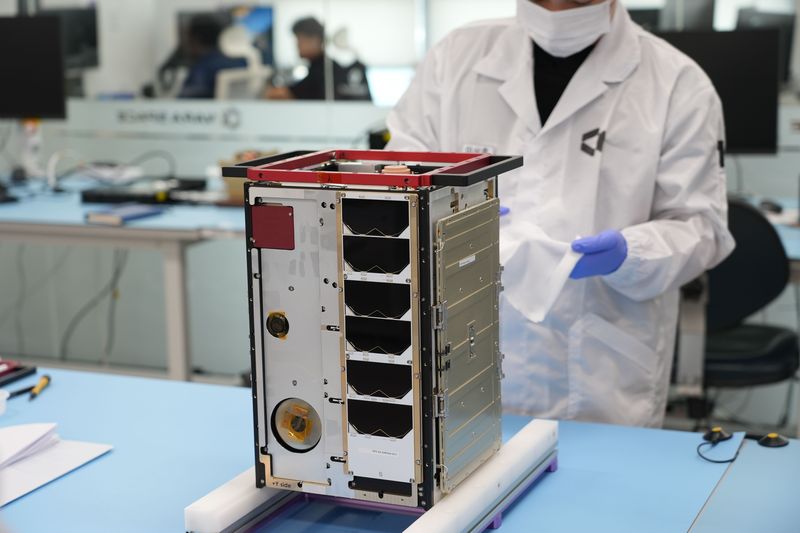
[Financial News] Following Samsung Electronics’ DRAM and NAND flash, full-scale performance validation of SK hynix’s products in the space environment is also getting underway.
Nara Space Technology said on the 8th that its space verification satellite EEETester-2 (E3T Unit 2), for which it developed and operates the satellite platform, successfully established two-way communications with a ground station after the fifth launch of Nuri on the 7th.
E3T Unit 2 is a satellite designed to validate semiconductors, electronic devices, components and technologies developed in Korea for space use under actual space conditions. It carries a range of devices, components and technologies, from semiconductors to equipment used in the satellite’s main systems. These include SK hynix’s DRAM and NAND flash, Insera Solution’s high-speed precision steering mirror, Momentum Space’s reaction wheel, KAIST’s attitude determination and system module, Cosmo B’s 1A-class hollow cathode for electric thrusters, and Intergravity Technologies’ avionics equipment for an orbital transfer vehicle, all of which will have their performance validated in the actual space environment.
Nara Space previously launched E3T Unit 1 on the fourth launch of Nuri on November 27 last year. The satellite has been operating successfully for 11 months since launch and continues to accumulate related data while carrying out space-validation missions for domestically made devices and components, including Samsung Electronics’ DRAM and NAND flash, the ADC/DAC ASIC from KAIST’s Mixed-Signal Integrated Circuit Laboratory, and MID’s SRAM.
After checking the satellite’s status and key functions during initial orbital operations following launch, E3T Unit 2 will begin its full-scale space-validation mission. It will then repeatedly test its payloads, collecting performance data on each device, component and technology and transmitting it to the ground. The tests are also expected to examine operating characteristics and changes in performance under extreme space conditions, including space radiation and temperature fluctuations.
E3T Unit 2 was launched at 12:25 p.m. on the 7th aboard the fifth Korean launch vehicle Nuri from the Naro Space Center in Goheung County, in the Jeonnam-Gwangju region, and successfully separated from the rocket in orbit about 17 minutes after launch. During its first communications session, about 1 hour and 57 minutes after separation, it successfully established two-way communications with the satellite control center at Nara Space’s headquarters. The satellite is currently undergoing initial operating procedures as its basic status is checked.
E3T Unit 2 was developed as part of the ‘Space Verification Support Program for Domestically Made Devices and Components,’ implemented by the Korea AeroSpace Administration and overseen by the Korea Aerospace Research Institute (KARI). KARI managed the program’s overall projects and integrated the satellite system, and played a central role in advancing the program so that a range of domestic devices, components and technologies could be tested in the actual space environment, including by selecting payloads for space verification. Following Unit 1, Nara Space was responsible for developing the satellite platform for Unit 2 and operating the satellite after launch.
Built to a total size of 12U and weighing 18.08 kg, E3T Unit 2 consists of a 4U bus system and an 8U payload bay. It is designed to accommodate a variety of payloads with different characteristics, test them in the space environment, and collect and transmit data. During testing, operating times for individual payloads are separated where possible to minimize mutual interference.
Nara Space CEO Park Jae-pil said, “Following the successful establishment of an operational foundation for E3T Unit 2, after E3T Unit 1 was launched last year, it is significant that we have once again demonstrated a reliable satellite platform capable of validating space-grade devices and components in the actual space environment.” He added, “We will continue to expand opportunities to validate a variety of space-grade devices and components in step with the global New Space trend, and steadily build up our capabilities so that we can help lay the groundwork for the growth of Korea’s space device and component industry.”
[email protected] Yeon Jian Reporter