'Semiconductor superboom' drives current account surplus above $40 billion for third straight month
- Input
- 2026-10-08 08:00:00
- Updated
- 2026-10-08 08:00:00
[Financial News] The country’s current account surplus topped $40 billion for the third consecutive month. The record-setting run of surpluses is expected to continue into the second half, thanks to the semiconductor superboom. Amid a recent sharp rise in global government bond yields, investment in foreign bonds (debt securities) topped $6.4 billion, hitting a record high.
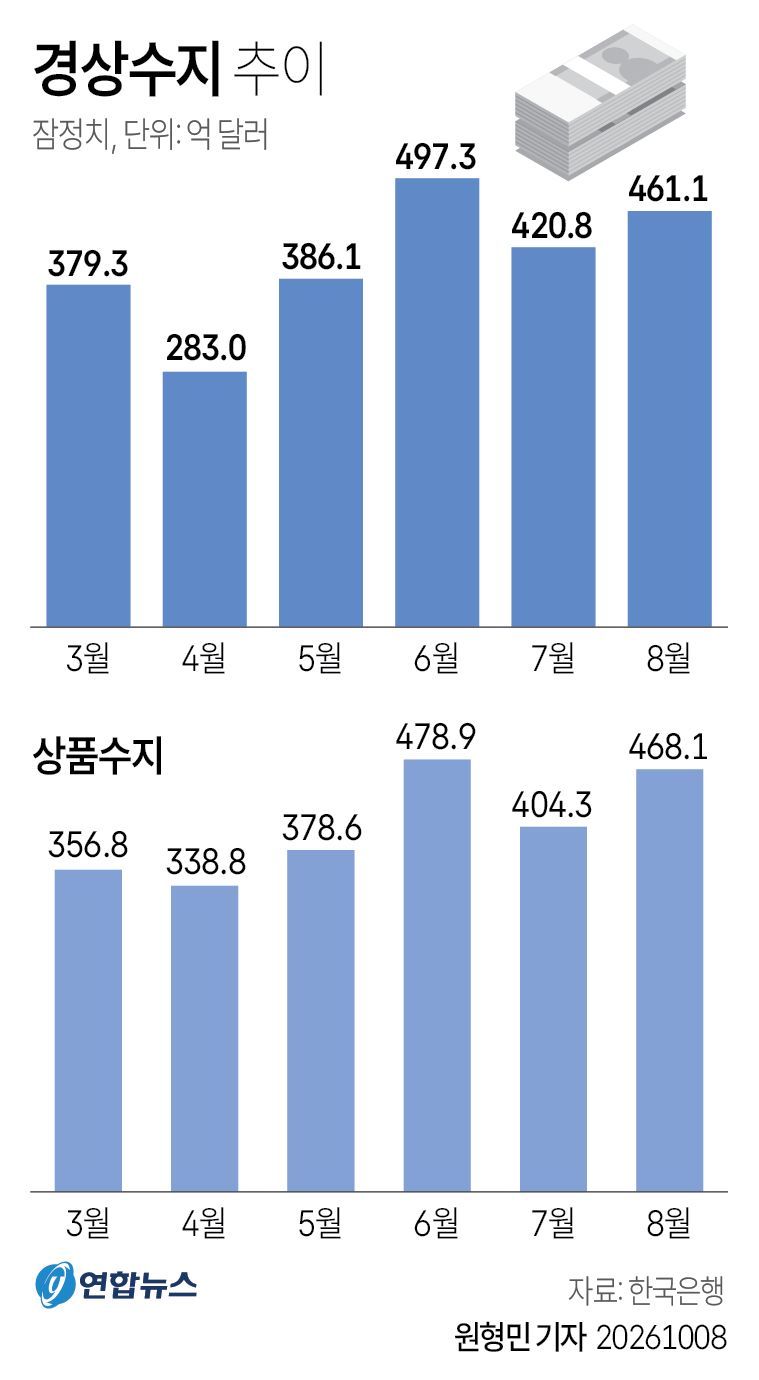
According to preliminary balance-of-payments data released by the Bank of Korea on the 8th, the current account posted a surplus of $46.11 billion in August this year. It was the second-largest on record, following June’s $49.73 billion. The July figure of $42.08 billion was also surpassed just one month later.
The cumulative surplus for January–August this year was $279.2 billion, nearly four times the $69.67 billion recorded in the same period last year.
“This is the result of goods exports, led by semiconductors, topping $100 billion for three consecutive months,” said Yoo Seong-uk, director of the Bank of Korea’s Financial Statistics Department. He forecast, “Considering factors such as September’s trade balance recording a much larger-than-expected surplus, the September current account should be at least as strong as August’s.”
The goods account posted a surplus of $46.81 billion in August.
Goods exports surged 82.1% from a year earlier to $104.8 billion. That was the second-largest figure on record, and exports topped $100 billion for the third consecutive month.
Information and communications technology (IT) exports rose 162.6% year on year. Computer peripherals (SSDs) (366.8%) and semiconductors (206.1%) posted explosive growth. Exports of petroleum products (64.9%) also increased, but passenger car exports fell 30.1%, largely due to fewer working days. Goods imports rose 23.8% to $57.99 billion. Growth in raw materials (13.1%) and capital goods (42.9%) continued, while imports of consumer goods (+4.3%) also rose again.
The services account posted a deficit of $1.68 billion.
The travel account posted a deficit of $770 million, largely due to increased travel payments during the peak season for overseas travel. However, the overall deficit narrowed from the previous month as the transportation account surplus widened to $520 million, driven by a recent rise in export freight rates.
The primary income account, which reflects money earned by working or investing abroad, posted a surplus of $1.92 billion.
The surplus narrowed, mainly because of the dividend income account, which recorded $1.18 billion. The dividend income account typically declines in August, when large dividend payments are made to foreign investors.
Net assets in the financial account—the value of overseas investment assets minus overseas liabilities—stood at $40.23 billion, similar to the previous month.
The increase in residents’ direct investment assets abroad widened to $6.22 billion. Foreign direct investment in Korea fell to $1.61 billion.
Residents’ overseas investments, including in U.S. stocks, increased by as much as $16.6 billion. The increase was the second-largest on record, following $17.29 billion in October 2025.
Residents made large-scale purchases of foreign stocks ($10.15 billion) and foreign bonds (debt securities, $6.44 billion). As U.S. Treasury yields surged, residents’ investment in debt securities, including government and corporate bonds, rose at least fivefold from July’s $1.24 billion, marking the largest increase on record.
By contrast, foreign investment in Korea declined. Funds flowed out of both bonds (-$4.38 billion) and stocks (-$470 million).
The temporary surge in foreign investment funds following SK hynix’s issuance of American Depositary Receipts (ADRs) in the United States last July had faded, and foreign investors sold large amounts of Korean bonds as the bonds became less attractive for capital gains.
[email protected] Jeong Sang-gyun Reporter