A Nobel Prize 25 Years Late ... Honored at 95
- Input
- 2026-10-08 07:01:40
- Updated
- 2026-10-08 07:01:40
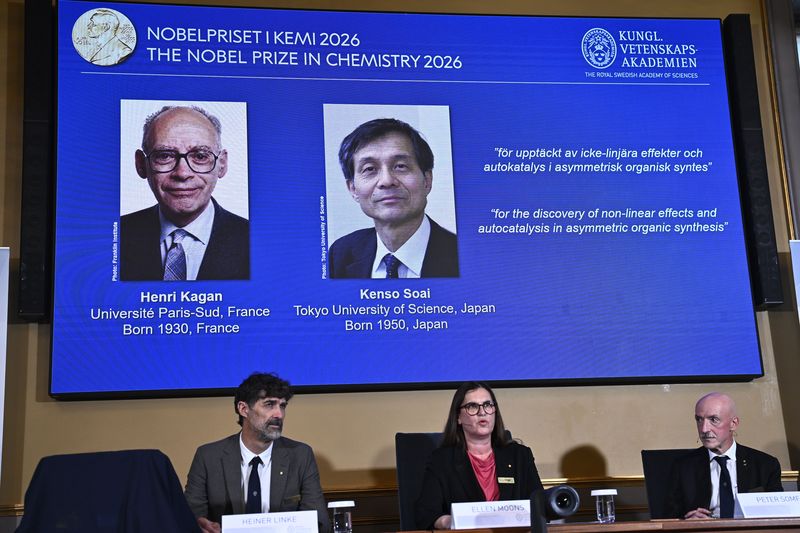
[Financial News] France’s Henri Kagan, an emeritus professor at Paris-Saclay University (Paris-Sud University), who received this year’s Nobel Prize in Chemistry,
was born in December 1930 and is now 95. By age at the time of the award, Kagan is the third-oldest Nobel laureate ever, after John Goodenough (2019 Nobel Prize in Chemistry) and Arthur Ashkin (2018 Nobel Prize in Physics).
In 2001, controversy arose when William S. Knowles and K. Barry Sharpless of the United States, and Ryoji Noyori of Japan, received the Nobel Prize in Chemistry for research involving asymmetric catalysis, while Professor Kagan, a pioneer in the field, was left out.
The French newspaper Les Echos said, “The Nobel Prize arrived 25 years late for Henri Kagan,” reporting that the French scientific community reacted strongly in 2001 and that then-Research Minister Roger-Gérard Schwarzenberg even sent a letter of protest to the chair of the Nobel Committee, but to no avail.
AFP reported that the Nobel Committee was unable to reach Professor Kagan to notify him of the award before announcing the laureates that day. Although he could not be reached, his daughter, Veronique Le Denf, said she was “very pleased that the creativity and originality of my father’s research had opened new paths for research,” AFP reported.
Professor Kagan’s success in the 1980s in asymmetric catalytic synthesis—precisely manipulating catalysts to produce more of one of a pair of mirror-image forms—was considered a “revolutionary change” in chemistry.
It is also said that the foundations of chirality research were laid by French chemist Louis Pasteur (1822–1895), who died before the Nobel Prize was established. In 1848, through his study of tartaric acid, which is important in wine production, Pasteur discovered molecular asymmetry.
The Nobel Committee of the Royal Swedish Academy of Sciences earlier announced on the 7th (local time) that it had selected emeritus professor Kagan and Professor Kenso Soai of Tokyo University of Science in Japan as laureates for discovering nonlinear effects and autocatalysis in asymmetric organic synthesis.
The Nobel Committee said the two laureates had provided an answer to chemistry’s mystery of the spontaneous emergence of “homochirality” (the phenomenon in which the molecules that make up living organisms have only one orientation).
The French Academy of Sciences said on Facebook, “Their research is particularly important for biochemistry and the production of pharmaceuticals,” adding, “We are very proud that Professor Kagan, elected a member of our academy in 1991, has received this extraordinary honor.”
[email protected] Lee Seok-woo, International Affairs Specialist Reporter