“I Experiment Even If I Fail”: Japanese Nobel Laureate Soai’s 30 Years of Steadfast Research
- Input
- 2026-10-07 23:26:18
- Updated
- 2026-10-07 23:26:18
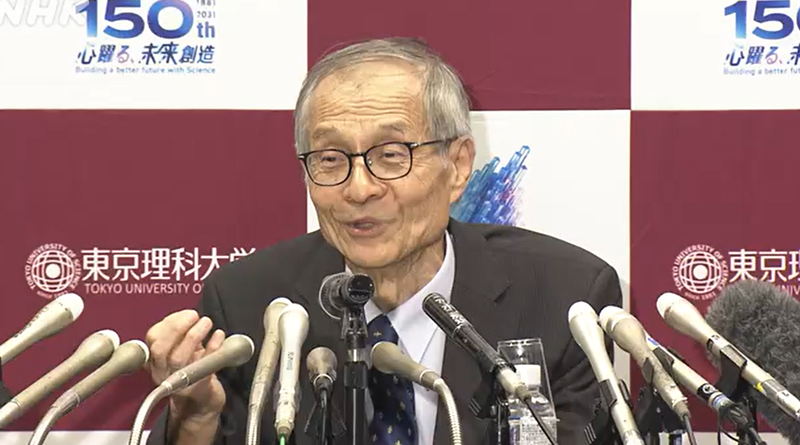
【Financial News, Tokyo = Correspondent Seo Hye-jin】“It is important to conduct experiments even if they do not work out.”
The research principle described by Genso Soai, the 76-year-old emeritus professor at Tokyo University of Science in Japan who was named this year’s Nobel Prize in Chemistry laureate, was simple: keep experimenting even when the results do not turn out as intended. Having offered a clue to unraveling the mystery of the emergence of life, he remembers his long research career as more enjoyable than difficult.
Asked about the difficulties of the research process at a press conference held at Tokyo University of Science in Shinjuku, Tokyo, at 10 p.m. on the 7th, Professor Soai said, “From the outside, it may have looked as though one difficult thing after another kept happening, but I myself didn’t think of it that way.” He continued, “I enjoyed the research, and there were moments when I thought, ‘This is amazing,’” he recalled.
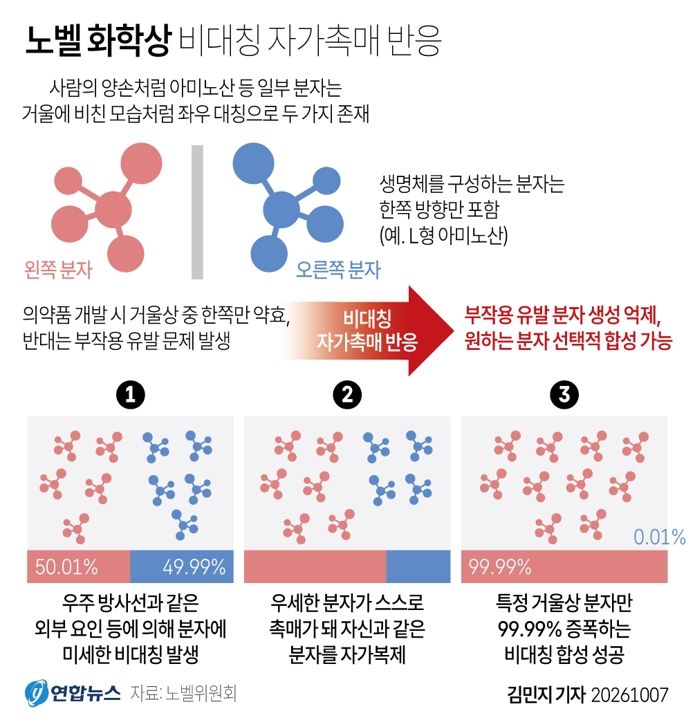
The Royal Swedish Academy of Sciences named Professor Soai and Professor Emeritus Henri Kagan, 95, of Paris-Saclay University in France, joint recipients of the Nobel Prize in Chemistry that day. They were honored for discovering the “nonlinear effect” and “autocatalytic reaction” in asymmetric organic synthesis. Their research helped explain why the molecules that make up living organisms came to have structures oriented in only one direction.
Professor Soai described the process of studying organic compounds as “like feeling your way along with a lamp strapped to your head in a dark place where you don’t even know whether there’s a mountain.” He meant that he had found a way forward through experiments even when he could not be sure where the goal lay.
The “Soai reaction,” which he presented in a paper in 1995, is a chemical reaction in which the molecules produced act as a catalyst, increasing the number of molecules with the same structure as themselves. More than 30 years after its discovery, it led to the Nobel Prize.
Molecules can have structures that are mirror images of each other, like the right and left hands, but cannot be perfectly superimposed. This is called “chirality.” Professor Soai demonstrated how even a slight excess of either the right-handed or left-handed form can be greatly amplified through repeated autocatalytic reactions.
This research is connected to the origin of life. Most of the amino acids living organisms use to make proteins are left-handed. Why life came to select one of the two structures had long been a mystery. The Soai reaction showed how a tiny initial difference can lead to the overwhelming dominance of one structure.
Co-laureate Professor Kagan discovered the “nonlinear effect” in 1986, in which a small structural bias is greatly amplified during a reaction. The Nobel Committee said the two had “provided an answer to a chemical mystery that had persisted for more than 100 years.”
Professor Soai described his research as “fundamental to and the foundation of the life sciences.” He said he hoped the award would help bring its importance to wider attention and prompt people who had not previously been interested to turn their attention to the field.
He credited the research environment and his colleagues for the award. At the start of the press conference, Professor Soai said, “I believe I was able to achieve results in Japan’s high-caliber research environment,” adding, “There must still be much we don’t know. I hope to contribute, however modestly, to advancing research in the future.”
In particular, he emphasized, “I was fortunate in the people I met, including outstanding students,” adding, “It was only because of the students that I was able to achieve results.”
Even as he expressed his joy at the award, he remained composed. He drew laughter from reporters when he said, “I thought no one would object to my receiving the award.” When he joined the Nobel Committee’s press conference by phone, he called it “one of the most moving days of my life” and said, “It is an honor to receive the award alongside Dr. Kagan, whom I greatly admire.”
Born in Hiroshima Prefecture in 1950, Professor Soai graduated from the Department of Chemistry at the University of Tokyo and earned his doctorate from the same university. After working as a postdoctoral researcher at the University of North Carolina at Chapel Hill in the United States, he served as a professor at Tokyo University of Science and became an emeritus professor in 2017.
With this award, the number of Nobel laureates in the natural sciences born in Japan, including U.S. citizens, rose to 28. He is Japan’s 10th Nobel laureate in chemistry, following Professor Susumu Kitagawa last year.
Japanese Prime Minister Sanae Takaichi called him that night to congratulate him, describing it as “a groundbreaking achievement that also contributes to solving humanity’s shared mystery of the origin of life.” She also said she would expand funding for scientific research and operating subsidies for national universities to strengthen the research base.
[email protected] Seo Hye-jin Reporter