Japan wins another Nobel: 10 in Chemistry, 31 laureates overall
- Input
- 2026-10-07 22:00:31
- Updated
- 2026-10-07 22:00:31
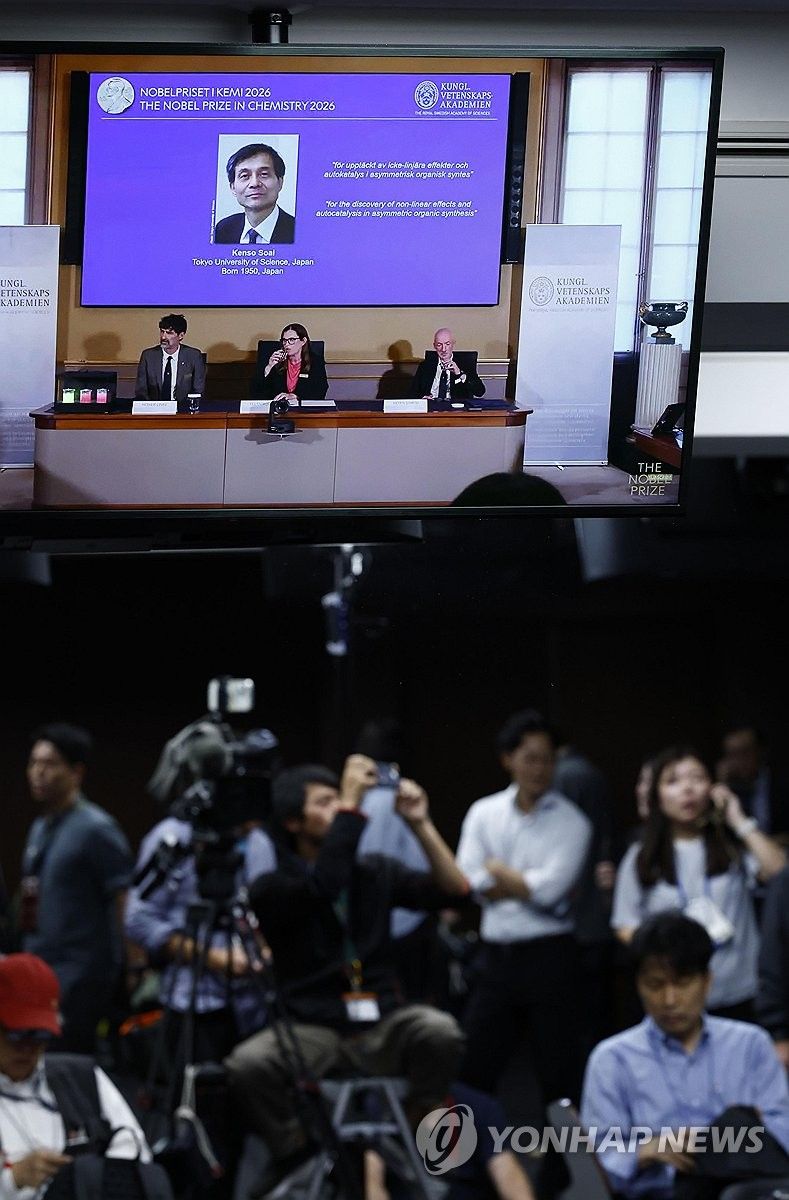
【Financial News, Tokyo—Special Correspondent Seo Hye-jin】Kenso Soai, 76, an honorary professor at Tokyo University of Science, was named this year’s Nobel Prize in Chemistry laureate, bringing the number of individual Nobel laureates of Japanese origin to 31. By producing a Chemistry laureate for a second consecutive year, following Susumu Kitagawa last year, Japan has demonstrated its strength in basic science.
The Nobel Committee of the Royal Swedish Academy of Sciences announced on the 7th that Professor Soai and Professor Henri Kagan, 95, of France, had been selected as joint winners of this year’s Nobel Prize in Chemistry. They were recognized for discovering nonlinear effects and autocatalysis in asymmetric organic synthesis. The work is regarded as having provided clues to explaining why molecules that make up living organisms are biased toward one three-dimensional structure.
Professor Soai, who is of Japanese origin, is the 10th Japanese Nobel laureate in Chemistry. Including three laureates who were born in Japan and later acquired foreign citizenship, the total stands at 31 individual Nobel laureates, 28 of them in the natural sciences.
Japan’s Nobel history began in 1949 with Hideki Yukawa, who received the Nobel Prize in Physics. By field, physics has the most individual laureates, with 12, followed by chemistry with 10, physiology or medicine with 6, literature with 2, and peace with 1. Separately from the individual laureates, the Japan Confederation of A- and H-Bomb Sufferers Organizations (Nihon Hidankyo) also received the 2024 Nobel Peace Prize.
The first Japanese recipient of the Nobel Prize in Chemistry was Kenichi Fukui in 1981. He was followed by Hideki Shirakawa (2000), Ryoji Noyori (2001), Koichi Tanaka (2002), Osamu Shimomura (2008), Akira Suzuki and Ei-ichi Negishi (2010), Akira Yoshino (2019), and Susumu Kitagawa (2025).
This award is also significant as a result of the research into asymmetric synthesis built up by Japan’s chemistry community. Asymmetric synthesis, which selectively produces a desired form from the two mirror-image forms of a molecule, is an important technology in drug development. Professor Noyori also received the Nobel Prize in Chemistry in 2001 for his research in this field.
Last year, Sakaguchi Shimon received the Nobel Prize in Physiology or Medicine for research on the immune system, while Susumu Kitagawa received the Nobel Prize in Chemistry for developing metal-organic frameworks (MOFs). This year, research into chemical reactions linked to the origin of life led to a Nobel Prize.
The award ceremony will be held in Stockholm, Sweden, on December 10, the anniversary of Alfred Nobel’s death. The two laureates will share the prize money of 12 million Swedish kronor, about 1.61 billion won.
[email protected] Seo Hye-jin Reporter