[Editorial] Nuri’s Fifth Launch Succeeds, Bringing South Korea One Step Closer to Becoming a Top-Five Space Power
- Input
- 2026-10-07 18:29:54
- Updated
- 2026-10-07 18:29:54
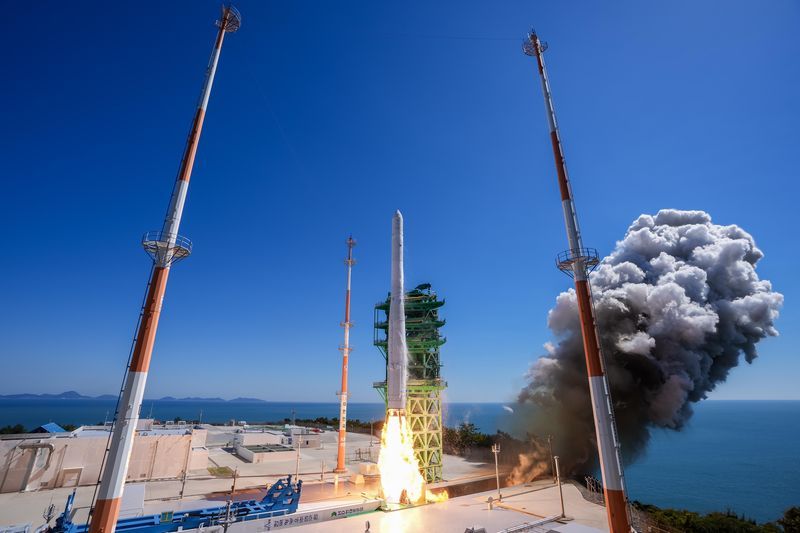
This was the first time Nuri had carried several primary payload satellites together and deployed them into orbit sequentially. To prevent the satellites from colliding with one another, the launch vehicle’s upper stage rotated by 30 and 60 degrees as it released the cluster satellites one by one at intervals of 35 to 40 seconds. It then released the CubeSats in sequence as well. The ability to deploy multiple satellites from a single launch vehicle at specified altitudes and in a set order is essential for commercial launch services. By accomplishing this with homegrown technology, South Korea raised its space transportation capabilities to a new level. The country’s space program has moved beyond launching rockets to reliably carrying a range of satellites into space.
The technology accumulated through the development of Nuri must now strengthen the competitiveness of the private space industry. Around 300 domestic companies took part in developing Nuri. Hanwha Aerospace, which led production of the fourth launch vehicle, also oversaw production of the fifth and expanded its role in launch operations. But competing in the global commercial launch market will require a substantial track record of launches and competitive prices.
That makes steady demand for launches crucial. Starting in 2029, the government plans to regularly launch domestic public satellites needed for defense, weather forecasting, disaster response and land observation aboard homegrown launch vehicles. It will need to further increase the number and scale of launches. The government should create an initial market so private companies can gain experience.
Launch sites and testing facilities must be significantly expanded, and regulations and permitting systems must be updated to support commercial launches, enabling South Korea to win contracts to launch foreign satellites as well. A space launch vehicle contains 370,000 components alone. More opportunities must be created for component manufacturers making engines, tanks, valves, sensors and other parts to build up their technological expertise. That is how the foundations of the domestic space industry can also be strengthened.
The standards for competitiveness in the global space industry have already moved beyond whether a launch succeeds. Today, the competition is decided by low prices, reliability and precision. With reusable rockets, SpaceX of the United States sharply increased launch frequency and lowered costs, changing the order of the global space transportation market in one fell swoop. China, Europe and Japan are also accelerating efforts to develop next-generation launch vehicles and foster private space companies. It is more important than ever for South Korea to secure next-generation technologies, including reusable launch vehicles and methane engines.
South Korea’s space program is a history of miracles built on countless failures and trials. Now it is time to make that technology blossom into an industry. The country must build an ecosystem connecting launch vehicles and satellites with space communications and data services, and actively nurture companies. If these foundations are put in place, becoming one of the world’s top five space powers will not be far off.