Plan to develop West Busan into an “economic hub of the maritime capital region” draws attention
- Input
- 2026-10-07 17:54:24
- Updated
- 2026-10-07 17:54:24
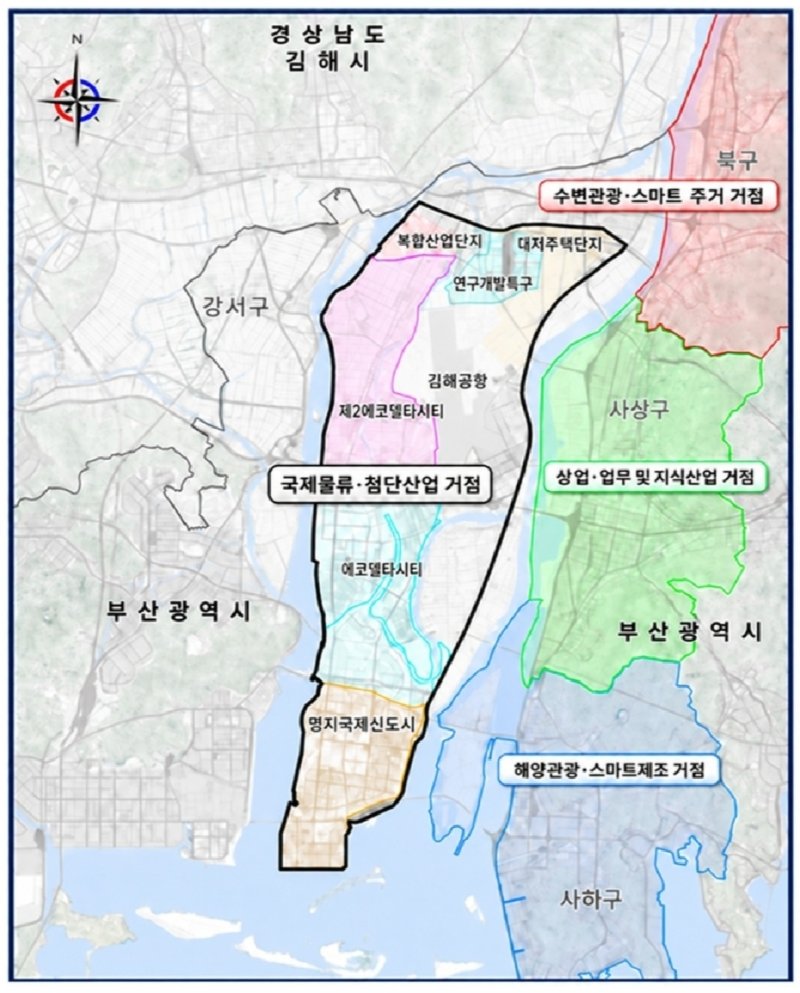
[Financial News] The Busan Port Future Policy Institute, co-directed by Jeong Seong-gi and Lee Gwang-guk, drew attention on the 7th after proposing a “four specialized hubs strategy” to link Gangseo, Buk, Sasang and Saha districts into a single economic zone at the founding forum of the Korea Airport Infrastructure Society, held that afternoon at the Busan Port International Exhibition & Convention Center (BPEX).
Jeong Seong-gi, head of the Busan Port Future Policy Institute, who presented at the forum, said, “With the government pursuing the opening of Arctic shipping routes and the development of a maritime capital region, discussions underway at the regional level on administrative integration among Busan, Ulsan and Gyeongsangnam-do, construction of Gadeokdo New Airport and Jinhae New Port, and expansion of metropolitan transport networks, underdeveloped West Busan is facing an opportunity for a new leap forward.”
In a presentation titled “A Strategy for Developing West Busan Through the Construction of Gadeokdo New Airport,” Director Jeong said, “We should make active use of the rapidly changing policy environment and develop West Busan into an economic hub of South Korea’s maritime capital region to promote balanced national development.” As a plan for putting this into action, he proposed a “West Busan Four Specialized Hubs Development Strategy.”
According to the presentation, the population of Gangseo District, Busan, rose by 58.9% over the 10 years from 2015 to 2025, while the population of Sasang District fell by 18.3% and those of Buk and Saha districts each declined by 15.3% over the same period.
It projected that Gangseo District, Busan, was growing rapidly on the back of development of the new port and its surrounding areas, while population decline, low birth rates and aging were occurring simultaneously in Buk, Sasang and Saha districts. Unless Gangseo’s growth drivers spread to neighboring areas, the population drop and loss of economic vitality could accelerate further.
It stressed that, to address this, West Busan should be developed as a single economic zone by organically linking Gangseo District’s strong growth potential, the manufacturing base in Sasang and Saha districts, and Buk District’s large residential and daily-living areas, all underpinned by Tri-Port infrastructure connecting Gadeokdo New Airport, Busan Newport and the regional rail network.
To that end, it proposed a specialized-hub development strategy that builds on the characteristics and strengths of the four districts, centered on Gangseo District, Busan.
Gangseo District, Busan, would be developed into an international logistics and advanced-industry hub spanning approximately 42.9 million square meters, linking Busan Eco Delta City and Myeongji International New City with Second Eco Delta City, the West Busan Complex Industrial Complex, research and development special zones, and other areas. The plan would concentrate high-value-added industries of the future, including AI (artificial intelligence)-convergent industries, next-generation energy, international logistics and advanced manufacturing.
In Buk District, Busan, the plan would create a Nakdong River waterfront tourism belt centered on Hwamyeong Ecological Park and linked with Samnak, Daejeo, Maekdo and Eulsukdo Ecological Parks, connecting it with local commercial areas. Alongside this, it would redevelop aging urban areas in Hwamyeong and Geumgok, developing the district into a hub for waterfront tourism and eco-friendly, smart housing.
The plan calls for Sasang District, Busan, to convert its aging industrial areas into an AI-based smart manufacturing center and actively attract digital and knowledge industries. It also calls for strengthening education, culture and other services around Sasang Intersection, developing the district into a hub for commerce, business and knowledge industries.
It stressed that Saha District would be developed into a hub for marine tourism and smart manufacturing by building a sea bridge from Gadeokdo New Airport to Dadaepo, creating a marine tourism belt linking the Dusong Peninsula, Dadaepo Port, Dadaepo Beach and Molundae, and making existing manufacturing smarter using AI, robotics and IoT (the Internet of Things).
Director Jeong also identified transport network expansion as a key task in developing the four specialized hubs as a single economic zone.
He stressed that growth in West Busan should be accelerated by rapidly expanding road and rail networks connecting areas within West Busan and Busan, Ulsan and Gyeongsangnam-do. These include the Southeastern Regional Circular Railway; access roads and rail lines to Gadeokdo New Airport; east-west and north-south deep-bore expressways; a sea bridge from Gadeokdo New Airport to Dadaepo; the Eomgung, Jangnak and Daejeo bridges; the Seunghaksan Tunnel and Second Baekyang Tunnel; and the Hadan–Noksan and Gangseo lines.
It also estimated that approximately 25.9 trillion won in investment would be needed by 2040 to develop the four specialized hubs, including the creation of industrial complexes and expansion of infrastructure such as roads and railways.
The proposed funding sources were 6.5 trillion won from the national government, 1.5 trillion won from the city and 17.9 trillion won in private capital. It said it had considered using private capital to develop industrial complexes and build privately funded roads, among other projects.
It argued that the investment environment should be improved, including through additional designations of Opportunity Development Zones and distributed-energy special zones and changes to urban spatial plans, saying that attracting investment from advanced companies, including AI firms, was particularly important.
Director Jeong projected that, if the plan goes ahead, West Busan could build up advanced industries as well as aviation, shipbuilding and marine industries on the strength of its Tri-Port infrastructure, while boosting Nakdong River waterfront tourism to create new jobs and a foundation for growth.
He said he expected the plan to contribute to balanced national development and enable West Busan to emerge as an economic hub of the maritime capital region.
The Busan Port Future Policy Institute proposed the following measures to the Busan Metropolitan Government to help West Busan emerge as an economic hub of South Korea’s maritime capital region.
First, the Busan Metropolitan Government should make the “West Busan Four Specialized Hubs Development Strategy” a key policy priority to develop West Busan into an economic hub of the maritime capital region.
Second, it should draw up a “West Busan Four Specialized Hubs Master Plan” to flesh out the institute’s proposal and reorganize Busan’s urban spatial structure accordingly.
Third, it should establish a dedicated organization within the Busan Metropolitan Government and create a public-private cooperation framework, including by forming a private body provisionally named the West Busan Development Promotion Council and building public support.
Fourth, it should work actively with the government and the National Assembly to identify new projects and secure funding for talent development, technology development and infrastructure expansion related to developing the maritime capital region and opening Arctic shipping routes.
Jeong Seong-gi, co-director of the Busan Port Future Policy Institute, said, “With a sense of urgency about reviving the economies of Buk, Sasang and Saha districts, which are losing vitality due to a rapidly shrinking population and aging, we drew up the ‘West Busan Four Specialized Hubs Development Strategy.’” He added, “I hope the proposal put forward by the institute will be adopted as a key policy priority by the Busan Metropolitan Government and put into action, so that West Busan can regain its vitality.”
[email protected] Byun Ok-hwan Reporter