POSCO to build 'Steel GX' with HyREX, creating a decarbonization belt from Pohang to Gwangyang
- Input
- 2026-10-07 17:44:19
- Updated
- 2026-10-07 17:44:19
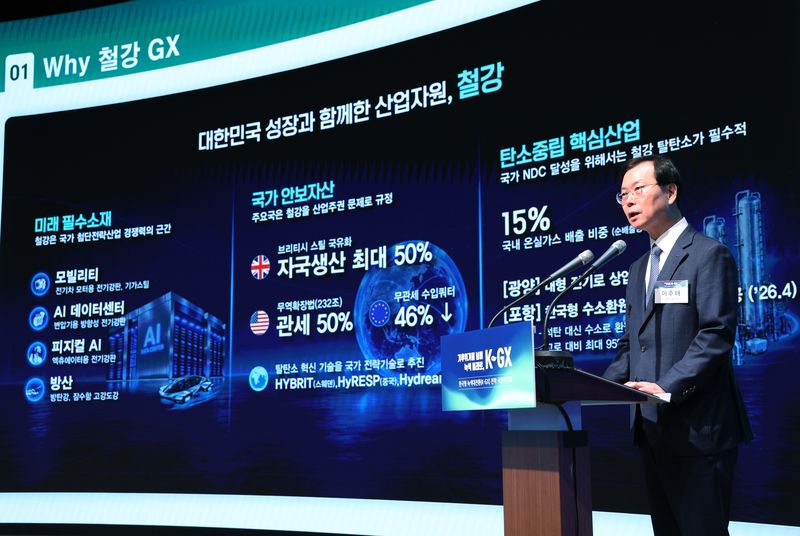
[Financial News] POSCO Group is moving to build a 'Steel GX' ecosystem centered on HyREX, its hydrogen-reduction ironmaking technology, as a flagship project of the Korean Green Transformation (K-GX). The plan is to build a HyREX demonstration facility with an annual capacity of 300,000 tons in Pohang by 2028 and establish a decarbonization cluster in the southeast that links clean energy supply with demand for low-carbon steel.
According to the government and POSCO on the 7th, POSCO Holdings announced its plan to build a decarbonized industrial ecosystem based on Steel GX at the public briefing on the Korean Green Transformation (K-GX) strategy held in Seoul that day.
The government presented K-GX as a 10-year plan (2026–2035) to pursue carbon neutrality and economic growth together, and decided to deploy a total of 1,000 trillion won in funding over the decade through fiscal resources, climate finance and other means. Investment totaling 220 trillion won is also being pursued for private-sector K-GX signature projects.
POSCO's Steel GX was selected as a signature project, alongside Hanwha Qcells' clean power-generation materials and perovskite tandem solar cells, and LG Electronics and Samsung Electronics' GX for residential spaces.
HyREX is POSCO's hydrogen-reduction ironmaking technology, which uses hydrogen instead of coal to reduce iron ore. POSCO is pursuing a roadmap to complete a HyREX demonstration facility with an annual capacity of 300,000 tons in Pohang in 2028.
The K-GX plan focuses on building an industrial ecosystem that goes beyond individual steelmaking technologies to connect power and hydrogen with steel demand markets. Since hydrogen-reduction ironmaking is a process that runs 24 hours a day, the ability to secure large volumes of electricity and clean hydrogen at stable prices is a key condition for commercialization. POSCO believes that decarbonizing the steel industry requires linking the entire chain, from clean energy supply to HyREX technology development and facility conversion, and the use of low-carbon steel.
On the demand side, POSCO identified the creation of a so-called 'green premium' market as a key task. The company said an initial market can be created by establishing low-carbon steel standards and green procurement systems so that the environmental value of low-carbon steel—which may cost more to produce than conventional steel products—is reflected in its price.
POSCO proposed a public-private partnership model called 'TIMUP,' bringing together Technology, Installation, Market, Utility and Policy. Under the plan, companies would take charge of technology development and facility conversion, while the government would support the foundations and infrastructure for clean energy supply and the creation of low-carbon markets.
POSCO proposed the southeast, centered on Pohang, as the first demonstration region. The plan is to link the HyREX demonstration facility with a clean hydrogen supply chain and build a steel decarbonization cluster connecting industrial complexes in Pohang and Ulsan.
POSCO Group expects the southeastern cluster to generate about 6 trillion won in economic benefits, create 14,000 jobs and deliver additional carbon reductions of 560,000 tons a year.
After validating the HyREX demonstration and the southeastern cluster model in Pohang, POSCO plans to expand Steel GX to the southwest, centered on Gwangyang. The plan is to support not only the conversion of processes at the Pohang and Gwangyang steelworks but also the green transition of advanced strategic industries such as mobility, AI data centers and robotics.
POSCO Holdings President Lee Joo-tae said, "Under the government's K-GX strategy, the public and private sectors will team up to build a decarbonized industrial ecosystem by creating low-carbon markets and supplying clean energy at competitive prices," adding, "We will grow together with local communities and fulfill our role in the country's carbon neutrality and the green transition of manufacturing."
[email protected] Kim Mi-hee Reporter