“Future Combined Forces Command to remain after OPCON transfer,” says Minister Kang Shin-chul; commissioning study for integrated military academy “inappropriate”
- Input
- 2026-10-07 17:27:13
- Updated
- 2026-10-07 17:27:13
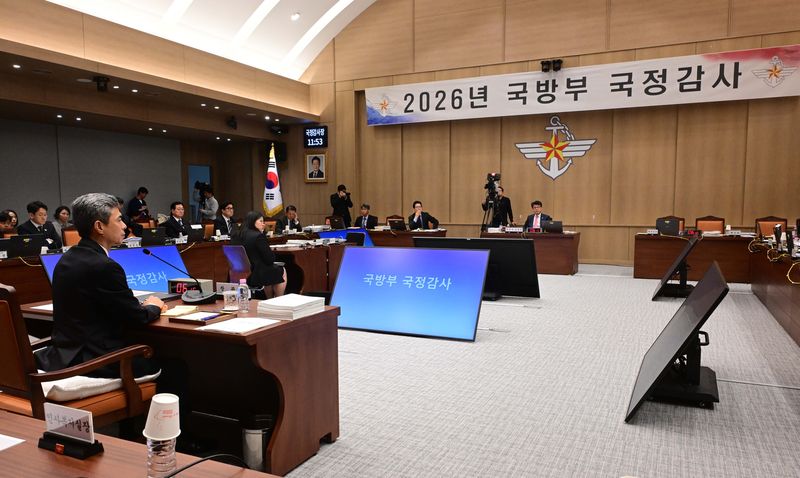
Kim Seong-min, deputy commander of the ROK-U.S. Combined Forces Command and a four-star Army general, appeared as a witness at the Ministry of National Defense audit held by the National Defense Committee of the National Assembly of the Republic of Korea on the 7th. Regarding the provisional force structure for the Future Combined Forces Command, which will lead ROK-U.S. combined operations after the OPCON transfer, he said, “It has been agreed upon with the U.S. side,” adding, “This provisional force structure will be finalized during the future evaluation of Full Mission Capability (FMC), the final stage.” The Ministry of National Defense is conducting the second stage of its FOC verification process, aiming to complete verification of the Future Combined Forces Command’s Full Operational Capability (FOC) at the ROK-U.S. Security Consultative Meeting (SCM) in November this year and recommend a year for the OPCON transfer to the presidents of both countries. If the second-stage verification is completed within the year, the process will move on to the final, third-stage FMC verification, which takes about a year.
In particular, when People Power Party lawmaker Han Ki-ho said there had been an implication that the Future Combined Forces Command would be disbanded after the OPCON transfer, Deputy Commander Kim firmly rejected this, saying, “That’s not the case.” He stressed, “The agreement between the ROK and the U.S. in place to date is that the Future Combined Forces Command will be organized and maintained even after the OPCON transfer.” Asked why the post of chief representative to the United Nations Command (UNC) Military Armistice Commission, held by the Combined Forces Command’s chief of staff, had been vacant for nine months, he replied, “I understand that an appointment will be made soon.”
In contrast to progress on the ROK-U.S. combined command structure, the project to establish an Armed Forces Academy—a key reform initiative in domestic talent development—came under scrutiny over hasty budget execution and procedural contradictions. When People Power Party lawmaker Lim Jong-deuk asked whether it was appropriate for the Ministry of National Defense to commission a preliminary study for the related construction project before a plan to integrate the Army, Navy and Air Force academies had been finalized, Defense Minister Kang Shin-chul said, “I was briefed on this too, and I thought it might not be appropriate to proceed when the plan hasn’t been finalized.” He acknowledged that there had been procedural shortcomings.
The Ministry of National Defense has reissued a notice on the Public Procurement Service’s KONEPS for a contract titled “Preliminary Study for the Armed Forces Academy Construction Project,” with an allocated budget of about 112.48 million won. Bids are due on the 13th. The study is intended to examine conditions for proceeding with construction of the Armed Forces Academy, the proposed site and a master plan for the facilities project, as well as the total project cost and financing options. Minister Kang clarified, however, that “the study is not intended to reach a conclusion right away based on any specific integration plan,” adding that the ministry had never used terms such as “merger, closure or abolition” in relation to the service academies. He continued, “Given that each service exists, its training institution can’t just disappear, can it?” suggesting that each service’s expertise and identity would be maintained.
[email protected] Lee Jong-yun Reporter