'Brazil’s Trump' rides his father’s name into presidential race: Who is Flávio Bolsonaro? [Hong Chae-wan’s Global Profile]
- Input
- 2026-10-10 05:00:00
- Updated
- 2026-10-10 05:00:00
From the State Legislature to the Senate... A Politician Who Rose Alongside His Father
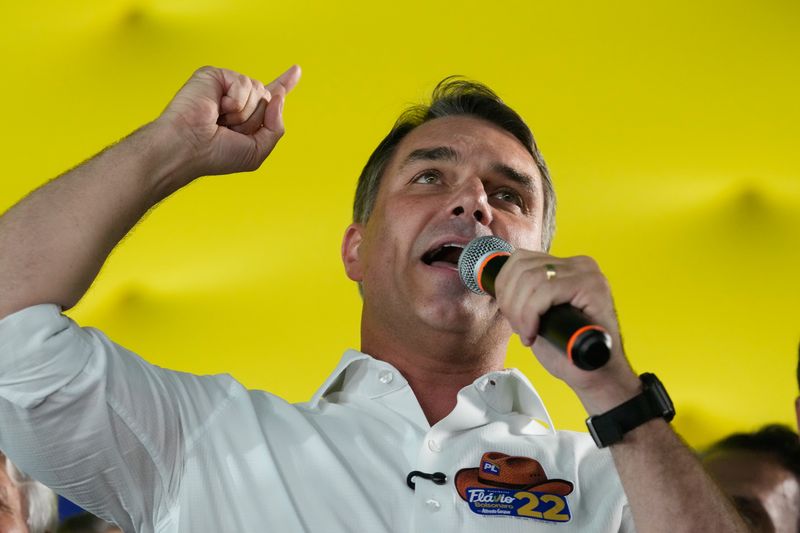
Born in 1981 in Resende, in Brazil’s state of Rio de Janeiro, Flávio studied law at Cândido Mendes University. Unlike his father, who had a military career, he studied law and embarked on a career in elected politics early on. After beginning his career as a Rio de Janeiro state legislator in 2003, he served four terms. In the state legislature, he was mainly involved in public safety, corrections administration and civil defense. In 2018, he was elected to the Federal Senate after receiving the most votes in Rio de Janeiro state, and began his term the following year. In effect, the son entered national politics the same year his father was elected president. After his father took office, Flávio expanded his role, becoming an informal adviser and a link between the government and Congress. His experience as a state legislator and senator, combined with his position as the president’s eldest son, also increased his political influence within the family. His father’s decision was also the decisive factor behind his presidential bid. Jair Bolsonaro was sentenced last year to 27 years and three months in prison on charges of plotting a coup to remain in power after losing the 2022 election. While imprisoned, he endorsed his eldest son’s presidential bid late that same year. Flávio took up his father’s support base, claiming that his father was being subjected to unjust political persecution. ‘A Vaccinated Bolsonaro’... A Successor Pushing a Moderate Image?
Flávio’s strategy is to carry on his father’s policies while presenting a different political image. He has emphasized market-friendly economic policies, including smaller government, tax cuts and privatization, while signaling that he would distance himself from the right’s cultural and ideological battles. In an interview last December, he identified reducing government spending and balancing the budget as priorities. He mentioned the possibility of privatizing the state-owned postal company and said the state oil company Petrobras could review its assets to improve operational efficiency. His plan is to continue his father’s government’s approach on economic issues. He pointed to COVID-19 vaccines as an example of how he differs. In the same interview, he said, ‘I’m a vaccinated Bolsonaro,’ explaining that he had received two doses of the AstraZeneca vaccine, while his father had chosen not to get vaccinated. The message is intended to retain conservative voters who support his father while reaching voters who are uneasy about his father’s controversies. He also promised to take a different approach to election results. In an interview last August, Flávio said he wanted to win under the current election rules and would respect the electoral process. This sets him apart from his father, who questioned the reliability of electronic voting and was convicted of plotting a coup after losing the presidential election. But presenting himself as moderate does not mean that all his political positions have changed. Brazil’s Folha de S.Paulo reported that a biography of his father, published by Flávio in 2017, contained arguments defending military dictatorship. Policies he supported at the time, including lowering the age of criminal responsibility, also feature in his current campaign platform. He has also recently stirred controversy with a pledge to ‘redemocratize’ Brazil. At a campaign rally on the 6th, Flávio said that, if elected, he would amend the Constitution and redemocratize Brazil. He did not, however, explain what constitutional changes he would pursue or what he meant by ‘redemocratization.’ The opposition objected to the pledge, given that Brazil is already a democracy. Marcelo Freixo of the Workers’ Party criticized the proposal, saying Brazil was redemocratized in 1988 and that the person who tried to reverse that was Flávio’s father, who was convicted of plotting a coup. Pardon Pledge and Salary Kickback Allegations... Political Liabilities Remain
His relationship with his father is Flávio’s greatest political asset and liability. He has said he would pardon his father if elected. He has also pledged to pursue pardons for those convicted among Bolsonaro supporters who stormed the presidential palace, Congress and the Supreme Court in Brasília in January 2023. The promise to respect election results sits alongside the contradictory pledge to pardon those involved in events that followed an election defeat. Flávio still faces the challenge of meeting his father’s supporters’ demands while persuading voters that he will honor his own commitment to democratic procedures. There are also allegations surrounding Flávio himself. When he was a Rio de Janeiro state legislator, he was investigated over claims that he received part of his aides’ salaries as kickbacks. Prosecutors also alleged that he registered ‘ghost employees’ who did not actually work and siphoned off their salaries. Flávio has denied the allegations. Legal disputes over the investigative process also continued in the case. In 2021, Brazil’s Superior Court invalidated some decisions and evidence from the investigation, and the Federal Supreme Court also ruled that four of the five financial information reports used as the basis for the charges were invalid. The allegations must therefore be viewed alongside the fact that the courts did not accept the legality of that evidence. In the first-round vote, Flávio showed that the Bolsonaro name still has considerable power to mobilize voters. But to win the presidency, he will need to secure broader support beyond his father’s base. Whether he can also be accepted as a leader capable of guiding Brazil will be decided on the 25th. [email protected] Hong Chae-wan Reporter