Why Are the Nobel Prizes Awarded in Two Different Places? [Park Jong-won’s Then and Here]
- Input
- 2026-10-10 06:00:00
- Updated
- 2026-10-10 06:00:00
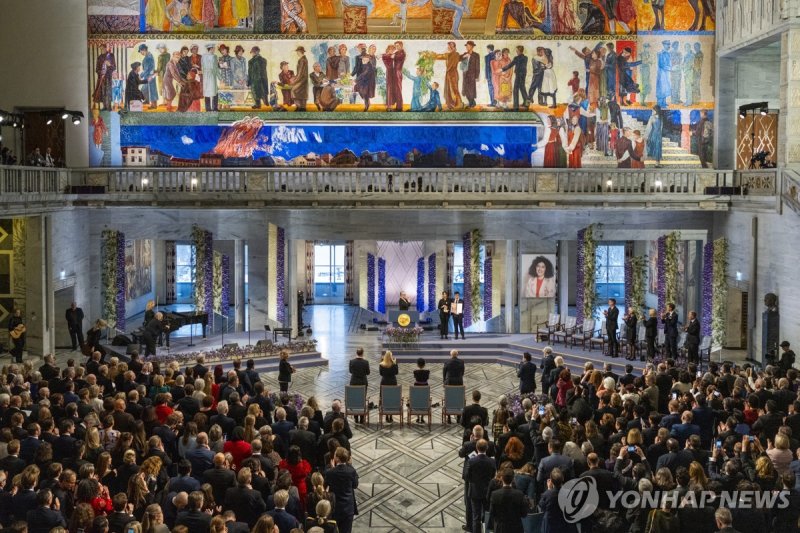
[Financial News] The Nobel Foundation, which selects Nobel Prize laureates, chooses them each October and holds the award ceremony on the anniversary of Alfred Nobel’s death (December 10). The Nobel Peace Prize is presented in Norway, while the laureates for the other prizes are announced and the awards presented separately in Sweden.
The reason is simple: Nobel himself decided it should be that way. But even 131 years later, we still do not know why he made that decision.
Nobel, an inventor born in Stockholm, Sweden, on October 21, 1833, died in San Remo, Italy, on December 10, 1896, from a cerebral hemorrhage and complications. He was 63. He changed the course of human history by inventing dynamite at age 33, and made astronomical sums by establishing dynamite-manufacturing companies in various countries, including Sweden, Germany and the United States. But he was disappointed that his invention, which he had expected to help people in mines, was being used in wars to kill people.
About a year before his death, on November 27, 1895, Nobel revised his will for the third and final time in Paris, France. He wrote that his entire estate should “be used to establish a fund, the interest on which shall be distributed annually as prizes to those who, during the preceding year, have conferred the greatest benefit on humankind.” He stated that “the interest shall be divided equally into five parts (the prize money for physics, chemistry, physiology or medicine, literature, and peace).” Nobel’s bequest amounted to 31 million kronor at the time, equivalent to about 240 billion won in today’s money. This year, the Nobel Prize award is 12 million kronor (about 1.69 billion won) in each category.
The Sveriges Riksbank Prize in Economic Sciences in Memory of Alfred Nobel was not established by Nobel; Sweden’s central bank added it in 1968 in his honor. Nobel’s descendants at the time asked that their ancestor’s name not be attached to the economics prize, but their request was not accepted. The Nobel Foundation, which oversees the Nobel Prize awards, was established in 1900, four years after Nobel’s death, and began awarding the prizes in 1901.
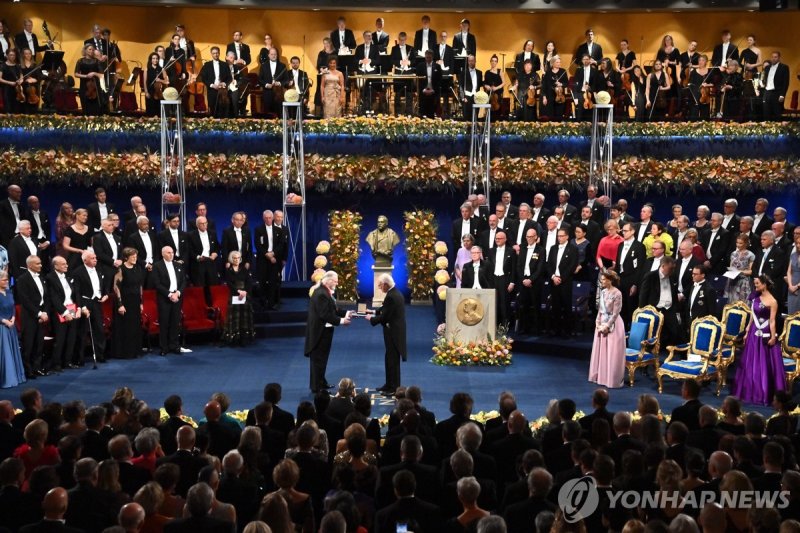
In his will, Nobel stated that “the prizes in physics and chemistry are awarded by the Royal Swedish Academy of Sciences, the prize in physiology or medicine by the Karolinska Institute in Sweden, and the literature prize is selected by the Swedish Academy in Stockholm.” He went on to write that “the peace prize shall be decided by a committee of five people selected by the Norwegian Parliament.” Accordingly, the Nobel Peace Prize ceremony is held each year on December 10 at City Hall in Oslo, the capital of Norway. The ceremonies for the other Nobel Prizes take place on the same day at the Stockholm Concert Hall.
Nobel never explained during his lifetime why he separated the Peace Prize ceremony from the others. Geir Lundestad, who served as executive director of the Nobel Foundation from 1990 to 2014, put forward three hypotheses about the background to Nobel’s decision in an article published in March 2001. First, Lundestad pointed to the political circumstances of the time. Norway had once been ruled by Denmark, but from 1814 it became part of Sweden under a “United Kingdom” arrangement and was, in effect, considered an autonomous territory. This relationship continued until Norway gained independence in 1905. Lundestad speculated that, taking political balance and harmony between the two countries into account, Nobel “had the most fiercely contested science prizes awarded by Swedish committees and at least the remaining Peace Prize awarded by a Norwegian committee.”
Lundestad also suggested that Nobel “may have taken into account that the Norwegian Parliament had brokered peaceful solutions to international conflicts in the 1890s.” Lundestad noted that, while recognizing the Norwegian Parliament’s peaceful role, Nobel “may have considered Norway—a country that had historically engaged in very few foreign invasions—more peaceful and democratic than Sweden.”
As a third reason, Lundestad argued that Nobel “may have admired the writer Bjørnstjerne Bjørnson, who was famous in Norway as a peace activist in the 1890s.” He added that “the three reasons mentioned above may have all played a role at the same time.”
[email protected] Park Jong-won Reporter