Controversy over 'The Assassins' surfaces at education ministry audit
- Input
- 2026-10-07 16:21:49
- Updated
- 2026-10-07 16:21:49
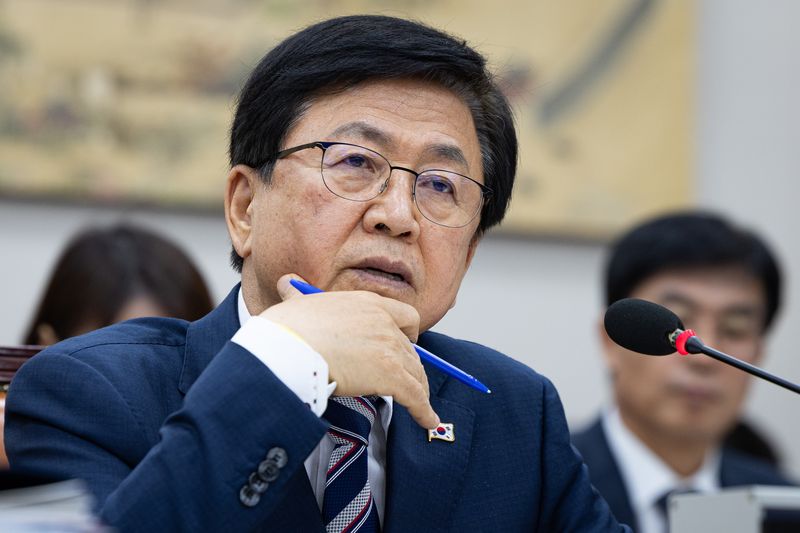
[Financial News] At a National Assembly Education Committee audit held on the 7th, the film 'The Assassins,' which deals with a conspiracy theory that the assassination of Madam Yuk Young-soo was staged, came under scrutiny, prompting fierce exchanges between ruling and opposition lawmakers over historical understanding. The opposition said the film could instill a distorted view of history in young people, while the ruling party countered by advocating the development of critical thinking and caution against pre-censorship of artistic works. Education Minister Choi Kyo-jin stressed the need to teach students to distinguish historical fact from fiction and to strengthen media literacy education.
■ Opposition: “Group screening of a film built on a false-flag conspiracy theory risks distorting young people’s view of history”
People Power Party lawmaker Jeong Seong-guk opened the debate by raising the recent case of a high school in Ulsan that planned a group screening of 'The Assassins' following a student vote, but canceled it after controversy arose. “The film is built on a third-rate conspiracy theory that leaves open the possibility that the Moon Se-gwang incident was staged by former President Park Chung-hee and the Korean Central Intelligence Agency,” Jeong said. “Even though it is an established fact that Moon Se-gwang himself confessed to being deceived by Chongryon, we must not use freedom of expression to excuse historical distortion,” he criticized. He went on to voice concern, citing a statement by the Korean Federation of Teachers’ Associations, that “many students are at serious risk of mistaking conspiracy-theory films like this and fake news for the truth,” and called on the Education Ministry to submit its record on media literacy education.
Fellow People Power Party lawmaker Park Jeong-hun also questioned the neutrality of education, pointing to past remarks and convictions expressed by Education Minister Choi Kyo-jin. Citing the controversy over supplementary teaching materials during Choi’s time as Sejong superintendent of education, his past reference to “Tang-tang Day,” and his response to past remarks by a Paichai High School student, Park stressed: “It is extremely dangerous to educate students with a biased view of history. We must strictly uphold the neutrality of education as stipulated by the Constitution and the law.”
■ Ruling party: “A chance to foster critical thinking... It must not lead to pre-censorship of artistic works”
Ruling party lawmakers countered, saying that diverse perspectives on history and critical thinking should be respected.
Democratic Party of Korea lawmaker Baek Seung-a cited past remarks by People Power Party leader Jang Dong-hyuk, stressing: “All perspectives on history and ways of recording it should be respected. History is something to be examined, not suppressed.” Baek said, “It would be desirable to educate students in a way that helps them develop the critical thinking skills to judge what is fact and what is fiction after watching this film, and makes it an opportunity for them to take an interest in that period.”
Democratic Party of Korea lawmaker Ko Min-jung also warned of a tendency among politicians to pre-censor artistic works. Citing the words of world-renowned director Jang In-mo, Ko said, “The film does not say that former President Park Chung-hee was an assassin; interpretation is up to the audience.” She added, “I’m afraid that students growing up today will see this situation and think that artistic works should be pre-censored,” stressing, “This controversy must not, in any way, turn into a wave of pre-censorship of art.”
■ Minister Choi Kyo-jin: “Need to distinguish history from fiction... Strengthening media literacy education”
In response to intense questioning from both parties, Education Minister Choi Kyo-jin emphasized the need to teach students to distinguish historical facts from fiction in works of art.
Regarding the controversy over 'The Assassins,' Minister Choi said, “When a work contains both historical facts and fiction, students may be confused, so they need to be taught how to understand it by distinguishing fact from fiction.” He added, however, “There are limits to how closely the Education Ministry can intervene in decisions about whether to watch a particular film.”
Minister Choi went on to say, regarding media literacy education, “I will report on the progress and results of media literacy education, which helps students critically understand and use digital media content, before the comprehensive audit.” In response to criticism over the neutrality of history education, he said, “We will take care to ensure that education helps students develop balanced thinking and a balanced view of history grounded in the Constitution.”
[email protected] Kim Man-gi Reporter