Clashes intensify between Houthi rebels and the Saudi-led coalition over positions around the Bab el-Mandeb Strait
- Input
- 2026-10-07 16:12:25
- Updated
- 2026-10-07 16:12:25
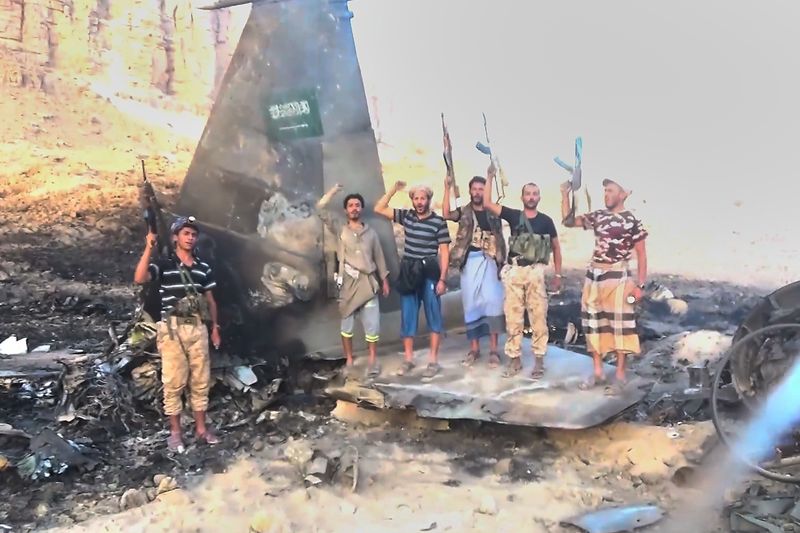
[Financial News] Clashes are intensifying as Yemen’s government forces, backed by Saudi Arabia, move to retake positions around the Bab el-Mandeb Strait seized by the Houthis in a surprise offensive.
Yahya Saree, a spokesman for Yemen’s Houthi rebels, claimed on the 7th (local time) that they had launched a drone attack on King Khalid International Airport in the Saudi capital, Riyadh, and missile and drone attacks on Abha Airport and King Khalid Air Base in Khamis Mushait, saying they had “hit the targets with precision.” This is the second time this week the Houthis have claimed to have attacked King Khalid International Airport.
The Houthi-controlled Saba news agency reported that missiles and drones had also targeted Aden International Airport in Yemen.
According to Swedish flight-tracking site Flightradar24, the airspace around King Khalid International Airport is being temporarily closed from time to time.
The Saudi-led coalition said it had intercepted a ballistic missile fired by the Houthi rebels toward Saudi Arabia that day.
AFP reported that Turki al-Maliki, spokesman for the Saudi-led coalition, said that day on X (formerly Twitter), “We intercepted and destroyed one ballistic missile fired by the terrorist Houthi militia from north of Riyadh.”
Saudi authorities have not publicly confirmed the closures or strikes on facilities. However, the Saudi Civil Aviation Authority said the previous day that Jazan and Najran airports in southern Saudi Arabia, near the border with Yemen, had been attacked, leaving at least three people injured.
Ground fighting also rages around the Bab el-Mandeb Strait on the Red Sea and in the port city of Mokha
Ground fighting is also fierce. Sources on both sides told AFP that at least 270 government troops and Houthi fighters were killed in a single day on the 6th. The Houthi health ministry said Saudi airstrikes had killed six members of one family, including four children, in a village in Hajjah province.
Yemen’s government forces claimed on the 5th to have driven the Houthis out of areas around the Bab el-Mandeb Strait on the Red Sea and the port city of Mokha, and to have “won on several fronts.” However, military sources on the government side stopped short of confirming that Mokha had been retaken, saying only that they had cut off supply routes.
Houthi spokesman Saree countered, saying, “We have complete control over all occupied territory,” and that the group had not given up any of the territory it captured last month.
As the Houthis target airports and oil refineries in several cities, including the Saudi capital Riyadh, airstrikes have apparently caused damage as far as areas near places where South Korean companies operate.
Iran’s Press TV reported that Houthi spokesman Brig. Gen. Yahya Saree said in a statement on the 5th that the rebels had used numerous ballistic and cruise missiles, as well as drones, to attack Saudi airports and oil refineries. He said they had directly struck King Khalid International Airport in Riyadh, disrupting air traffic, and had then attacked Aramco’s refinery facilities in the Red Sea coastal city of Rabigh, where a fire broke out.
Houthi rebels focus attacks on Saudi airports and air bases
The Houthi rebels also said they had attacked Abha Airport in southwestern Saudi Arabia, the nearby air base in Khamis Mushait, and military facilities in the regions of Asir, Najran and Jazan.
Spokesman Saree claimed that the rebels had also attacked another Saudi airport on the 6th.
Rabigh, one of the areas targeted in the latest Houthi strikes, has close ties to South Korean companies. GS Engineering & Construction won a contract in the 2010s and built the Petro Rabigh petrochemical complex, which is operated by Saudi national oil company Aramco, while Korea Electric Power Corp. won a contract in 2009 for a 1,200-megawatt heavy fuel oil-fired power project and operates it. South Korean companies have established a presence in the area in succession.
Hyundai Motor is currently building a factory at King Salman Automotive Industrial City, about 40 kilometers south of Rabigh, and construction workers reportedly commute from accommodations in Rabigh.
[email protected] Seok-woo Lee, international affairs correspondent Reporter