Kim Yong-beom not named as witness for parliamentary audit... Will blame for the “leveraged ETF debacle” ultimately land on Lee Eok-won?
- Input
- 2026-10-07 16:40:25
- Updated
- 2026-10-07 16:40:25
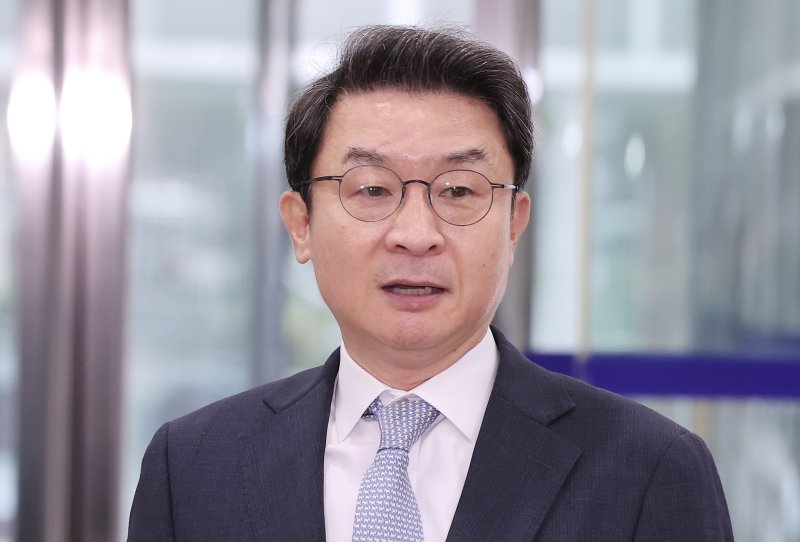
The final responsibility within the government for introducing single-stock leveraged exchange-traded funds (ETFs) tied to Samsung Electronics and SK hynix—whose introduction caused the sharp KOSPI decline last July and massive losses for individual investors—appears to be landing on Financial Services Commission Chairman Lee Eok-won. After Kwon Dae-young, First Vice Minister of Economy and Finance, said on the 6th that “the FSC made the final decision on introducing single-stock leveraged ETFs,” attention is now focused on Lee’s response at the National Assembly’s audit of the National Policy Committee on the 8th.
Political circles and financial authorities said on the 7th that questions at the National Assembly’s audit of the Financial Services Commission by the National Policy Committee are expected to focus on whether the presidential office intervened in the decision to introduce single-stock leveraged ETFs, the hacking incident in the financial sector, and the reasons behind the Korea Development Bank and Industrial Bank of Korea’s investments in the film “Assassin(s).” Kwon Dae-young, who previously served as vice chairman of the Financial Services Commission (a post at vice-ministerial level) and is now First Vice Minister of Economy and Finance, said during the Strategy and Finance Committee’s audit on the 6th, in response to a question from People Power Party lawmaker Park Soo-young, that “the FSC made the final decision [on introducing single-stock leveraged ETFs].” Lee is also expected to raise the issue of the FSC’s responsibility along the same lines at the National Policy Committee’s audit. Kim Yong-beom, the former presidential policy chief identified as a key figure in the introduction of single-stock leveraged ETFs, has not been selected to testify. If Lee takes responsibility as the final decision-maker, the issue could also affect his future in office.
The opposition is expected to question Park Sang-jin, chairman of the Korea Development Bank, and Jang Min-young, president of the Industrial Bank of Korea (IBK), closely about the investment decision-making process for the recently controversial film “Assassin(s).” IBK directly invested 2 billion won in the film, while the Korea Development Bank invested 400 million won through an investment fund. The opposition is alleging that the investment was a “favor in return,” citing Park’s status as a fellow Chung-Ang University Law School alumnus of President Lee Jae-myung. Both banks, however, maintain that “there was no outside pressure during the investment process.” A Korea Development Bank official said, “The investor in the film ‘Assassin(s)’ was the fund, not KDB; the fund manager made the investment decision independently,” adding, “Investment decisions and post-investment management are the manager’s exclusive responsibilities, and KDB cannot get involved.”
The five major bank chiefs may also be called as witnesses at the parliamentary audit in connection with recent data leaks caused by hacking: Lee Hwan-ju of KB Kookmin Bank, Jeong Sang-hyeok of Shinhan Bank, Lee Ho-sung of Hana Bank, Jeong Jin-wan of Woori Bank and Kang Tae-young of NH NongHyup Bank. The ruling and opposition parties are discussing summoning the five chiefs to the National Policy Committee’s audit of the Financial Supervisory Service on the 19th. Since the aim is to review security management across the financial sector and measures to prevent a recurrence, the chiefs are widely expected to appear together as witnesses regardless of whether any harm was caused. If all five are named as witnesses, it would be the first time in four years, since 2022. At the time, the committee summoned bank chiefs to hold them accountable for a series of financial incidents, including large-scale embezzlement and abnormal foreign-exchange remittances, and to review measures to improve internal controls.
[email protected] Jo Eun-hyo Reporter