KOSPI closes down 1.98% at 6,803.90; KOSDAQ slips below 900 [fn Market Close]
- Input
- 2026-10-07 15:57:15
- Updated
- 2026-10-07 15:57:15
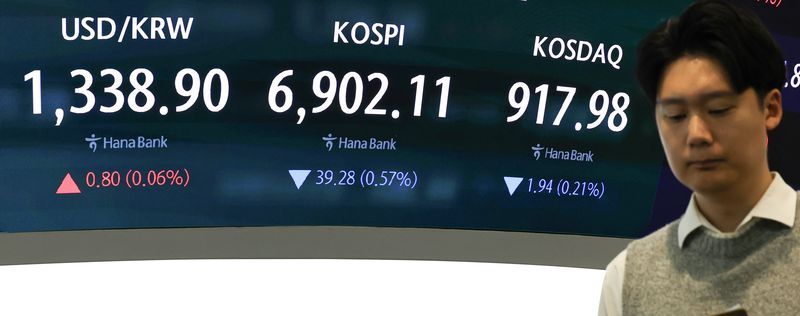
[Financial News] KOSPI closed in the low 6,800s, pressured by foreign investors’ selling in the 3-trillion-won range. KOSDAQ also fell by around 2.3%, slipping below the 900 mark.
According to the Korea Exchange, KOSPI closed at 6,803.90 on the 7th, down 137.49 points (1.98%) from the previous day. The index opened at 6,864.25, down 1.11% from the previous close, then extended its losses during the session and finished at its low.
On the KOSPI market, retail investors were net buyers of 3.31 trillion won, while foreign investors and institutions were net sellers of 3.1019 trillion won and 914.7 billion won, respectively.
By sector, medical and precision instruments (5.86%), entertainment and culture (3.95%), and textiles and apparel (1.51%) were among the gainers, while metals (-4.14%), transportation equipment and parts (-3.54%), and machinery and equipment (-2.50%) were among the decliners.
Among the top stocks by market capitalization, KB Financial Group (1.02%), SK Innovation (0.82%), and Celltrion (0.44%) rose, while HD Hyundai Heavy Industries (-4.88%), Hanwha Aerospace (-4.40%), and Samsung Electro-Mechanics (-4.00%) fell.
Large-cap semiconductor stocks also fell. Samsung Electronics ended trading at 269,500 won, down 2,500 won (0.92%) from the previous day, while SK hynix closed at 1,724,000 won, down 49,000 won (2.76%).
KOSDAQ closed at 898.43, down 21.49 points (2.34%) from the previous day. Retail investors were net buyers of 580.1 billion won, while foreign investors and institutions were net sellers of 328.3 billion won and 227.2 billion won, respectively.
Lim Jeong-eun, a researcher at KB Securities, said, “Semiconductor stocks weakened amid concerns about Samsung Electronics’ earnings,” adding, “With the September Federal Open Market Committee (FOMC) minutes due to be released in the early hours of the 8th, and Samsung Electronics’ preliminary earnings announcement and options expiration scheduled domestically, a wait-and-see mood and increased volatility are possible.”
[email protected] Bae Han-geul Reporter