[Exclusive] Subway bars e-scooters from being brought in, but 6 in 10 cases are caught 'on trains'
- Input
- 2026-10-07 15:39:10
- Updated
- 2026-10-07 15:39:10
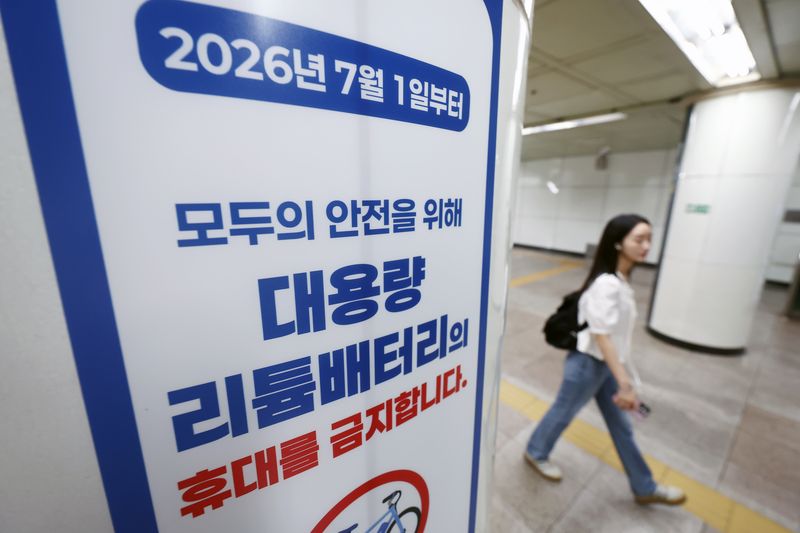
[Financial News] The Seoul subway banned large-capacity lithium batteries and e-scooters and other devices that use them starting in July to prevent the risk of fires in the subway system. However, six out of every 10 cases in which action was taken on site were discovered only after the riders had already boarded a train, according to a report. Given how difficult it is to inspect every passenger's belongings on the subway, calls are growing for additional measures, such as intelligent closed-circuit television (CCTV) and fines.
32 of 33 cases discovered after passing fare gates... 20 made it onto trains
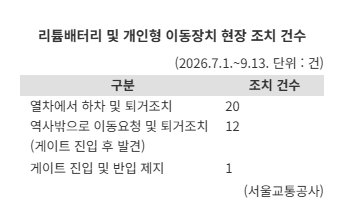
According to data obtained by Financial News from Seoul Metro, a total of 33 cases involving lithium batteries and personal mobility devices (PMs) were handled on site between July 1 and September 13.
Of these, 20 were discovered after the riders had already boarded trains, and they were made to get off and leave. Another 12 were found after they had passed through fare gates and entered stations, and they were directed to leave the stations. Just one case was stopped in advance at the fare-gate entry stage.
That means 32 cases, or 97% of all on-site interventions, occurred after passengers had passed through fare gates. In particular, six out of every 10 cases were detected only after prohibited items had actually been brought onto trains.
Citing the risk of lithium battery fires, Seoul Metro revised its passenger transport terms and conditions effective July 1, banning devices powered by lithium batteries exceeding 160 watt-hours (Wh)—including personal mobility devices (PMs) such as electric kick scooters, e-bikes and electric unicycles—from being brought into stations or onto trains.
Cases of prohibited items being brought in have continued even since the rules took effect, as have related reports and complaints. From July through September 13, Seoul Metro received a total of 39 related reports, complaints and tips: 23 in July, 12 in August and four in September. Of these, 32 complaints were filed with the customer center: 15 by phone and 17 by text message.
Lee Jun-seong, 28, an office worker who commutes on Line 1, said, “Compared with before, I haven’t seen e-scooters and the like on the subway as often lately.” He added, “But given the risk of lithium battery fires, it’s true that I’m concerned simply about them being brought onto trains.”
Difficult to inspect passengers’ belongings... “CCTV and fines needed”
Unlike on aircraft, it is difficult to inspect every passenger’s belongings on the subway, which is seen as a limitation on preventing prohibited items from being brought in beforehand. Critics also point out that even if passengers pass through fare gates or board trains with PMs, it is difficult to stop them in advance unless staff spot the devices or another passenger reports them.
Questions have previously been raised about the effectiveness of public awareness efforts and on-site enforcement. On the very first day the rules took effect, for example, some people were found trying to use the subway with PMs without knowing they were prohibited.
Experts advised establishing a system to detect prohibited items in advance using intelligent CCTV and other measures, focusing on transfer stations and stations with high passenger volumes, since it would be difficult to deploy additional staff at every station.
Gong Ha-seong, a professor in the Department of Fire and Disaster Prevention at Woosuk University, said, “It is practically difficult to assign separate staff to every station because of the labor costs.” He added, “Intelligent CCTV could help detect and manage prohibited personal mobility devices more efficiently.”
There are also calls for effective penalties that go beyond simply making riders leave. Lee Yong-jae, a professor in the Department of Fire Safety Management at Kyungmin University, said, “Because subway services run for long hours each day, station staff have limited capacity to check every case of prohibited items being brought in.” He added, “It would be preferable to encourage passengers to comply with the rules voluntarily through appropriate fines and public awareness efforts.”
[email protected] Lee Dong-hyeok Reporter