Choi Jae-min takes office as head of Seoul Serious Crime Investigation Agency, pledging “top-tier investigative expertise” despite staffing of just 68.9%
- Input
- 2026-10-07 15:17:02
- Updated
- 2026-10-07 15:17:02
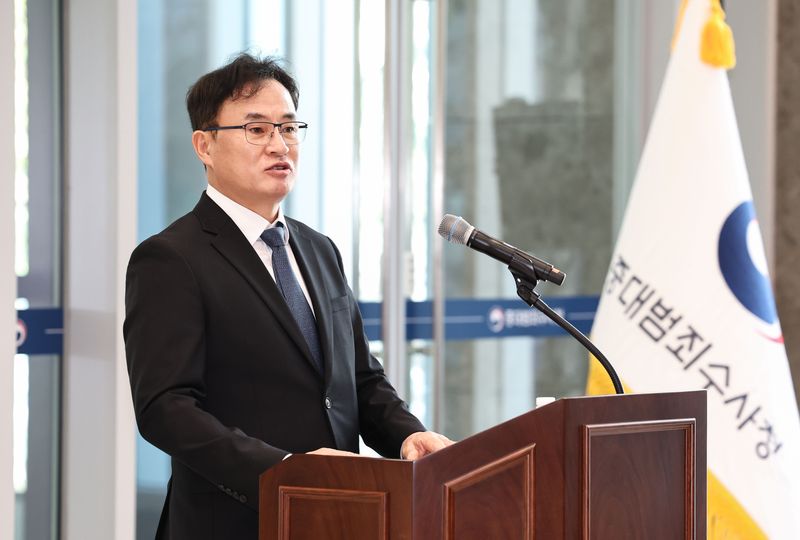
[Financial News] Choi Jae-min officially took office on the 7th as the inaugural head of the Seoul Metropolitan Serious Crime Investigation Agency, with the task of bringing investigative staffing up to its authorized level and establishing a specialized investigative system. The Seoul agency was designed to have a large investigative workforce of more than 200 in finance and cybercrime alone, prompting attention to whether, once the organization is fully operational, it will be able to take on complex financial crimes directly, such as recent bank-sector hacks and customer data leaks.
At his inauguration ceremony that day at the Seoul agency’s headquarters in Jung District, Seoul, Chief Choi urged staff to “develop the nation’s best professional investigative capabilities, worthy of the name Serious Crime Investigation Agency.” He said, “In-depth expertise is needed to understand complex financial transactions and the structure of capital markets, find evidence in vast amounts of data, and uncover the truth behind crimes,” and stressed the need to strengthen both the ability to use advanced investigative tools such as AI and training for specialists.
However, investigative conditions at the Seoul agency remain incomplete in its early days. The agency has an authorized strength of 1,089, but currently has 750 staff, leaving it at just 68.9% of capacity. It still needs to fill 339 positions. Chief Choi also said, “I’m well aware that there are difficulties because not all the necessary conditions are in place yet,” adding, “Let’s fill in one another’s gaps and build an investigative system that meets the public’s expectations.”
The organizational design gives considerable weight to the financial and advanced-investigation fields. The Seoul agency has separate Financial Crime Investigation and Advanced Investigation bureaus. The four divisions under the Financial Crime Investigation Bureau have 150 authorized positions, including the bureau chief, while the three divisions under the Advanced Investigation Bureau have 117. The two bureaus, which handle joint investigations of financial and virtual-asset crimes and cyber and industrial technology crimes, respectively, have a combined authorized strength of 267. That is a marked difference from the roughly 45 staff at the Seoul Southern District Prosecutors’ Office who previously handled financial crimes and related cases.
A recent large-scale hack targeting the financial sector is seen as the first case that could show how this organizational structure works in practice. The National Police Agency formed a dedicated investigative team of 28 on suspicion of violations of the Act on Promotion of Information and Communications Network Utilization and Information Protection. Depending on whether the affected computer network is deemed critical national infrastructure, however, the case could also fall under the Seoul agency’s remit for cybercrimes such as hacking. The possibility of notifying the agency and transferring the case to it is therefore also open. An agency official said, “We are preparing for the possibility of receiving a notification from the National Police Agency.”
Once specialist staff in finance, cybercrime and digital forensics are recruited, the agency is expected to have greater capacity than it does now to identify and investigate major new cases on its own initiative. An agency official said, however, that “the shortage is not confined to any particular bureau or division.”
Legal circles believe that jurisdictional overlaps between the National Police Agency and the Seoul agency over financial and cyber cases could become more frequent as the latter’s organization becomes fully operational. Disputes could arise over the jurisdictional basis for cases meeting the criteria for investigation by the agency, such as “attacks on national critical infrastructure” and “cybercrimes.” Establishing practical standards for dividing cases or transferring them based on the specific charges applied, the scale of harm and the direct links between offenses is also seen as a task.
Meanwhile, the previous day the Seoul agency assigned to Division 1 of its Anti-Corruption Investigation Bureau a complaint filed by a civic group against Oh Yu-kyung, Minister of Food and Drug Safety, and began a full-scale review of the case. Since its launch on the 2nd, the agency has been receiving complaints and accusations. Although its staffing and investigative system are not yet fully in place, it is understood to be getting its investigative work underway by assigning cases as they are received.
[email protected] Choi Eun-sol Reporter