As anxiety over jeonse and monthly rents grows... “Ease land transaction permit rules and expand private and public rentals”
- Input
- 2026-10-07 17:59:20
- Updated
- 2026-10-07 17:59:20
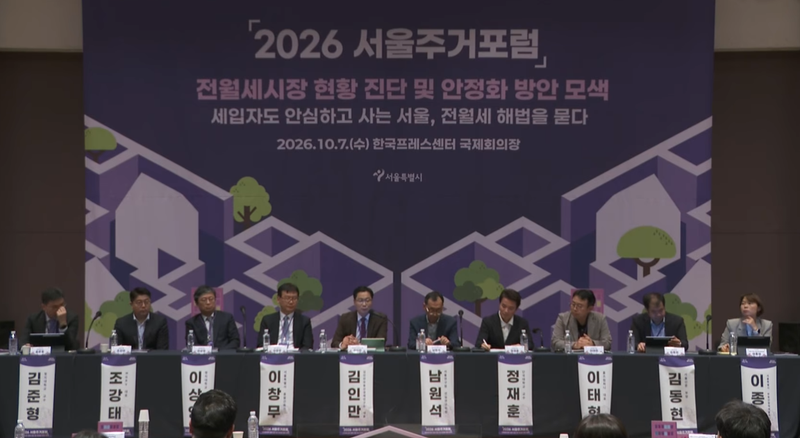
[Financial News] Recommendations were made to ease the land transaction permit system and tax restrictions on owners of multiple homes and non-owner-occupying single-home owners, while also expanding the supply of private and public rental housing to ease instability in Seoul’s jeonse and monthly-rental market.
Lee Chang-moo, Seoul Metropolitan Government’s chief architect, called for an exit strategy through the removal of regulatory measures in the home sales market, along with easing the land transaction permit system and adjusting the tax burden on owners of multiple homes, at the 2026 Seoul Housing Forum held at the Korea Press Center in Seoul on the 7th.
The forum was held under the theme “Assessing the Current State of the Jeonse and Monthly-Rental Market and Exploring Stabilization Measures.” Discussions covered the impact of recent changes in the home sales market on the jeonse and monthly-rental market, the system for supplying private rental housing, and the role of long-term jeonse housing.
Lee delivered a keynote presentation on “Tighter Regulation of the Home Sales Market and Instability in the Jeonse and Monthly-Rental Market.”
According to Lee, around the launch of the Lee Jae-myung administration, the focus of Seoul’s rising home prices shifted from the Gangnam area to the Han River Belt and the northeastern region. Apartment sale prices in the southeast, which had risen 14.38% in the 16 months before the administration took office, increased by just 11.57% afterward. By contrast, the increase accelerated in Han River Belt Zone 2, from 10.74% to 19.99%, and in Northeast Zone 2, from 3.45% to 15.60%.
A similar trend emerged in the rental market. In Han River Belt Zone 2, jeonse prices rose 4.08% in the 16 months before the administration took office and 10.72% afterward, while monthly rents increased from 4.47% to 15.10%. In Northeast Zone 2, jeonse price growth jumped from 4.71% to 18.10%, and monthly rent growth from 4.13% to 24.54%, with increases accelerating even more sharply.
Lee said that although home sale price growth in the Gangnam area had relatively slowed, the resulting balloon effect had triggered sharp rises in apartment prices in the Han River Belt and steep increases in jeonse and monthly rents in mid- to lower-priced and outlying areas.
He said the two-year owner-occupancy requirement resulting from designation of land transaction permit zones, along with tax restrictions on owners of multiple homes and non-owner-occupying single-home owners, had contributed to a decline in properties available for jeonse and monthly rent. He therefore recommended easing the land transaction permit system, adjusting comprehensive real estate tax rates for owners of multiple homes, and easing surcharges on capital gains and acquisition taxes.
He said, “The endpoint for stabilizing the jeonse and monthly-rental market is to remove the restrictions on non-owner-occupying single-home owners, the bombs dropped on owners of multiple homes or registered rental business operators, and the rules related to land transaction permit zones.”
There were also calls to improve the structure for supplying rental housing on both the private and public sides to ease instability in the jeonse and monthly-rental market.
Lee Sang-young, a professor at Myongji University, said corporate-style private rentals need to be expanded and the related system overhauled. “The current Special Act on Private Rental Housing classifies rental business operators only as individuals or corporations, so it has no separate provisions for corporate-style rentals,” Lee said. “We should define corporate rental business operators separately and ease the relevant regulations to establish an institutional basis for companies to supply and operate rental housing as a business over the long term.”
There were also calls for public rental housing, alongside the expansion of private rentals, to serve not only as a housing safety net but also as a stepping stone to building assets. Kim Jun-hyung, a professor at Myongji University, noted, “Jeonse accounted for 70.4% of rental transactions in 2011, but now makes up only 32.1%. Citizens want and seek jeonse, yet in the market it has become increasingly scarce while monthly rent has become the norm.”
Kim added, “Long-term jeonse housing is a type of rental housing that can serve both as a housing safety net and as a housing ladder. Rather than simply remaining part of the rental market, it should also be combined with various asset-support programs so people can build assets.”
[email protected] Choi A-young Reporter