Germany's far right rises again ... First far-right speaker of a state parliament since World War II
- Input
- 2026-10-07 14:40:11
- Updated
- 2026-10-07 14:40:11
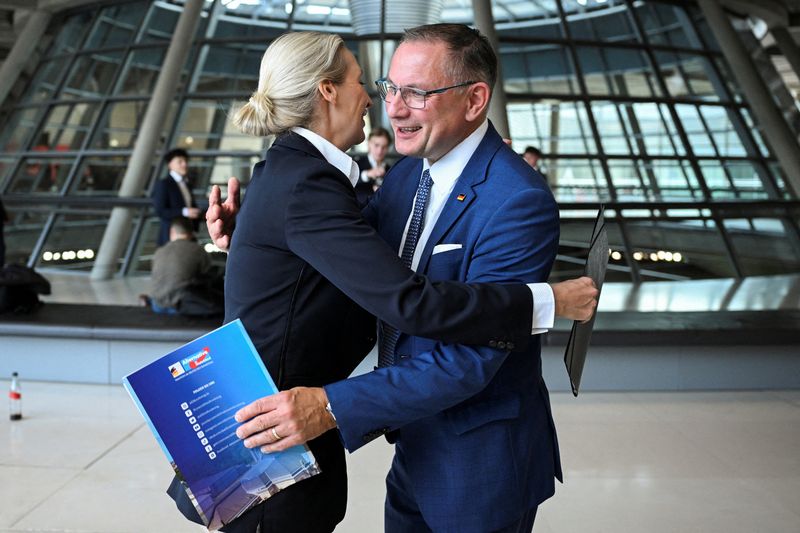
[Financial News] The far right is making a comeback in German politics. For the first time since World War II, a state parliament speaker from a far-right party has been elected.
According to German news agency dpa and other outlets, Tobias Rausch of the far-right AfD was elected speaker of the Saxony-Anhalt state parliament on the 6th (local time), winning 48 of 82 votes.
The result came as AfD continued to notch up victories in state parliament elections and threaten the ruling center-right Christian Democratic Union (CDU). Five lawmakers from the left-wing populist party Alliance for Social Justice and Economic Rationality (BSW, formerly the Sahra Wagenknecht Alliance) also cast their votes in the election.
The AfD had 39 seats and could not secure the speakership on its own, but BSW's five votes enabled it to win a majority.
This showed that, despite mainstream German parties having established the so-called 'firewall' principle of not cooperating with the AfD, the party can still secure coalition partners. The outcome is being viewed as a potential major turning point in postwar German political history.
In his acceptance speech, Rausch said, "I will take differing opinions seriously and make decisions transparently."
A former real estate agent, he is also a close associate of Ulrich Siegmund, the AfD's candidate for state premier in Saxony-Anhalt.
For Siegmund to become state premier, he will once again have to cross the firewall and join forces with another party.
However, BSW, which supported Rausch in this election, says it could accept the formation of an AfD-led government only if a nonpartisan figure leads the state government.
Although the AfD won last month's state parliament election, it failed to secure a majority, leaving it needing to form a coalition or a minority government by December.
[email protected] Lee Seok-woo, International Affairs Specialist Reporter