Opposition bloc: “Lee, don’t dig in on real estate policy” ... Ruling party also calls for a “shift in policy direction”
- Input
- 2026-10-07 15:37:24
- Updated
- 2026-10-07 15:37:24
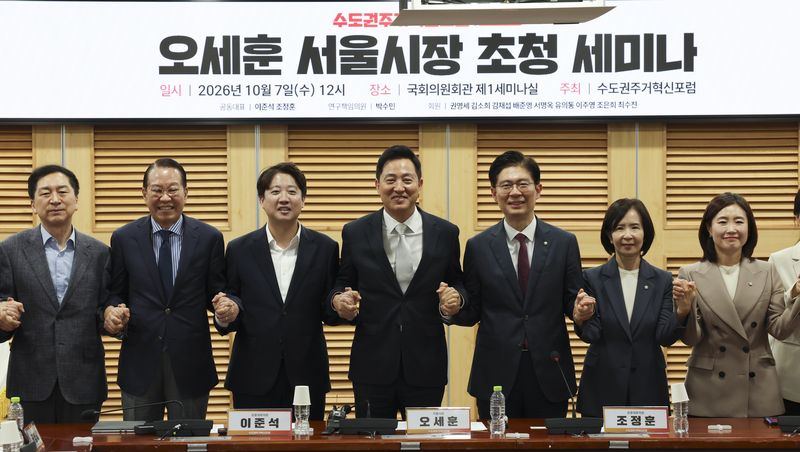
[Financial News] Concerns are mounting across political circles over the Lee Jae-myung government’s real estate policies. The People Power Party joined forces with the Reform Party and Seoul Mayor Oh Se-hoon to call for stronger, private-sector-led housing supply. The Democratic Party of Korea also likened the “triple strength” across home sales, jeonse and monthly rents to a disaster and called for a change in policy direction. The key question is whether political circles can put partisan wrangling aside and work together across party lines to stabilize the real estate market.
Oh Se-hoon: “Lee administration must make a major shift in real estate policy ... Policies must be tailored to genuine home seekers”
The Capital Region Housing Innovation Forum, a gathering of lawmakers from the People Power Party and the Reform Party, held an emergency debate on the 7th and invited Seoul Mayor Oh Se-hoon as a speaker. The forum serves as a broad conservative real estate alliance, co-chaired by People Power Party lawmaker Cho Jung-hun and Reform Party lawmaker Lee Jun-seok. Around 10 lawmakers from the capital region attended the debate, even though it was the second day of the parliamentary audit.Oh called on the Lee Jae-myung government to make a major shift in housing policy. With Seoul apartment prices rising for 86 consecutive weeks and jeonse and monthly rent prices also entering a period of steep increases, his point was that the current real estate policies cannot solve the problem. “To solve the real estate problem, we need the courage to change policy, not force and stubbornness,” he said, urging the government to “shift away from a policy approach centered on regulation and pledge housing supply that can actually be built.” On supplying homes on part of the Yongsan Park site, he again dismissed the idea, saying, “That is a space where the resolve not to touch even a single centimeter has been explicitly enshrined in law,” and that it was “not up for discussion at all.”
He also stressed that the Seoul Metropolitan Government was working hard to increase housing supply. Among the achievements he cited were designating 35 new redevelopment zones over the past five years under Oh’s administration and reducing the time needed to designate such zones from more than five years to around two. He added that housing starts had increased 44.4% from the previous year. He said tax and financial policies tailored to genuine home seekers without homes were also needed to expand housing opportunities for young people and newlyweds and to supply homes quickly.
Democratic Party also calls for a shift in real estate policy direction
Meanwhile, voices are emerging within the Democratic Party of Korea expressing concern about rising home prices and saying the government’s policies need to be revised. With the prevailing analysis that real estate policy was a major reason for the party’s weaker-than-expected results—including its failure to regain the Seoul mayoralty in the June 3 local elections—the party is seeking to boost housing supply while also coordinating with the opposition.At a parliamentary audit held that day by the Land, Infrastructure and Transport Committee, Democratic Party lawmaker Bu Seung-chan voiced concern over the government’s policy of purchasing non-apartment homes to rent out. “Actual apartment preference among young people and newlyweds reaches 80%,” he said, adding that “only 4.5% of young households currently live in non-apartment homes they own.” His remarks were understood as a call to review housing supply measures in line with young people’s preferences.
With the steep drop in the Democratic Party’s approval rating in Seoul raising alarm, the party is continuing efforts to win back public support on real estate issues. The dispute over supplying homes on the Yongsan Park site, which had pitted the Ministry of Land, Infrastructure and Transport against the Seoul Metropolitan Government, has now slowed. The passage of an amendment to the Urban Renewal Act, which had been expected to be put before a plenary session as early as the 1st, was also delayed due to opposition from the People Power Party. The party is also reportedly discussing with the Seoul Metropolitan Government the transfer to local government heads of permitting authority for redevelopment and reconstruction projects of 500 households or fewer in Seoul.
Democratic Party leader Kim Min-seok also expressed disagreement with the government over amendments to real estate tax laws. Kim’s position was that owners of a single home should not be treated differently depending on whether they live in it, but the government submitted a tax reform proposal to the National Assembly that distinguishes between the two. The possibility that the proposal could be revised under the Democratic Party leadership’s direction as it is discussed at the Tax Subcommittee of the Finance and Economy Planning Committee in November cannot be ruled out.
[email protected] Lee Hae-ram Reporter