Ruling party seeks to narrow CIO’s investigative remit... “President, lawmakers to be handled by Serious Crimes Investigation Agency”
- Input
- 2026-10-07 14:10:18
- Updated
- 2026-10-07 14:10:18
[Financial News] The Democratic Party of Korea (DPK) is pursuing a plan to narrow the Corruption Investigation Office for High-ranking Officials’ (CIO) investigative remit, focusing it on people working in judicial and investigative agencies, such as judges, prosecutors, police officers and investigators at the Serious Crimes Investigation Agency. The plan is to assign investigations into crimes involving other high-ranking public officials, including the president and lawmakers, to the Serious Crimes Investigation Agency, comprehensively reorganizing the system for investigating power-related crimes after the Prosecutors’ Office is abolished.
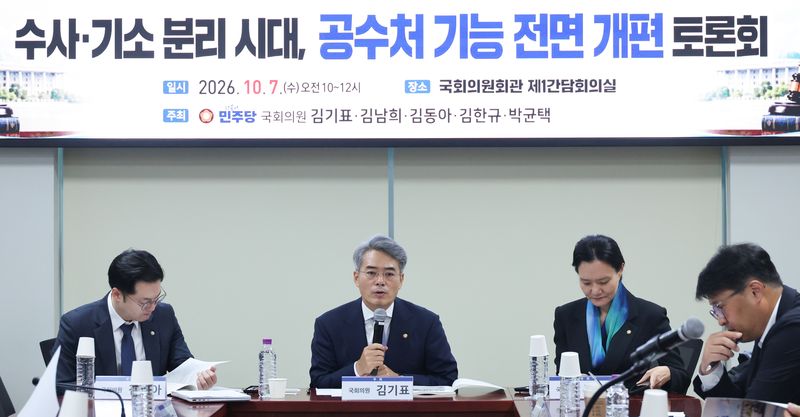
Democratic Party of Korea lawmakers Kim Ki-pyo, Kim Nam-hee, Kim Dong-a, Kim Han-kyu and Park Kyun-taek held a forum at the National Assembly on the 7th titled “A Comprehensive Overhaul of the CIO’s Functions in the Era of Separating Investigation and Prosecution,” where they discussed the plan.
“The CIO has too many people subject to investigation, and its remit is too broad,” lawmaker Kim Ki-pyo said. “With the Serious Crimes Investigation Agency set to launch as a powerful agency to combat corruption, leaving the CIO as it is—or expanding it—even though its investigative targets largely overlap with the agency’s, is not the answer either.” He added, “I think it would be more efficient to have the Serious Crimes Investigation Agency conduct investigations and the CIO monitor any errors it makes.”
The proposal is to divide the roles so that the CIO continuously monitors and investigates crimes by judges, prosecutors, police officers and Serious Crimes Investigation Agency investigators, while the Serious Crimes Investigation Agency handles investigations into high-ranking public officials such as the president and lawmakers. They are also considering broadening the range of offenses the CIO can investigate in cases involving people under its remit, in order to reduce instances in which an investigation is halted depending on the type of crime.
Kim also expressed his intention to pursue amendments to the law. “The urgent task now is to reduce the number of people subject to investigation and allow investigations into those people to proceed without restriction,” he said. “I believe this should be pursued very forcefully, and if there are no problems, I’m considering drafting a bill after the parliamentary audit concludes.”
Lawmaker Kim Dong-a also said, “The CIO is in an extremely incompetent state,” adding, “I agree with the approach of limiting the people subject to investigation while expanding the range of crimes investigated in relation to them.” He continued, “For prosecutorial reform to take root properly, the CIO must also be reformed promptly and in step with it; only then will a proper judicial system take root.”
The CIO, however, maintains that narrowing its investigative remit could weaken its role in checking independent power agencies. In the legislative process ahead, a key issue is expected to be how to allocate investigative targets between the Serious Crimes Investigation Agency and the CIO, as well as how to design checks and balances between investigative agencies.
[email protected] Kim Gyeong-min Reporter