Save home shopping, and cable can survive too...Expand the playing field through M&A beyond the carriage-fee battle
- Input
- 2026-10-07 16:46:15
- Updated
- 2026-10-07 16:46:15

[Financial News] As the downturn in the TV home-shopping industry drags on, concerns are deepening in the cable TV sector, which relies on carriage fees as a key source of revenue. With profitability worsening for both home shopping and cable TV, observers say it will be difficult to avoid a lose-lose outcome if the two sides keep clashing over carriage fees. Calls are growing to boost home shopping’s business competitiveness through mergers and acquisitions (M&A) and an influx of outside capital and technology, and to address the shared crisis facing the paid-TV ecosystem.■ Home-shopping revenue falls for fourth straight year...cable faces a “shared crisis,” tooAccording to the Broadcasting Media and Communications Commission on the 6th, broadcast business revenue for home-shopping program providers (PPs) fell for the fourth consecutive year, from 3.8204 trillion won in 2021 to 3.3662 trillion won last year. This reflects a shrinking TV-based market as consumers shift to mobile and e-commerce for their purchases.
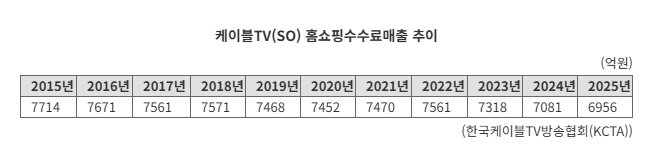
The slump in home shopping is also hitting cable TV hard. According to the Korea Cable TV Association (KCTA), home-shopping carriage-fee revenue for cable TV operators (SOs) fell from 771.4 billion won in 2015 to 695.6 billion won last year. Over the same period, subscribers declined by 1.86 million, from 13.8 million to 11.94 million, while operating profit plunged from 405.6 billion won to 45.1 billion won.
As both sides’ profitability has worsened, the home-shopping and paid-TV industries continue to clash over carriage fees. Home-shopping companies complain about the fee burden as TV sales decline, while paid-TV providers counter that their business conditions could deteriorate faster if carriage-fee revenue also falls after subscriber numbers have declined.
Industry observers say that simply sharing the burden of carriage fees will not be enough to resolve the structural crisis. Since reducing the burden on home-shopping companies would also cut into paid-TV providers’ revenue, the industry itself needs to become more competitive.■ Beyond the carriage-fee battle...reforms to M&A rules neededOne proposed solution is to shift from a TV-centered business structure to one based on mobile, AI and data. The home-shopping industry is also extending its existing strengths in product planning and video production to mobile and short-form content. In the first quarter of this year, GS Home Shopping ran a “pre-planned integrated sales” program linking TV, mobile and social media, increasing transaction volume for about 90 brands by 32% from a year earlier. CJ OnStyle also recorded more than 3 million products ordered on mobile via short-form content in the first half of this year.
Industry observers say that combining outside companies’ technology, customer bases and distribution channels is necessary to accelerate the home-shopping sector’s business transformation. M&A with AI and data companies or online and digital commerce operators, as well as strategic partnerships, are being cited as possible alternatives.
However, as broadcasting business operators, home-shopping companies must go through a change-approval process under the Broadcasting Act if an M&A changes their largest shareholder. Article 15-2 of the Act stipulates that approval for changes to a broadcasting business operator’s largest shareholder or other major investor must take into account factors including broadcasting’s public responsibility and impartiality, the operator’s social credibility and its financial capacity. Given that home shopping is expanding into mobile and content commerce, industry players believe M&A reviews should give significant weight to operators’ distribution and commercial characteristics as well as their public responsibilities. They say the review criteria should be redesigned to reflect changes in the industry, allowing new capital and technology to flow in and drive innovation in business models.
An industry official said, “The crisis in home shopping does not end with the sector itself; it could have a cascading impact on paid-TV platforms and the ecosystems of small and medium-sized businesses and manufacturers.” The official added, “It is important to reduce regulatory uncertainty by clarifying the relevant procedures and applicable standards so that strategic partnerships and business restructuring—including M&A, equity investments and joint ventures with AI and data companies and digital commerce operators—can proceed smoothly.”
[email protected] Choi Hye-rim Reporter