Busan’s Geumjeong-gu, Dongducheon in Gyeonggi and Tongyeong in South Gyeongsang newly designated Depopulation Regions
- Input
- 2026-10-07 13:58:47
- Updated
- 2026-10-07 13:58:47
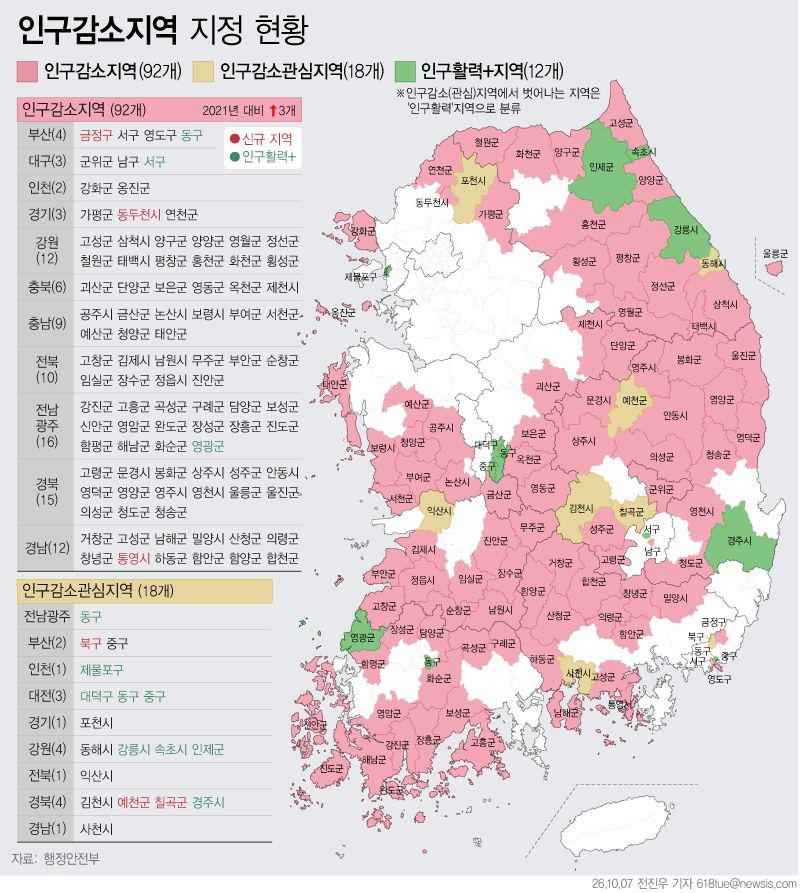
[Financial News] Busan’s Geumjeong-gu, Dongducheon-si in Gyeonggi and Tongyeong-si in South Gyeongsang have been newly designated as Depopulation Regions and will each receive 6 billion won from this year’s Local Extinction Response Fund. Five years after the first designations in 2021, the government revised its assessment criteria and selected Depopulation Regions again, considering not only registered residents but also regional economic vitality, including the number of employed people and the living population. As a result, the number of Depopulation Regions has increased from 89 to 92.
Geumjeong, Dongducheon and Tongyeong to receive 6 billion won each in first year
The Ministry of the Interior and Safety announced the results of the redesignation of Depopulation Regions and its plans for future action on the 7th, following a briefing by Minister Yun Ho-jung at Government Complex Seoul. It also redesignated 18 areas of concern that are at high risk of population decline, in addition to the 92 Depopulation Regions.
The Depopulation Region system designates cities, counties and districts at high risk of local extinction and coordinates support through the Local Extinction Response Fund, administrative and financial special measures, and central government projects. The newly designated Geumjeong-gu, Dongducheon-si and Tongyeong-si will each receive the base amount of 6 billion won this year without undergoing an assessment of their project plans. From next year, the fund will be allocated according to the results of project-plan assessments, as it is for other regions. Funding for Depopulation Regions ranges from 6 billion to 12 billion won.
As three areas previously designated as areas of concern moved into the Depopulation Region category, Busan’s Buk-gu and Yecheon County and Chilgok County in North Gyeongsang were newly added to the areas of concern. Each will receive 1.5 billion won this year. The redesignation introduced “Population Vitality Plus Regions” for the first time. Three existing Depopulation Regions—Yeonggwang County in Jeonnam-Gwangju, Busan’s Dong-gu and Daegu’s Seo-gu—saw their conditions improve in this assessment, but will retain their Depopulation Region status for five years. Nine existing areas of concern, including Dong-gu in Jeonnam-Gwangju, whose conditions have improved, will also continue to receive support in the same way.
The decision reflects concern that abruptly ending support because indicators have improved could reverse the recovery momentum built up so far. These regions will remain eligible for support on the same basis as existing Depopulation Regions or areas of concern, but their allocations from the Local Extinction Response Fund will be determined through project-plan assessments, as for other regions.
At the briefing, Jin Myeong-gi, head of the Ministry of the Interior and Safety’s Local Innovation Office, said that immediately ending support for regions whose conditions have improved enough to leave the Depopulation Region category raised concerns that “it could perhaps have the effect of cutting off those very shoots.”
Assessment looks beyond population to employment and the living population
The criteria for identifying Depopulation Regions have also changed. The government calculated a “population vitality index” using nine indicators, adding the urbanized-area ratio, the number of employed people and the living population to the existing indicators, which included the average annual population change rate, the shares of older people and children, the crude birth rate, the net migration rate of young people and fiscal self-reliance. The urbanized-area ratio is the share of total land used for urban purposes such as housing, commerce and industry.
The Ministry of the Interior and Safety applied weights to each indicator in official national statistics, calculated the population vitality index for cities, counties and districts nationwide, and ranked them. It then used the “inflection point” at which the index deteriorated sharply as the basis for designating Depopulation Regions. It did not use an absolute threshold under which regions scoring below a set level would be designated.
However, the population vitality index and rankings for individual regions will not be made public. The Ministry of the Interior and Safety said that releasing the rankings could lead to stigma, with the regions being seen as “the poorest” or “underdeveloped.” This has also prompted criticism that outsiders will find it difficult to verify in detail why individual regions were designated or reclassified—for example, which indicators led to the new designations of Geumjeong-gu, Dongducheon-si and Tongyeong-si, or which indicators improved and by how much in Population Vitality Plus Regions.
The government plans to focus investment on projects that improve the conditions needed to settle in, such as housing, income and care, rather than simply building facilities.
Minister Yun said, “We will support Population Vitality Plus Regions so that the hard-won recovery momentum is not interrupted, enabling each region to generate its own vitality and continue to grow.”
[email protected] Lee Bo-mi Reporter